Showing posts with label Fruit. Show all posts

Monday, September 10, 2012

Permaculture Plants: Elderberry

Elderberries should be in every Forest Garden
American Elderberry (Sambucus canadensis)
 
Common Name: Elder, Elderberry
Scientific Name: Sambucus species
Family: Adoxaceae (the Elders and Viburnum Family)
Common Species:
  • American Elderberry (Sambucus canadensis, sometimes named Sambucus nigra subspecies canadensis)
  • Common/European Elder (Sambucus nigra)
  • American Red Elder (Sambucus pubens)
  • European Red Elder (Sambucus racemosa)
 
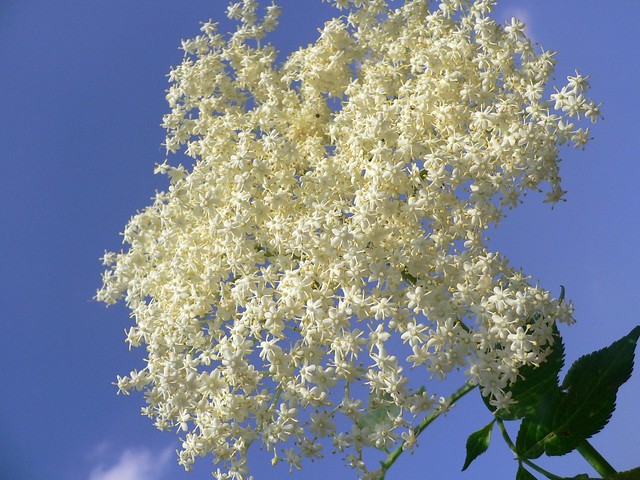
Elderberry flowers are often valued more than the fruit!
American Elderberry (Sambucus canadensis)
 
Description:
The Elderberry is a large shrub that is best known for its showy flowers (often made into fritters) and small but abundant, edible, dark blue-purple berries. However, it is also a fantastic attractor of beneficial insects and hummingbirds, can be used as a windbreak or living fence, provides food and shelter for wildlife (especially birds), and is a great pioneer species.
History:
The American Elderberry is native to eastern North America from Canada south through to Panama in Central America. The European Elder is common in cooler areas of the European continent. It was used by native peoples in all places for food, drink, and medicine. Many cultivars have been developed but mainly for ornamental purposes and not flower or fruit production.

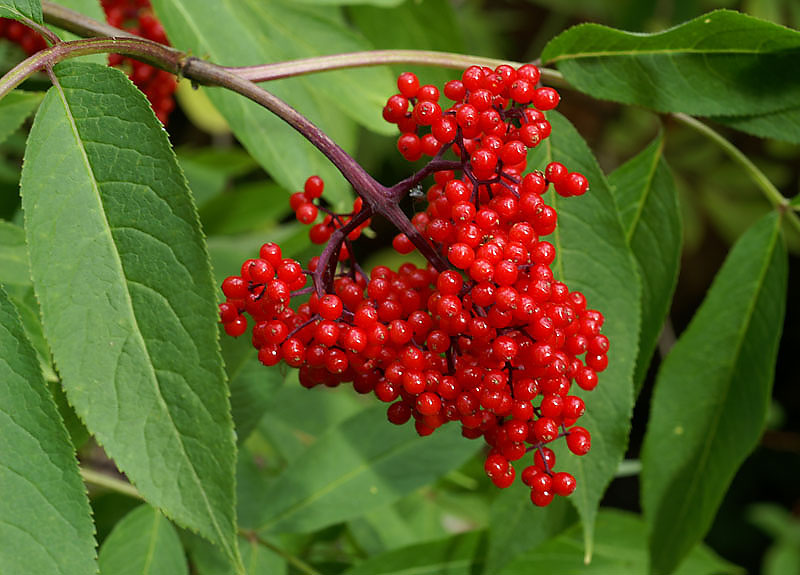
The Red Elder/Elderberry species are named for their berry color
Red Elderberry (Sambucus racemosa)
 
Trivia:
  • There are between 5 and 30 species of Elder depending on how "species" is defined
  • There are "black-berried", "red-berried", "Australian", and "dwarf" groups of Elder species as well as a few others that don't really fall into these groups
  • The Red Elder/Elderberry species, of which there are many, produce red berries
 
USING THIS PLANT
Primary Uses:
  • Edible fruit – cooked (most common), fresh (some don’t like the taste), dried, or used in preserves/jams/jellies, etc.
  • Edible Flowers – fresh or cooked. Popular when covered in batter and fried into fritters. Can be pickled if picked when unopened. Fresh flowers can be soaked in water to make a refreshing drink.
  • Tea Plant (dried flowers are used)

Secondary Uses:
  • General insect (especially bees) nectar plant
  • Wildlife food plant, especially birds
  • Nectar source for hummingbirds
  • Shelter plant for small mammals and birds
  • Windbreak species
  • Living Fence species
  • Larger varieties can be coppiced
  • Pioneer Species
  • Fruit and flowers can be used for wine or flavor adjuncts in beer, liquors, and cordials
  • Medicinal Uses. There are many reported, but its use as an antiviral has a lot of scientific support in the medical literature.

Yield: 12-15 lbs (5.5-7 kg) per plant, but often less
Harvesting: Flowers - pick on sunny days when shedding pollen. Fruit - harvest in Late Summer (August-September) when in full color. Many people will either use a berry picker/comb or snip off whole heads and pick off at home.
Storage: Use or process fresh as flowers and fruit do not last long
 

Larger varieties and species can be used as a Canopy or Sub-Canopy Layer
Common/European Elderberry (Sambucus nigra)


DESIGNING WITH THIS PLANT
USDA Hardiness Zone: 3-10
AHS Heat Zone: 8-1
Chill Requirement: Likely, but no good information is available

Plant Type: Small Tree or Large Shrub
Leaf Type: Deciduous
Forest Garden Use: Canopy Layer for small Forest Garden, Sub-Canopy (Understory) Layer, Shrub Layer
Cultivars/Varieties: Multiple varieties available

Pollination: Requires cross-pollination with at least one other variety/cultivar
Flowering: Late Spring through Summer (May-July)

Life Span:
Years to Begin Bearing: 2-4 years,
Years to Maximum Bearing: 3-6 years
Years of Useful Life: No good information available, but this plant freely suckers. As one plant is starting to decline, a suckering plant can be established to take the original plant’s place in the garden and in production.

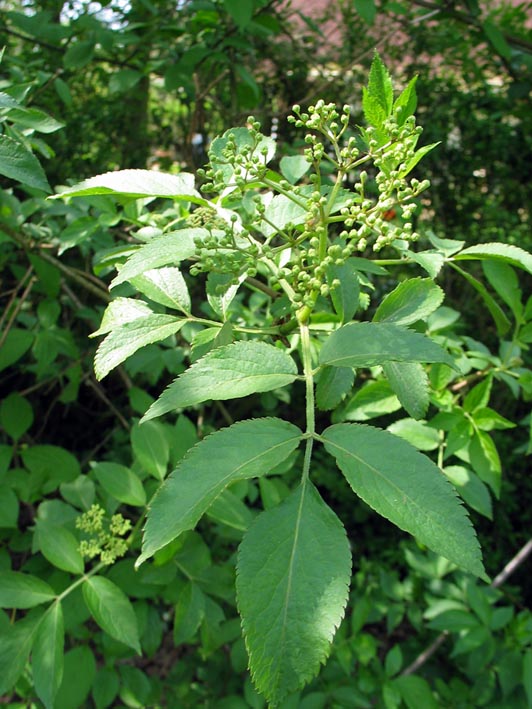
The leaves and flower buds of the Elder.
Common/European Elderberry (Sambucus nigra)
 
PHYSICAL CHARACTERISTICS OF THIS PLANT
Size:
  • American Elderberry (Sambucus canadensis) - 6-13 feet (1.8-3.5 meters) tall and wide
  • Common/European Elder (Sambucus nigra) - 13-20 feet (4-6 meters) tall and wide
  • Red Elder (Sambucus racemosa) - 10 feet (3 meters) tall and wide
Roots: Fibrous with the ability to sucker (send up shoots from underground roots)
Growth Rate: Fast
Elder flowers can be eaten fresh, cooked, or used as flavorings in drinks
Common/European Elderberry (Sambucus nigra)

GROWING CONDITIONS FOR THIS PLANT
Light: Full to partial sun
Shade: Tolerates light shade
Moisture: Can grow in wet to dry soils
pH: prefers fairly neutral soil (6.1 - 7.5), but can tolerate more alkaline soils
 
Propagation: Usually from seed (germination highest with cold stratification, up to 39 weeks). Can be propagated from cuttings of half-ripe wood in Summer or mature wood in Autumn. Can divide suckers in late Autumn and Winter when the plant is dormant, but don't take too late in Winter as Elderberry leafs early.

Maintenance:
Minimal, but will need to cut back suckers if not wanted.

Concerns:
Poisonous – Leaves, stems, roots, and immature fruit contain a precursor to cyanide (large amounts need to be eaten for this to be toxic).

Whole sprays/heads, full of fruit, are often easier to harvest all at once.
American Elderberry (Sambucus canadensis)
 

Monday, July 9, 2012

Permaculture Plants: Sea-Buckthorn

Sea-Buckthorn... this plant can do it all!

Common Name: Sea-Buckthorn
Other Names: Seaberry, Sandthorn, Sallowthorn, Siberian Pineapple
Scientific Name: Hippophae rhamnoides
Other species: Himalayan/Willow-Leaved Sea-Buckthorn (Hippophae salicifolia)
Family: Elaeagnaceae (the Oleaster family)

These small berries are best harvested by hand.

Description:
Best known for their thorns, silvery-green leaves, and their bright orange berries (oval and just under an inch long), Sea-Buckthorns have a lot more to offer... edible berries that are very high in vitamin C and antioxidants, drought-tolerant, nitrogen-fixing, tolerates maritime environments, can form a fruit-bearing windbreak or living fence, has almost no pests or diseases, and requires minimal maintenance. I have not eaten or grown this plant yet, but I plan to if I can while I am living within sight of the ocean.
Originating in Asia and eastern Europe, there are 7-8 Sea-Buckthorn species/sub-species. The Common Sea-Buckthorn (Hippophae rhamnoides) is by far the most widespread and cultivated. The vast majority of these plants are cultivated in China, and they are used due to their soil and water conserving properties. Many of the improved varieties of Sea-Buckthorn were developed in Russia.

Trivia:
  • Sea-Buckthorn has not become more popular on a larger scale due to the difficulty with large-scale harvesting. The fruit does not come off easily with any mechanical means (pickers squash the berries and shakers can harvest less than half the ripe fruit), so the only good way to harvest is slowly with our bare hands... the old-fashioned way. Perfect for the home grower!
  • Sea-Buckthorn berries contain one of the highest levels of vitamin-C (15 times that of oranges!).
  • A beer named Tyrnilambic Baie d'Argousier from Brussels uses Sea-Buckthorn berries.
  • The berries contain up to 9% oil (essential fatty acids... from a fruit!)
  • Sea-Buckthorn is used in a lot of cosmetics
  • Sea-Buckthorn has an extensive, tangled root system, so it has been used for soil restoration projects around the world
  • The berry contains a single seed

These small, tart berries are nutritional powerhouses.

USING THIS PLANT
Primary Uses:
  • Fresh eating – only certain varieties, as the fruit is very tart (very acidic); however, fruit that has undergone a frost is often sweeter, but the fruit is often past its prime
  • Juice - often sweetened (sugar, honey) and even diluted with water (up to 5 parts water to 1 part Sea-Buckthorn Berry Juice)
  • Cooking (i.e. sauces) - try to avoid overcooking as this will destroy the flavor
  • Baking (pies, tarts, etc.)
  • Preserves, Jellies, Jams, etc.
  • Fruit Leather
  • Flavoring component to Beer, Wine, Liquors, Cordials, etc.

Secondary Uses:
  • Nitrogen fixing plant (puts nitrogen back into the soil) - inoculated with actinorhizal bacteria (Frankia).
  • Windbreak (especially in maritime climates)
  • Hedge/living fence
  • Soil conservation
  • Fall and Winter food for wildlife, especially birds
  • General insect nectar plant (Spring)
  • Small craft projects - fine grained wood
  • Charcoal production
  • Soaps, lotions, and other cosmetics
  • Dye from the berries and sap
  • A number of traditional medicinal uses

Yield: 20 pounds (9 kg) per plant 
Harvesting: Late Summer-Early Autumn. Pick when the berries are bright orange and just starting to soften. The fruit does not fall off the plant until it is past its prime. The thorns can make harvesting difficult (i.e.painful!), so go slow. Some people will even clip berry-laden branch, stick it in the freezer for a few hours, and then easily shake the frozen berries off into a bucket.
Storage: Fresh for a few days. Frozen for a few months.

The dense, thorny, fast-growing hedge or windbreak can withstand salty winds.

A single specimen in a garden - very pretty.

DESIGNING WITH THIS PLANT
Chill Requirement: Likely considering is origin, but no reliable information available

Plant Type: Large to Very-Large Shrub
Leaf Type: Deciduous
Forest Garden Use: Canopy Tree for small Forest Garden, Sub-Canopy (Understory), Shrub Layer
Cultivars/Varieties: Many varieties available.

Pollination: Dioecious (male and female plants); Need at least 1 male plant per 8-10 female plants for pollination. Appears to be pollinated primarily by wind.
Flowering: Spring.

Life Span:
Years to Begin Bearing: 2-3 years,
Years to Maximum Bearing: 3-5 years
Years of Useful Life: No reliable information, but as this plant suckers so easily, this should not be an issue... as one plant starts to diminish, we can allow and nuture a new sucker.

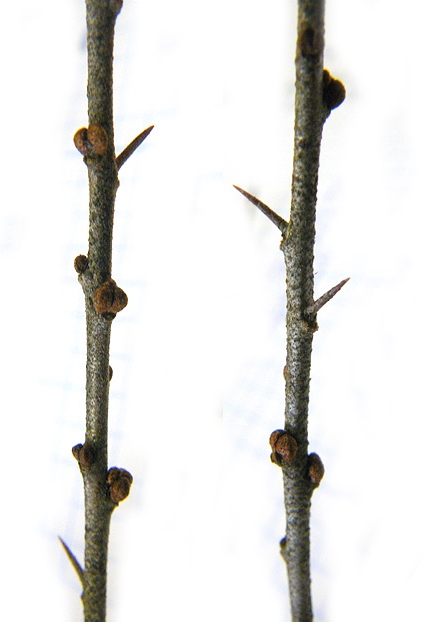
The thorns of Sea-Buckthorn are hard to spot with berries and leaves in place.

PHYSICAL CHARACTERISTICS OF THIS PLANT
Size: 10-20 feet (3-6 meters) tall and wide; Hippophae salicifolia is taller, up to 33 feet (10 meters)
Roots: Suckering - new plants can grow from root shoots some distance from the trunk
Growth Rate: Medium - Fast

The very small flowers are green and resemble leaves.

GROWING CONDITIONS FOR THIS PLANT
Light: Prefers full sun
Shade: Tolerates light shade, produces better in full sun
Moisture: Dry to medium, even wet if well drained
pH: tolerates a wide variety of soil (5.5-8.5)

Special Considerations for Growing:
  • Tolerates a maritime environment well.
  • Tolerates frost (especially the flowers in Spring).

Propagation: Usually from hardwood cuttings for true-to-type plants. Seed (needs 17 weeks of cold stratification).

Maintenance:
Minimal.  However, since plants will fruit best on branches that are 2-years-old, regular pruning will increase yields, but it is not necessary. May need to prune back suckering roots to keep the plant under control... to keep it from forming a thicket.

Concerns:
  • Sea-Buckthorn can spread fairly easily through seed or root suckering.
  • Thorns can make it a hassle to harvest.

Widely known for juice, Sea-Buckthorn has many attributes making it worth growing.

Thursday, November 17, 2011

How to Make Cordial


Black Current Cordial
I had a great black current cordial while visiting Luxembourg.  
It was made to raise funds to support restoration and maintenance on Castle Beaufort.

Here is a photo of me and my boys exploring Castle Beaufort!


Cordial.  What is it and how do you make it?

Cordials are a fun way to use fruits from our land, either cultivated or wild.

A cordial is a drink, usually an alcoholic liqueur, with a strong fruit component.  It is typically sweet and very strongly flavored.  While not always alcoholic, most cordials have either brandy or a grain alcohol as its base.  Brandy (distilled wine) is the most common alcoholic base for making cordial, but Vodka (distilled grain or potatoes) is often used.  Whiskey (distilled barley, rye, wheat, or corn) can also be used as well as about any distilled alcohol.

One of the most common non-alcoholic cordials is elderflower cordial.  Instead of an alcoholic base, this cordial is steeped in a concentrated sugar solution.  A cordial that is non-alcoholic and then concentrated is usually called a squash.  Squashes are often mixed with still or sparkling water and served cold.

Traditionally, some cordials were mixed with herbs and were used more as a medicine.  Due to the high alcohol content, cordials were seen as a stimulant, an invigorating drink, a warming drink, or a tonic... a drink that gave a feeling of vigor or well-being.  Alcohol can obviously reduce anxiety and give a feeling of well-being due to its intoxicating properties.  We also now know that alcohol dilates surface blood vessels which happen to be near our skin's temperature sensors.  So when we drink a strongly alcoholic beverage, we get the sensation of warmth.  In reality, our core temperature doesn't change at all.  In older (and colder) times, when a person was trying to stay warm in frigid weather, a nip of strong alcohol was thought to help keep them warm.  In reality, it made them feel warmer, but the dilation of blood vessels close to the skin actually caused a person to lose body heat.

Cherry Cordial (jar on the left) steeping in the sunlight.

So how are cordials made?

The basic cordial recipe:

  • One large jar of fruit (if fruit is large, cut into small chunks)
  • Enough alcohol to cover
  • About half as much sugar as alcohol
  • Add all ingredients together, cover tightly (airtight is best), and wait anywhere from 2 to 8 weeks, gently shaking the jar about once a week.
  • Strain the liquid and store in a glass jar or bottle.
  • The cordial often improves with age (3-6 months) - unless it contains citrus

This is really about it.  Honest.  There are many, many variations based on ingredient.  We can add spices or herbs, adjust times of steeping, mash the fruit first, freeze the fruit first, use a variety or mix of base alcohols... the possibilities are limited only by our imagination.

Some tips:

  • If the cordial is too sweet, we can add some watered alcohol to balance the sweetness.  This is just a 1:1 ratio of water to whatever alcohol we used to make the original cordial.
  • We are shooting for a 20-30% alcohol content (40-60 proof alcohol by U.S. standards).  If the cordial is too strong, we can add some sugar water (again about a 1:1 ratio) or some fruit juice.
  • Use perfectly ripe fruits - maximum sugar content will give maximum flavor.
  • If our cordial starts to become less sweet over time in storage, don't worry.  This is a natural process of the more complex white table sugar (composed of glucose and fructose) breaking down into its less sweet component parts.  We can fix this if you want by just adding a bit more sugar.
  • Honey can be substituted of the white table sugar.  We may need to use less since honey is sweeter.  However, honey (especially depending on the type) does have a unique flavor profile that we may or may not want in our final cordial.

A beautiful blackberry cordial.


Some one-ingredient cordials that I have seen (some I have tried) include:

  • Cherry
  • Blackberry
  • Raspberry
  • Black Currant
  • Red Currant
  • Rose Hip
  • Prune
  • Plum
  • Blueberry
  • Cranberry


Here are some combination-ingredient cordials:

  • Raspberry and Lemon
  • Gooseberry and Lemon Verbena
  • Rhubarb and Strawberry
  • Apple and Cinnamon with Cloves
  • Orange (fruit and peel), Lemon (fruit and peel), and Vanilla Bean
  • Banana, Pineapple, and Vanilla Bean
  • Coconut, Pineapple, and Vanilla Bean