Showing posts with label Honey. Show all posts

Thursday, September 20, 2012

Video: Killing Bees - Are Government and Industry Responsible?


Today is just a quick link to a video. This is an interesting documentary about honeybees and their decline over the last decade. There is a stong case to be made at placing the blame at the feet of government and agriculture corporations.


From their press release:
Whether you are a beekeeper, a conservationist, an ecologist, a food-producer or a parent - please take half an hour to watch this new American video documentary about the global death of honeybees, bumblebees and other pollinators. 

This is NOT just about the death of entire bee populations around the world, it is about the potential loss of 30% of our food supply and an all-out assault on the ecosystems of the world: insects, birds, amphibians, bats, fish - everything is threatened by the global distribution of hyper-toxic, neuro-toxic pesticides being applied to over 200 million acres of corn and crops in North America alone.


Tuesday, January 3, 2012

Permaculture Plants: Jujube

The Jujube is an uncommon fruit in the West, but very well known in the East.

Common Name: Jujube, Chinese/Korean/Indian Date, Tsao
Scientific Name: Ziziphus zizyphus (a.k.a. Ziziphus jujuba)
Family: Rhamnaceae (Buckthorn family)
Description:
The Jujube is a small, drooping, deciduous tree or large shrub with prominent thorns (in most varieties) and small, dark, shiny leaves.  The Jujube will produce a small fruit (0.5-2 inches / 1.5-5 cm in diameter) with thin, edible skin that can be eaten fresh and is reminiscent of an apple, or it can be left on the tree will it will shrivel, darken, and dry and looks and tastes like a date.  

The Jujube can tolerate a wide variety of soil conditions, but a warm to hot summer and plenty of water will give the highest yields.  It spreads easily by root suckers and seed, so left unchecked, it can produce a thicket.  We can use that to our advantage in using this plant for a hedge or windbreak.

I have yet to try one of these fruits, but considering the long history of cultivation, the large number of varieties (over 400!), and the long list of uses (see below), I think it is safe to say that while rare in the U.S., there is ample reason to include this tree in my future forest garden.  I am hoping to find some fruit to sample this coming summer.

Illustration of Ziziphus zizyphus by Adolphus Ypey, 1813
Tab. 54 from Adolphus Ypey, Vervolg ob de Avbeeldingen der artseny-gewassen met derzelver Nederduitsche en Latynsche beschryvingen, Eersde Deel, 1813

History:
Likely originating in what is southern Asia, some scholars believe as early at 9,000 BC.  Over 400 cultivars have been developed in many parts of Asia.  

Trivia:

  • The leaves, fruit, and bark are used extensively in traditional Chinese and Korean medicine, and in many places in India and Africa.
  • The most expensive honey in the world is made from flowers of a close relative, Ziziphus spina-christi (Christ's Thorn Jujube or Sidr Tree).  The honey sells for about $100 USD per 1 lb (~500 grams).
  • The resin (called Lac) secreted from the scale insect (Kerria lacca) after it feeds on another close tropical relative of the Jujube tree (Ziziphus mauritiana) is refined and used to make a high quality shellac for fine lacquer work.
  • The Jujube was first introduced in Texas in 1875.
USING THIS PLANT
Primary Uses:

  • Fresh eating
  • Dried - eaten as is or mixed in delicacies, often cooked
  • Smoked
  • Cooking and baking - use fresh as you would apples, use dried as you would dates

Secondary Uses:

  • General insect (especially bees) nectar plant
  • Shade tree
  • Windbreak
  • Hedge
  • Erosion control
  • Can be preserved, stored in liquor - known as jiu zao ("spirited jujube")
  • Alcohol from distilled fermented fruit pulp
  • Used as flavoring in teas
  • Dried fruit can be used as a coffee substitute 
  • Juiced
  • Jams, Jellies
  • Vinegared
  • Pickled
  • Fruit Butter - make like apple butter
  • Candied
  • Dried fruit can be ground into a powder and used in a variety of ways
  • Young leaves can be cooked and eaten as a vegetable, but not reported to have a great flavor
  • Can be coppiced
  • Firewood
  • Charcoal
  • Woodworking - wood is hard and strong and close-grained
  • Bark and root used in dyeing (brown, grey, or reddish colors)
  • Bark and root used in tanning


Yield: 20-60 lbs (9-27 kg) per year
Harvesting: Mid summer - autumn.  However, Jujube Trees will flower through the whole growing season with fruit ripening throughout the middle to end of the growing season.  The fruit will not ripen off the tree.
Storage: Fresh fruit does not keep well (about a week), but dried fruits can last for months in a cool, dry environment

Ziziphus zizyphus has small, almost non-descript flowers, but bees like them!

Great image showing the leaves of the Jujube.

DESIGNING WITH THIS PLANT
Chill Requirement: 50-450 hours/units depending on the species and variety

Plant Type: Small Tree to Large Shrub
Leaf Type: Deciduous
Forest Garden Use: Canopy Tree for small Forest Garden, Sub-Canopy (Understory), Shrub
Cultivars/Varieties: Many varieties available (over 400!). 

Pollination: Most require cross-pollination.  While many are Self-Pollinating/Self-Fertile, yields with these cultivars are likely higher with cross-pollination
Flowering: April-May (late spring through summer), but will often flower throughout the growing season

Life Span:
Years to Begin Bearing: 3-4 years from seed
Years to Maximum Bearing: No good data, but likely just a few years after fruit production begins
Years of Useful Life: No good data, but many reports show this to be a long lived tree
PHYSICAL CHARACTERISTICS OF THIS PLANT
Size: 16-32 feet (5-10 meters) tall and 23 feet (7 meters) wide
Roots: Forms a main, deep taproot, but it is also suckering (the tree will send up shoots from the roots many feet from the main tree)
Growth Rate: Fast


GROWING CONDITIONS FOR THIS PLANT
Light: Prefers full sun
Shade: Tolerates very light shade (less than 25%)
Moisture: Tolerates a wide variety of moisture levels
pH: Tolerates a wide pH range

Special Considerations for Growing:
None really.  Bright sun and hot summers will give best fruit yields.  Likely not tolerate of juglones (so don't plant next to walnuts).

Propagation:  Suckering: divide from mother plant during dormant season..  Seed (requires 3 months stratification).  Cuttings: use mature wood of the same season's growth, try to keep at 40-50 F (5-10 C) - a greenhouse in the winter months is ideal.  With all methods, try to place plant in permanent location as soon as possible to prevent damage of the main taproot.

Maintenance:
Minimal.  Some branches will often die back each year.  While there are a few pests in its home range, in North America, there are almost no pest or disease problems.

Concerns:
Can spread easily through seed or root suckering.  

Wednesday, October 26, 2011

Recipe: Whipped Honey


Whipped Honey... You've got to try it!

For anyone who has ever tried Whipped Honey, you understand why this form of honey is so popular.  Of course, regular liquid honey is the most commonly sold and used form of honey, but whipped honey is a fantastic way to enjoy this sweet treat.

Perfect accompaniment for breakfast or light snack.

What is Whipped Honey?
Whipped Honey is also called Creamed Honey, Spun Honey, Churned Honey, Candied Honey, Set Honey, Honey Fondant, and Spreadable Honey.  These names suggest that maybe some ingredient was added to the honey or that the honey was churned or spun.  In reality, Whipped Honey is nothing more than a type of crystallized honey.

Most of us are familiar with how honey crystallizes.  It often occurs around the lid, but honey crystallization can occur throughout the entire jar.  This is not a sign of spoiling or bad honey.  All honey can and will crystallize if old enough or cold enough.  You can reverse this by placing the jar or bottle of honey in some warm water or a sunny window.  The quality will still remain good, because honey truly never spoils unless it is contaminated.

The crystals in our old or cold honey are large crystals.  You can eat this honey.  It is crunchy.  I actually like it on a peanut butter and honey sandwich.  In contrast, the crystals in Whipped Honey are much smaller.  They are so small that they give the honey a smooth and spreadable consistency.  Also, these small crystals prevent the formation of the larger, harder, and crunchier crystals in the honey.

The Dyce Method
The first practical method of making Whipped Honey was developed in 1928 by Elton .J. Dyce, Ph. D., professor of Apiculture at Ontario Agricultural College, while he was working at Cornell University.  After finely grinding large, hard honey crystals, he added between 5-10% of the fine crystals to 90-95% regular, liquid honey.  The crystals are gently stirred into the liquid honey and allowed to rest at a temperature of 57 F (14 C).  In about a week, the "seed" crystals have converted most of the liquid honey to Whipped Honey.  The "seed" crystals don't actually "reproduce" themselves as some have suggested, but it is rather a chemical/physical reaction that spreads through the honey, and the "seed" crystals act as the impetus.

If you have the right spot, making Whipped Honey is very easy!

Making Whipped Honey at Home
We can make Whipped Honey relatively easily at home if we have a place that stays at a steady cool temperature of 55-59 F, ideally at 57 F.

  • Find a location with a steady, cool temperature.
  • Purchase a good quality Whipped Honey - this will be your "seed" or "starter".
  • Take a clean jar and fill it 90-95% with liquid honey.
  • Fill the remainder of the jar with Whipped Honey (less than 5% will produce coarse crystals, and more than 10% is not needed).
  • Stir the Whipped Honey through the liquid honey.
  • Let sit in the cool location for 1-2 weeks.


Previous related articles:


Friday, June 17, 2011

Honey

Yeah... I love Honey!

In a previous post, I discussed an Introduction to Beekeeping.  While there are many other benefits to keeping bees (pollination and wax being the main things), it is the honey that remains the prime motivation for beekeeping.  It just tastes so good!

Honey packed in the honeycomb.

So what exactly is Honey?
Honey is the primary food source for honey bees during the winter when no fresh nectar is available.

In the spring, summer, and part of the fall, a honey bee will travel from flower to flower and collect pollen and nectar from the flowers.  It will eat what it needs, but it will also store as much as it can in its "honey stomach" before flying back to the hive.  A bee actually has two stomachs.  One is called the honey stomach, and it acts like a backpack.  The second stomach is its true stomach used for eating.

Once returning with a full honey stomach, the bee will transfer small drops of the nectar to other bees called "house bees".  These house bees will hold the nectar on their tongues and "chew" the nectar, mixing specific enzymes into the nectar.  The enzymes are converting the nectars from complex sugars to simple sugars (mostly Fructose and Glucose).

The house bees will then put the nectar into the honeycombs where most of the water evaporates.  House bees will fan their wings to speed up the evaporation process.  With less water, the sugars are concentrated.  This concentrated sugar prevents fermentation and bacterial growth.  The bees then cover the honeycomb with wax sealing in the honey, and the bees have stored food for the winter.

So many types of Honey!

What are the different types of Honey?
This really depends on the types of flowers (or insect!) that the honeybees visited.  The source of nectar determines the wide variety of colors, aromas, and flavors of the resulting honey.  There are literally thousands of types of honey.  Basically, honey can be broken down into the following major categories:

True Wildflower Honey.

Wildflower Honey: Also known as Polyfloral Honey.  It is derived from many types of flowers.  Usually, the primary sources are known.  This gives the honey a wide variety of tastes, colors, and aromas.

Commercial Honey is usually Blended Honey

Blended Honey: This is a mixture of multiple types of honey.  Most commercial honey is available as blends to create standard flavor, color, and aroma.  Consistency is the key to repeat customers... well, so they think.  I am not a fan of this practice, but usually the honey still tastes pretty good.

Honey Bee collecting nectar for Orange Blossom Honey

Monofloral Honey: This honey is derived primarily from one type of flower.  Obviously, a beekeeper cannot know that each bee brought back nectar from only one flower type, but they do a pretty good job of only providing one nectar source: orange groves in blossom, fields of clover in blossom, etc.  Here are just a few of the more common types from around the world:

  • Orange blossom
  • Clover
  • Tupelo
  • Buckwheat
  • Sage
  • Fireweed
  • Thyme
  • Heather
  • Acacia
  • Dandelion
  • Honeysuckle
  • Chestnut
  • Basswood
  • Blueberry
  • Pumpkin Blossom
  • Alfalfa
Honey Bee collecting honeydew from the Sooty Beech Scale (a honeydew producing insect).

Honeydew Honey: This honey is derived when honeybees collect the sweet secretions from aphids or other sap-sucking insects.  Yeah, pretty crazy.  The honey is very dark and is not nearly as sweet as floral honey.  Germany, Greece, Bulgaria, New Zealand, and Northern California are all known for producing honeydew honey.

What are the forms of Honey?


Crystallized Honey... it's not ruined!


Crystallized Honey: Also known as granulated honey.  If honey is old enough or cold enough, some of the glucose crystalizes.  You can eat it, and the honey has a bit of a crunch to it.  I like it like this sometimes.  All you need to do is gently heat it, and the crystals convert back to liquid.

Raw Honey... straight from the comb.

Raw Honey: Straight from the hive.  It can be filtered or strained, but not heated.  Raw, unfiltered honey will contain some pollen and small bits of wax.  Local, raw honey is said to be helpful in alleviating seasonal allergies.  While there some mixed results in scientific studies attempting to validate or refute this, I would say that it is unlikely to harm.  And it may do some good.

Creamy, Whipped Honey... it's delicious!

Whipped Honey: Also known as creamed honey, spun honey,  and set honey (among many other names).  Crystallized honey contains large crystals, and these large crystals are ground into really tiny crystals.  These ground crystals are mixed into regular liquid honey, and the small crystals create a domino effect, reproducing really small crystals throughout the honey.  You are left with a honey that feels whipped and creamy, and it is thick and easy to spread.


Fairly typical Honey processing/pasteurization set-up.


Pasteurized Honey: Honey that has been heated to 161F (71.7C)  It kills yeast cells.  Destroys microcrystals so that the honey takes longer to crystallize in storage.  It also destroys enzymes (diatase is the one we know for sure) as well as who knows what else.  I think if you are going to use it yourself and not store it for long, there is not as much need for pasteurization.

Honeycomb Buffet in Turkey.

Comb Honey: Honey that is still in the comb.  Often sold in a container with the caps removed.  I have been to a number of buffets in Turkey that have a whole frame on the table.  You take a knife and cut a piece for your plate.  I love the novelty of it, but there is a lot of wax in the honeycomb.  If you chew too much, you will get all the honey out and be left with a mouthful of wax.  It is tough to discreetly spit out a chewed hunk of wax.  And yes, I have eaten some big chunks of wax to avoid this.

I hope this gives you a better understanding and appreciation of the liquid gold your busy insects are making.

NOTE: DON'T GIVE HONEY TO ANY CHILD UNDER THE AGE OF ONE!
The bacteria Clostridium botulinum can produce a toxin (boulinum toxin) when the spores of this bacteria grow without oxygen.  Children under the age of one do not have a stomach mature enough to kill the spores, and the bacteria reproduce rapidly... and rapidly produce the toxin that can kill.

Sunday, June 5, 2011

Introduction to Beekeeping

Honey Bee on Apple Blossoms


Benefits of Beekeeping. 
It's not all about the honey... well, okay, mostly it is.  But there are some other things that make it a great addition to your Permaculture design.

  • Minimal time investment (short visits about once a week to once every three weeks during the spring and summer, much less during autumn and winter)
  • Small investment of money to get started.
  • Minimal maintenance required.
  • Great rewards in pollination for your gardens
  • About 1-2 gallons (12-24 lbs) of honey in your first year or two.
  • Average is about 2-4 gallons (24-48 lbs) of honey in a summer.
  • A good year can produce 4-5 gallons (48-60 lbs) or even well over 100 lbs in the right locations.
Ukranian Beekeeping History Stamps - I love this!

Brief History of Beekeeping

  • Humans have been gathering honey from the wild since humans first walked the earth.  Why?  'Cause it tastes so darn good!
  • Many ancient cultures raised honey bees and collected honey using hollow logs and pottery that had to be destroyed to obtain the honey.
  • At least three thousand years ago, in ancient Israel, there was a thriving honey and wax industry.
  • Aristotle (Greek) and Virgil (Roman) wrote wrote at length on beekeeping.
  • In the 18th Century, scientists began to study the honey bee in earnest.
  • One of the more amazing stories in science is that of Francois Huber who became blind before he was twenty.  With the aid of his wife and his secretary, he created a glass-walled beehive and studied the honey bee.  His research laid the scientific foundations of the life history of honey bees.  Seriously?  While he was blind?  This blows me away!
  • Using Huber's research, Langstroth developed the first real moveable comb hive in 1853  His basic design is what most beekeepers still use today (with some minor modifications).


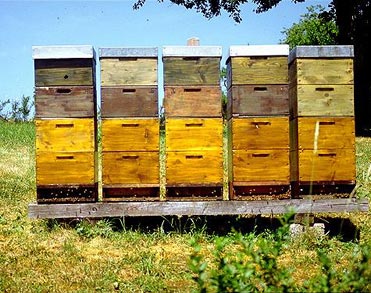
Standard 10-Frame "Langstroth" Hive

Top Bar Hive


Equipment for Beekeeping

  • Standard 10-frame hive (with all components - see diagram above).  Here are PDF instructions for building your own Standard Langstroth Hive.
  • Some people are using the Top Bar Hive (see above and link to Wikipedia article) instead of the Standard Langstroth Hive.  It is much cheaper to build, bees are easier to interact with, and it is much lighter to handle/carry.  It does not save the combs for future use.  Top Bar Hives are being used a lot in developing countries, and it is something I am going to look a lot more into for myself.  Here are instructions for building your own Top Bar Hive.
  • Bee veil - so you don't get stung in the face.
  • Gloves
  • Bee smoker - Slowly burns fuels (hessian, burlap, pine needles, or prepared fuels) and masks the alarm pheromone in bees.  They also think the hive may be on fire, so they start eating honey in case they need to escape.  Yes, you are being mean and tricking a little insect.
  • Hive Tool - used to pry the frames apart to remove and examine them
  • Bee Brush - brush bees off a honey frame
  • Uncapping knife - electric heated knife that makes removing the caps easier to extract the honey
  • Feeder (to provide sugar syrup until the hive is established)
  • Centrifugal Extractor (optional) - spins the frame around to extract the honey without damaging the combs. You can also hang the frame over a heat source (Carla Emery, author of The Encyclopedia of Country Living, suggests a wood stove) and let the honey melt away from the comb into a collecting pan.
  • Beekeeping Clothing (Helmet, Coveralls, etc) - Optional.  Gives you fairly definitive protection, but many beekeepers gradually use less and less protective clothing as they feel more comfortable.
  • Bees - typically people buy a 3 lb package through the mail (9,000-10,000 bees), but you can also purchase from a local beekeeper or collect a swarm (see below).
The Italian Honey Bee
They will make you an offer you can't refuse... okay, sorry.  That was lame.


Types of Honey Bees
There are about 20,000 species of bees.  There are only 7 species of honey bee.
Almost all honey bee keepers use the Western or Common Honey Bee, Apis mellifera.
There are many subspecies of Apis mellifera that have been developed over time and in different locations.  The most common is the Italian Honey Bee, Apis mellifera ligustica.  The other two most common types are the Carnolian and Caucasian.  There are many hybrids of these as well.


Illustration of Honey Bee Caste

Photos of the Honey Bee Caste
Note that the Queen in purchased colonies have a small paint spot for easier identification.
http://www.westmtnapiary.com/media_images/gif/3bees.gif

Honey Bee Castes
Honey bees have a caste system.  There is one queen, 100-1,000 males/"drones" (that leave the hive to mate then die), and 10,000-50,000 female workers who do all the building, cleaning, foraging, honey making, and care for the young.  The queen is the only sexually mature female.  She lives 1-3 years.  All the workers and drones are her offspring.  Yes, you read that right... the women do all the work, and the men have sex with their mother and die.


Beekeeping Basics
Start planning in the winter.

Get your supplies ready and assemble your hive.  Paint it a light color if heat is an issue.  White is traditional.

Site the hive in a location that doesn't have a lot of foot traffic in the "landing zone" at the entrance.  This will reduce stings and will make your hive more relaxed.  Avoid placing it near any electrical or vibratory source (air conditioner, lawn mower route, etc).  Place them where they will get some early morning sun.  This will encourage them to go and forage earlier and will help warm it up in the winter.  Make sure you have a source of water close to the hive.  Ideally, water should be fresh and running.  Bees will bring water back to the hive to cool it using evaporation. If you see a bunch of bees at the entrance, then it may be too hot inside.  If no creek or stream is nearby, then a faucet slowly dripping water onto a flat surface will suffice.

Bees drinking.  Try to avoid still water like this. It may spread disease.

Bees need nectar to produce honey.  Honey is their main food.  They do eat some pollen, but not too much and it is mixed with honey.  How do they get nectar?  From flowers!  So have a lot of them, all over, and as many types as you can.  A wide range of plants with differing flowering times is part of good design in Permaculture.  This is very beneficial for honey bees (as well as all the other beneficial insects that survive on nectar).  Honey bees can travel for miles to find nectar.  If there is nothing local, then your bees will take long trips.  This reduces production.

If you can afford two hives, it is better - you can compare progress, health, have more honey (share with the other if it is too low), and replace a queen if needed (take a brood frame from the hive with a queen, place it in the queen-less hive, and the workers will raise a new queen).

Order your bees.  Arrange to have your bees delivered about when you have the first flush of flowering of your plants in the spring. The earlier you get your bees in the season, the more time they have to build up (increasing their numbers and laying wax combs) and producing honey (first for themselves for food in the winter, and second as surplus... for you!)

Installing bees in a Top Bar Hive

Install your bees in the early evening of a sunny day or on a rainy day.  Pre-feed the bees with sugar syrup sprinkled on their cage.  Open the hive.  Remove 5 of the brood frames.  Place the queen cage (if you ordered your bees) between the top bars of a couple of the frames.  She will be trapped by a layer of candy.  Once the workers know she is there, they will eat away the candy and free her.  After the bees in the cage have eaten all they can, dump your bees in the open area of the hive.  Slowly and carefully replace the 5 brood frames.  The bees will move with smoke if needed.  Replace the lid.  Set up the feeder.  Stuff the entrance with grass to trap the bees in their new hive.  This will keep them inside for a day so they get used to and begin establishing their new home.

Check on them no more than once a week.  Monitor for problems.  Wait for the honey!

Beehives in Winter.

Before winter make sure there is a windbreak to prevent cold winds.  Make sure there is enough food to last them the winter (upper hive body should be full and the lower hive body should be at least half full). If there is not enough honey, provide a feeder with sugar syrup.  Remove the queen excluder (this has kept the queen from laying eggs in the supers from which you want to take honey).  Provide an upper entrance for good air circulation.  Minimize the main opening to block mice and other predators.  Once winter hits, don't bother your bees.

Bee Stings
Yes, bees do sting.  But they only do so when they feel threatened.  Move slowly and gently.  Wear light colored clothing.  Almost all bee keepers get stung on a fairly regular basis regardless of what they tell you.  Most people develop a bit of an immunity to it.  Initially it will hurt!  Over time, the bee sting will still be painful, but it won't be that bad and won't last for too long.  I would recommend talking to your doctor, telling them you are a bee keeper, and requesting an Epi-Pen.  Anybody at any time can develop an allergy to bees... even if you have been stung hundreds of times in your life.

Swarming Honey Bees
A pretty depressing sight if these were your bees... but, finders keepers!

Swarming
Swarming is when the queen and a lot of the workers leave the hive to look for a new home.  The hive is left with workers, eggs, and larvae (one of which will be the new queen).  This can lead to reduced honey produced for you.  The number one reason for swarming is overcrowding, but overheating and consistent hive disturbance can also cause it.  Prevent overcrowding by adding more supers (extra frame boxes above the hive).  It is a good idea to add a super when the bees are working on 8 of the 10 frames.

A Queen Cell - many say it resembles a peanut.

Signs that swarming may happen: A near stopping of flights in and out of the hive.  The workers are filling their stomachs with honey in preparation of leaving.  Also, watch for queen cells (for a replacement queen).  Their presence is usually in anticipation of swarming.

Honey Extraction and Honey Types
I'll reserve that for a later post.

Check out these other pages on beneficial insects in your garden!
Bees
Lacewings
Ladybugs
Praying Mantis
Trichogramma Wasps