Wednesday, October 24, 2012

Permaculture Cities?


I read the following article on the Permaculture Magazine website. To be honest, I am not sure how I feel about it. There is something in me that is so adverse to cities, that I don't know if I am giving this article's concepts a fair shake. I think it brings up some great points and some interesting ideas. I think that the idea of a Permaculture-minded and designed city sounds great, I think it is impractical for decades. I wish that were not the case, but unfortunately, these concepts are too obscure or too intangible to be applied... yet. I do hope and think there will be a time when humans will see that this really is the only way to live in a city, but I do feel that this is quite a long way off in the future. Sooner or later, this is an interesting article nonetheless.

Can We Make Our Cities Sustainable?


Tuesday, October 23, 2012

Permaculture Plants: Horseradish


Horseradish - a root that yields strong opinions... I love it!

Common Name: Horseradish
Scientific Name: Amoracia rusticana
Family: Brassicaceae (the Mustard and Broccoli family)


A well tended Horseradish patch

Description:
Horseradish is a fairly well known condiment with its spicy, sinus-clearing, pungent flavor. This plant, with its famous roots, also has edible leaves, confuses garden pests with its scent, and can be grown in almost any location. A perfect plant for the Edible Food Forest.


"Horseradish, plate 415 from 'A Curious Herbal'" oil on Canvas


History:
Likely originating from southeastern Europe and western Asia, horseradish was popular with the ancient Greeks, Egyptians, and Romans. It was popular during medieval times in Europe and Britain as a food and medicine. European colonists brought horseradish to North America. Today it is used all over the world.


Trivia:

  • Whole Horseradish roots have almost no aroma, but once the root’s cells are ruptured (from cutting or grating), the enzymes released will convert the naturally produced root compound sinigrin into the highly aromatic allyl isothiocyanate (a.k.a. mustard oil).
  • The English name “Horseradish” likely came about through ignorance. The German name for this plant is meerrettich (meer = sea; rettich = radish). At some point this was mistakenly called mahrrettich (mahr = mare (female horse); rettich = radish). It is not a far leap for someone to mistakenly translate the mare radish to horse radish.


Processing Horseradish requires a well-ventilated location!

USING THIS PLANT
Primary Uses:

  • Roots – typically grated raw and mixed with vinegar; may be sliced and cooked like other tubers or carrots/parsnips; can be dried, then ground to a powder, but it is not as strongly flavored as fresh.
  • Leaves – “Horseradish Greens” are edible, and reportedly have a horseradish flavor. I’ve never tried them, but I think they could be used raw in small amounts in a mixed green salad or used cooked as a spinach replacement. Also used in pickling cucumbers to keep the cucumbers crunchy (as are grape leaves).


Secondary Uses:


Yield: Variable, but roots can grow to over 20 inches (50 cm) long and 2 inches (5 cm) thick.

Harvesting:

  • Leaves – smaller, new growth ideal for salads; older growth best cooked.
  • Roots – As desired. The plant grows the most during late Summer and early Autumn, so waiting until just before the ground freezes (depending on your location) will give you the maximum yield. Alternatively, you can harvest in the Spring. Dig a hole or trench 12-24 inches (30-60 cm) deep along the plant, then from the opposite side dig the roots back to the hole. Grab the base of the greens and pull the roots out laterally toward the hole. Use the largest taproots for processing, and use the smaller roots for Spring planting stock if harvested in Autumn or immediately if harvested in Spring. NOTE – Horseradish roots older than 2 years can get stringy and woody. In a Forest Garden, we can harvest in the Spring and replant smaller roots immediately, or we can leave a patch of horseradish growing and harvest from the outer ring or just toss the woody roots in the compost bin or in the forest to compost in place.


Prepared Horseradish, grated with vinegar and salt

Processing:

  • Leaves – use as any other green
  • Roots – peel the brown “skin” off the root; roughly chop; add to a food processor or blender with a little bit of water or you can use a simple vegetable grater or food grinder (whatever way you choose, do so where you have a breeze to blow the fumes away!); add a tablespoon of white vinegar (white wine or distilled vinegar) and a pinch of salt for every 10 inches (25 cm) of root (or 2-3 tablespoons vinegar and ¼ - ½ teaspoon salt per each 1 cup grated horseradish). Vinegar stops the enzymes from converting the sinigrin to the hot mustard oil, so add vinegar immediately after grating for mild and wait for about 3 minutes for hot horseradish.


Storage:

  • Leaves – use immediately
  • Roots – Use immediately for best flavor. Can be stored in dry sand for a few months (a cooler location will keep for longer – ideally under 40 F (4 C) but above freezing); this dry sand storage is a great place to put Spring planting stock. If wrapped in plastic and placed in the coldest part of the refrigerator, it may stay good for a few months. Light will turn the roots green. Processed, refrigerated horseradish will last about a month.


Braised Horseradish Greens with Bacon

DESIGNING WITH THIS PLANT
USDA Hardiness Zone: 2-10 (although some sources are more conservative at 5-8)
AHS Heat Zone: 12-1
Chill Requirement: Not likely, but not good information available


Plant Type: Large Herbaceous Plant
Leaf Type: Deciduous
Forest Garden Use: Underground Layer, Herbaceous Layer
Cultivars/Varieties: There are only a few named cultivars.


Pollination: Self-fertile
Flowering: Late Spring to early Summer (May-June)


Life Span: No good information available as we typically harvest roots of plants less than 2 years old.


When Horseradish blooms, it attracts beneficial insects

PHYSICAL CHARACTERISTICS OF THIS PLANT
Size: 3 feet (0.9 meters) tall and as wide as you allow it to grow
Roots: Large taproots
Growth Rate: Fast


Horseradish can be grown in a wide variety of soils and locations

GROWING CONDITIONS FOR THIS PLANT
Light: Prefers full sun
Shade: Tolerates moderate shade
Moisture: Dry to moist soils, but prefers soil a bit more damp
pH: 5.1-8.5 (tolerates a wide range of soil conditions)


Special Considerations for Growing:
Reported to inhibit brown rot if planted under apple trees.


Propagation:
Typically from root cuttings or divisions in Spring; ideally at least 8 inches (20 cm) in length. Any root will likely grow to a new plant. Seed is not typically produced in plants grown in modern cultivation, but if a patch is allowed to mature, then seed will likely form. Seed is best sown in place.


Maintenance:

  • Minimal.
  • Root Rot can develop – just replant strong roots and compost the rest.
  • Some insects can cause extensive leaf damage in traditional gardens; this doesn’t affect the roots much and should be less of a problem in a Forest Garden.
  • A thorough digging and dividing of the roots every 3-4 years will keep a patch healthy, growing strong, and productive.


Concerns:

  • Poisonous – Reportedly, if one consumes a large amount of fresh roots the strong, volatile oils can be poisonous. This is not well researched, nor do I think people typically consume large amounts at any one time!
  • Spreading Habit – some sources state this plant can become invasive by spreading too fast, and other sources state that this rarely occurs.


Sunday, October 21, 2012

What I am Brewing: Holiday Brew

My cooling wort just waiting for some yeast

Name: Holiday Brew #1


Comments:
 
My goal with this beer was to make a lightly spiced, dark ale for the holidays. As we are in the second half of October already, this beer should be ready just in time for Thanksgiving. I'm hoping there will still be some left by Christmas!

Cinnamon stick, fresh ginger (needs chopping), whole nutmeg (needs grinding), and specialty grains (needs crushing)

Amarillo Hops (left), Vanguard Hops (right), and spices ready to go

Ingredients:
  • 3 lbs - Muntons Dried Plain Dark Malt
  • 3 lbs - Muntons Dried Plain Aber Malt
  • 2 lbs - Muntons Dried Plain Light Malt
  • 1/2 lb - Grains: Crystal 50/60
  • 1/2 lb - Grains: Caramel 120
  • 1 Cinnamon Stick - whole
  • 1 Teaspoon Nutmeg - freshly ground
  • 1 Teaspoon Ginger - freshly chopped
  • 3 Cloves - whole
  • 1.0 oz - Hops: Vanguard (AA 4.8%), boiling hops
  • 1.0 oz - Hops: Amarillo (AA 7.1%), finishing hops
  • Yeast - Safale S-04


Method:
  • Simmer crushed grains in 3 gallons of water at 155 degrees F for 30 minutes.
  • Rinse grains with 1 gallon water - drained right into the brew kettle
  • Add more water to bring total to 5 gallons
  • Bring to boil.
  • Add malt extracts and return to boil
  • Add boiling hops for 60 minutes
  • Add spices at T-10 minutes
  • Add finishing hops at T-2 minutes
  • Cool and transfer to clean 5 gallon carboy
  • Add yeast when completely cool (below 75 degrees F)
  • Ferment, rack, prime with 3/4 cup corn sugar, bottle, age, drink!


Wednesday, October 17, 2012

Permaculture Tip: What to do with Autumn Leaves?


I had a question "from the audience" the other day, and I thought I would share it with my answer.

What would you do with your fall leaves if you were extremely short on time? I just purchased a home and don't have much time to work outdoors before winter sets in. I have a lawn that is covered in both deciduous leaves and conifer needles, but no dedicated garden beds, Permaculture projects, or compost bins going yet. Bottom line: How would you use those leaves to maximize next year's usage?

Short answer:
Save them all!

Long answer:
Loosely pile the leaves and run your lawnmower over them, or put them in a large, plastic garbage can and run your weed eater (a "whipper-snipper" in the UK) like a large kitchen blender. Then pile the leaves in one of two spots. The first location would be an out of the way spot that you may use for future compost bins. The second location would be in the general area where you will want to plant garden beds next year.

A few things to consider...
If your leaves are mostly dried and brown, consider adding some vegetable scraps from your kitchen or fresh lawn trimmings to the leaf pile. Dried leaves are high in carbon, but low in nitrogen. To get them composting well before the cold of winter hits, adding nitrogen-rich material will help. The alternative is also true. If the leaves are all green, then the addition of carbon-rich brown material would speed the composting process. However, there will likely be a mix of both, and these will eventually compost on their own without any help from us. Just like in a forest.

Pine needles take a long time to compost. If you can shred them with the lawnmower, it will help.

Freezing and thawing will help the leaves break up and decompose as well. Make sure there is enough moisture in the pile as you build it (AFTER the leaves are shredded!).

Other Options...
If you have any existing trees or shrubs that you are planning on keeping, you can pile the leaves underneath as natural mulch. Doing this after the leaves are shredded will minimize wind distribution.

If you plan on keeping chickens next spring, consider saving some of the leaves in a dry area. Maybe just piled high and covered with a tarp. These can be used as a deep litter source for a henhouse. A deep litter plan is the only way I would recommend keeping chickens unless they are being pastured. The book that best describes this is The Small-Scale Poultry Flock.

I have also heard of people filling a bunch of garbage bags full of the leaves. The bags were stacked against a poorly insulated wall in a partially-exposed basement wall. This natural insulation dropped the owner’s heating bill. I imagine bags could be placed in attics or crawlspaces as well. They may be viewed as ideal nesting sites for rodents, but they could be removed easily.

A Permaculture Tip is an idea that is derived from observing and interacting with nature.  It is simple.  It is safe.  It is effective.  It helps build a sustainable system of agriculture and life in general.  If you have any Permaculture Tips you would like to share, please let me know.  I will post it here, give you the credit, and post a link to your blog or website if you have one.  Email me here: kitsteiner@hotmail.com


Tuesday, October 16, 2012

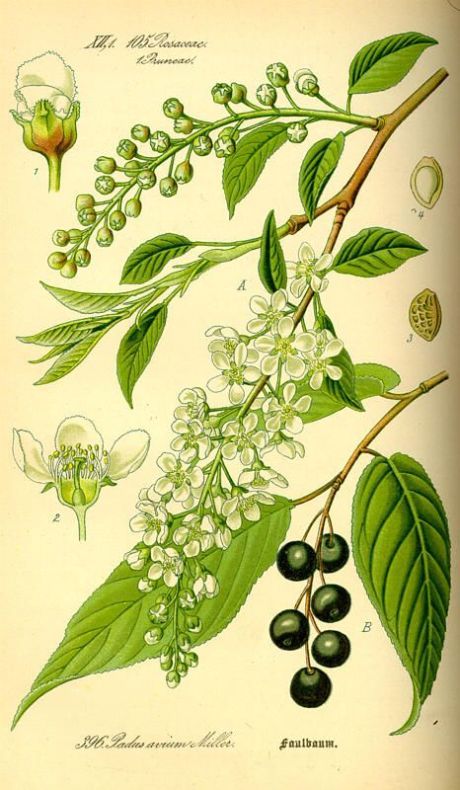
Permaculture Plants: Cherry, Sweet

The Sweet Cherry is a more temperamental tree to grow, but the fruit is probably worth it
 
Common Name: Sweet Cherry, Wild Cherry
Scientific Name: Prunus avium
Family: Rosaceae
Description:
Sweet Cherries (a.k.a. Wild Cherry or Bird Cherry) are the cherries commonly sold in grocery stores. These prized fruits are significantly more picky about their growing enviroment and are more susceptible to pests and disease than their cousins the Sour Cherry. However, if you have the space, and some luck (or a lot of time for babying it), you will have one of the best tasting fruits in the natural world. I plan on growing a few of these trees on my land for all their other attributes like attracting beneficial insects, wildlife food, and wood production. If I get a small to medium harvest, I will be thrilled.
History:
Sweet Cherries have been consumed by humans for thousands of years. Native to the Mediterranean region, likely eastern Europe/western Turkey, it has spread through accidental and intentional plantings. Sweet Cherries were cultivated in Turkey by 800 BC. Since then,they have been grown on all continents but Antartica.
 
Trivia:
  • Sweet Cherries can be dark purple (almost black) to bright red to bright yellow to almost white... and any color along this spectrum (birds prefer red fruits)
  • An older used division of Sweet Cherries split them into the Heart (a.k.a. English Gean - cherries with a softer flesh) and Bigarreau (cherries with a firmer flesh - these are the kind typically in grocery stores)
  • Sweet Cherries were once known as Gean and Mazzard
  • Sweet Cherries are also known as Wild Cherries, because in Europe, these trees do indeed grow wild in many places
  • An Early Bonze Age human settlement in Italy had Sweet Cherry pits dating to 2077 BC
 
USING THIS PLANT
Primary Uses:
  • Fresh Eating!
  • Baking - pies, tarts, turnovers, etc.
  • Cooking - used in savory dishes commonly with meats
  • Preserves, jams, jellies, etc.
  • Juice - often combined with other sweeter fruit juices or sweeteners (sugar, honey, etc.)
  • Dried
  • Fruit Leather
  • Flavoring component to beers, wines, and liquers

Secondary Uses:
  • General insect (especially bees) nectar plant
  • Wildlife food source, especially birds (Summer)
  • Specimen plant (i.e. decorative) - some varieties have been developed for profuse flower production, but these are often sterile and will not produce fruit
  • Living Fence/Hedge plant
  • Larger varieties may be coppiced for wood used in woodworking, fuel, etc. (will delay fruit production for a few years after each coppicing)
  • Wood - high quality lumber
  • Gum - sap that has dried over bark wounds can be chewed as a natural gum

 
Yield: 1-2 bushels/35-70 liters/50-100 lbs (22.5-45 kg) per tree, large standard trees have been known to produce up to 300 lbs of fruit!
Harvesting: Summer (July-September). Pick when the fruit is ripe... when the fruit is in full color and the fruit stalk (stem connecting the fruit to the tree) separates easily from the tree
Storage: Fresh Sweet Cherries should be used within a few days, maybe up to two weeks if kept very cool and moist. Sweet Cherries typically freeze well.

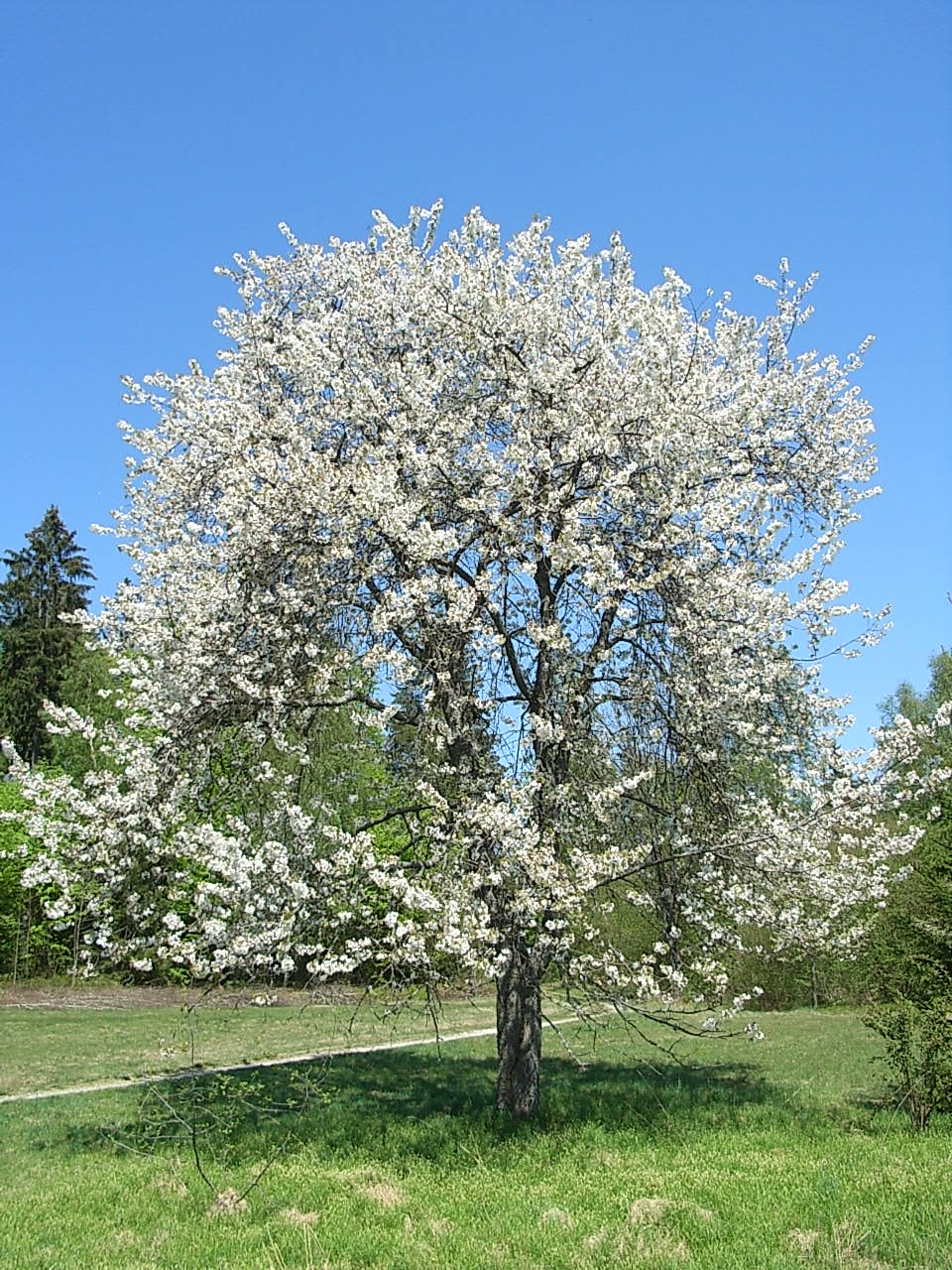
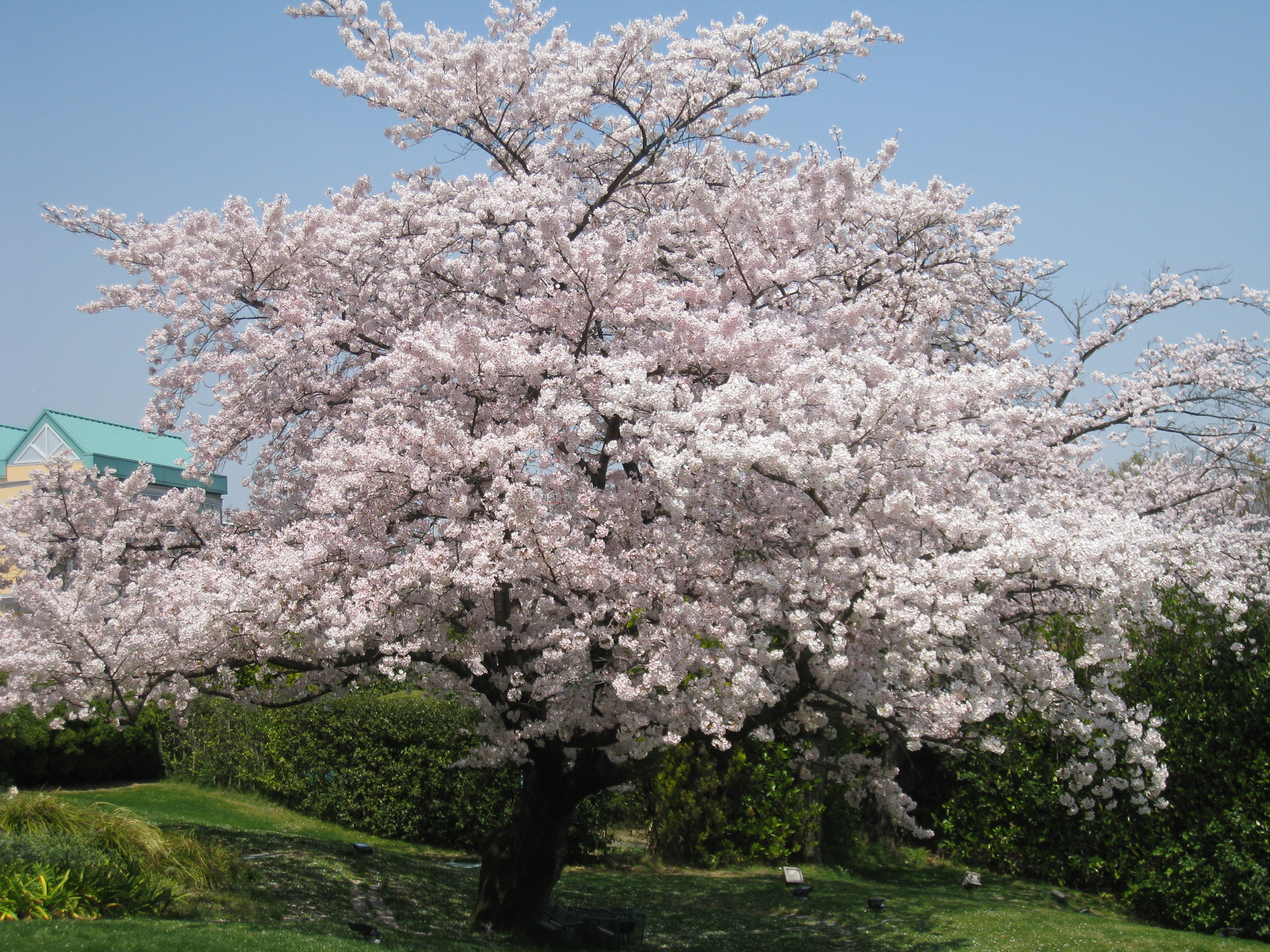
Sweet Cherry in Spring bloom... breathtaking.
 
Sweet Cherry trees can grow to be one of the largest fruit trees.
 
DESIGNING WITH THIS PLANT
Chill Requirement: 500-1,500 hours/units depending on the variety

Plant Type: Very Small to Large Tree
Leaf Type: Deciduous
Forest Garden Use: Canopy Tree Layer, Sub-Canopy (Understory) Layer, Shrub Layer
Cultivars/Varieties: Many varieties available.

Pollination: A few are self-fertile, but most require cross-pollination from another compatible variety/cultivar. See the following links for compatibility charts:
Raintree Nursery Cherry Compatibility Chart
NY State Ag Extension Cherry Compatibility Chart (go to page 3)
 
Flowering: Spring. April-May depending on the variety and USDA Zone where it is planted. May be susceptible to late frosts.

Life Span:
Years to Begin Bearing: 4-5 years, earlier for dwarf varieties, later for non-grafted trees
Years to Maximum Bearing: 10-20 years
Years of Useful Life: 15-25

Typical lateral banding of Sweet Cherry.
Young trees have more. Older trees become more gnarled.
 
PHYSICAL CHARACTERISTICS OF THIS PLANT
Size: Standard (full-sized trees): 25-35 feet (7.5-10.5 meters) tall and 35-40 feet (10.5-12 meters) wide depending on the variety/cultivar, and many do not reach max height.
Wild varieties may grow double the size of Standard fruit varieties.
Semidwarf trees are about half sized and Dwarf trees are about one quarter size of Standard.
Roots: Fibrous, may sucker
Growth Rate: Medium

Cherries should be picked when perfectly ripe but do not store well.
  
GROWING CONDITIONS FOR THIS PLANT
Light: Prefers full sun
Shade: Tolerates a little shade
Moisture: Medium soil moisture
pH: most species prefer fairly neutral soil (6.1 - 7.0)

Special Considerations for Growing:
  • Many edible cherries tolerate juglone (natural growth inhibitor produced by Black Walnut and its relatives). If not sure, then consider using other trees as a buffer between your walnuts and other plantings.
  • Consider netting to protect fruit crop from the birds.
  • Consider choosing varieties with fruits other than red - birds prefer red fruits
  • A site in full sun with well drained soil will help prevent pests and disease

Propagation:
Usually grafted. Seeds need at least 13-16 weeks cold stratification for germination and can take up to 18 months to germinate. Cuttings can be taken from Early Spring through Summer. Suckers can be divided in dormancy, but only consider this if the tree is not grafted.

Maintenance:
Minimal. Prune out live wood for training as desired and dead or diseased wood in late Summer and Autumn - not when dormant.

Concerns:
Poisonous – Leaves and seeds contain a precursor to cyanide (large amounts need to be eaten for this to be toxic).
 

Monday, October 15, 2012

How I Spent My Sunday... Planting my Garden Beds!


I spent a few hours today planting my garden beds. Lots of fun! I did get a little help from Elijah, my 3 year old son.

Here is what I planted today. Almost all were seeds. I'll post some more photos as things start growing.
  • Basil – Genovese
  • Basil – Thai (Siam)
  • Beets – Detroit Dark Red
  • Beets – Burpee’s Golden
  • Beets – Tall Top Early Wonder
  • Broccoli – Romanesco (yeah, some people call it a cauliflower)
  • Brussels Sprout – Long Island Improved
  • Cabbage – Copenhagen Market
  • Cabbage – Red Acre
  • Cauliflower – Purple Cape
  • Cauliflower – Snowball
  • Cauliflower – unknown variety of seed that I saved from my previous garden
  • Dill
  • Garlic – Softneck (grocery store garlic that started to sprout)
  • Garlic – Hardneck (grocery store garlic that started to sprout)
  • Kale – Dwarf Blue Curled
  • Kohlrabi – Early White Vienna
  • Leek – American Flag
  • Leek – Giant Musselburgh
  • Lemongrass
  • Lettuce – Black Seeded Simpson
  • Lettuce – Parris Island Cos (Romaine)
  • Onion – Long Red Florence
  • Onion – Sweet Spanish Yellow Utah Jumbo
  • Onion – Walla Walla
  • Parsley
  • Radish - Watermelon
  • Sage
  • Shallots – Red (grocery store shallots that started to sprout)
  • Spinach - America
  • Swiss Chard – Five Color Silverbeet
  • Turnip – Purple Top White Globe
  • Rosemary

Friday, October 12, 2012

Vote for the Dinner Party - article by Michael Pollan

Michael Pollan

Yet another great article by Michael Pollan.  I highly recommend reading this.


Is this the year that the food movement finally enters politics?
One of the more interesting things we will learn on Nov. 6 is whether or not there is a “food movement” in America worthy of the name — that is, an organized force in our politics capable of demanding change in the food system. People like me throw the term around loosely, partly because we sense the gathering of such a force, and partly (to be honest) to help wish it into being by sheer dint of repetition. Clearly there is growing sentiment in favor of reforming American agriculture and interest in questions about where our food comes from and how it was produced. And certainly we can see an alternative food economy rising around us: local and organic agriculture is growing far faster than the food market as a whole. But a market and a sentiment are not quite the same thing as a political movement — something capable of frightening politicians and propelling its concerns onto the national agenda.
 
California’s Proposition 37, which would require that genetically modified (G.M.) foods carry a label...