Monday, March 18, 2013

Permaculture Plants: Asian Pears

The Asian Pear is quite different than its European relative.

Common Name: Asian Pears
Scientific Name: Pyrus species
Family: Rosaceae (the Rose family)

Asian Pears can be russeted and light brown or clear and yellow.


Common Species:
  • Chinese Pear, Nashi Pear, Sand Pear (Pyrus pyrifolia)
  • Siberian Pear, Harbin Pear (Pyrus ussuriensis)
  • Chinese White Pear, Ya Pear (Pyrus x bretschneideris)

Description:
Asian Pears are not nearly as common in the West as their closely related cousin, the European Pear, but they are quickly gaining in popularity. They ­are typically round (apple-shaped), although the Chinese White Pear is more “pear”-shaped.  Asian Pears are more similar to an apple in texture and a cross between an apple and European Pear in flavor. They are at their best when picked ripe. All you need is to taste a perfectly ripe Asian Pear, and you will make room for it in your Forest Garden.

There are three types of Asian pears.

  • Round or roundish-flat fruit with green to yellow skin
  • Round or roundish-flat fruit with yellow to brown skin and bronze to gold russet (little dots)
  • Pear-shaped with green skin or brown skin and bronze russet 


History:
Native to the eastern Asia, specifically China, Korea, and Japan, Asian Pears are now grown throughout their native land as well as in Australia, New Zealand, and the United States.

Trivia:
  • Asian Pears are the oldest known cultivated pear.
  • Asian Pears contain enzymes that tenderize meat, which is why they are used in marinades.

Fall Fruit Salad with Asian Pears

Asian Pear and Tangerine Salad

Asian Pear Wine and Liquors by Subarashi Kudamono (means "wonderful fruit" in Japanese)

USING THIS PLANT
Primary Uses:
  • Fresh eating – Asian Pears are more similar to an Apple in texture and a cross between an Apple and European Pear in flavor. Eat when fully ripe or it will be dry and hard. Great in salads.
  • Cooking – Asian Pears have a high water content, so they are not used identical to European Pears. They are great when used for marinating (see trivia below). Drier varieties may be used for cooking, baking, pies, tarts, etc., but they really are best cooked after they have been pureed. The crisp texture is not softened with cooking as with European Pears.
  • Sauces – In Asia, the pears are often ground and mixed into sauces instead of other sweeteners
  • Preserved – Preserves, Jams, Jellies, etc – will often need longer cooking times to reduce the high water content. Asian Pears dehydrate very well, and the dehydrated fruit can be used in many recipes for desserts or just eaten as is.

Secondary Uses:
  • General insect (especially bees) nectar and pollen plant
  • Wildlife food
  • Wildlife shelter
  • Primary or adjunt flavor component in beer, wine, cider, perry, mead, liquor, etc.
  • Can likely be Coppiced, although I can find no good reference for this.
  • Wood – Poles, posts, stakes, tools, crafts
  • Wood – Firewood, charcoal
  • Wood – Smoking/Barbeque: pear wood gives a soft “fruity” smoke to meats, similar to apple wood

Yield: Standard root stock – 3-8 bushels (105-280 liters) or 170-450 lbs (80-200 kg); semi-dwarf root stock – 1-2 bushels (35-70 liters); dwarf root stock – 1 bushel (35 liters) or 56 lbs (25 kg)

Harvesting: Late Summer to Autumn (August-October), but can vary based on variety and location. Pick when still crunchy (like an apple) and giving off a strong aroma – the strong and sweet fragrance of a ripe Asian Pear is the key to knowing when it is ripe. Softness is used to help determine ripeness in European Pears, but not Asian Pears.

Storage: Best when used right away, but can be stored for up to a month or more if kept in a cool, dry place and handled carefully to prevent bruising

Asian Pears will be covered in the beautiful flowers every Spring.
'Large Korean' variety of Chinese Pear (Pyrus pyrifoliaI)

Siberian Pear (Pyrus ussuriensis)

Siberian Pear (Pyrus ussuriensis)

DESIGNING WITH THIS PLANT
USDA Hardiness Zone: Zone 4-9, but really depends on the species and variety
AHS Heat Zone: Zone 9-3, but really depends on the species and variety
Chill Requirement: 300-750 chilling hours/units depening on the variety

Plant Type: Small to Medium-sized Tree depending on the root stock
Leaf Type: Deciduous
Forest Garden Use: Canopy Layer, Sub-Canopy (Understory) Layer
Cultivars/Varieties: Many varieties available. (see my article about Asian Pear varieties)

Pollination: Asian Pears traditionally require cross-pollination, although a few varieties are self-fruitful. This requires two different varieties of Asian Pear. Some European Pears (Pyrus communis) will cross-pollinate Asian Pears. Because there is such a wide variety of pears and cross-pollination variations, it is best to get cross-pollination information from the nursery or catalog company you are purchasing your pears. Pollinated by insects.
Flowering: Spring (May)

Life Span:
Years to Begin Bearing: 3-7 years depending on the variety and rootstock
Years of Useful Life: up to 300 years. Dwarfing rootstocks live shorter lives

Siberian Pear (Pyrus ussuriensis) in Autumn
Chinese Pear (Pyrus pyrifolia) in Autumn waiting for harvest

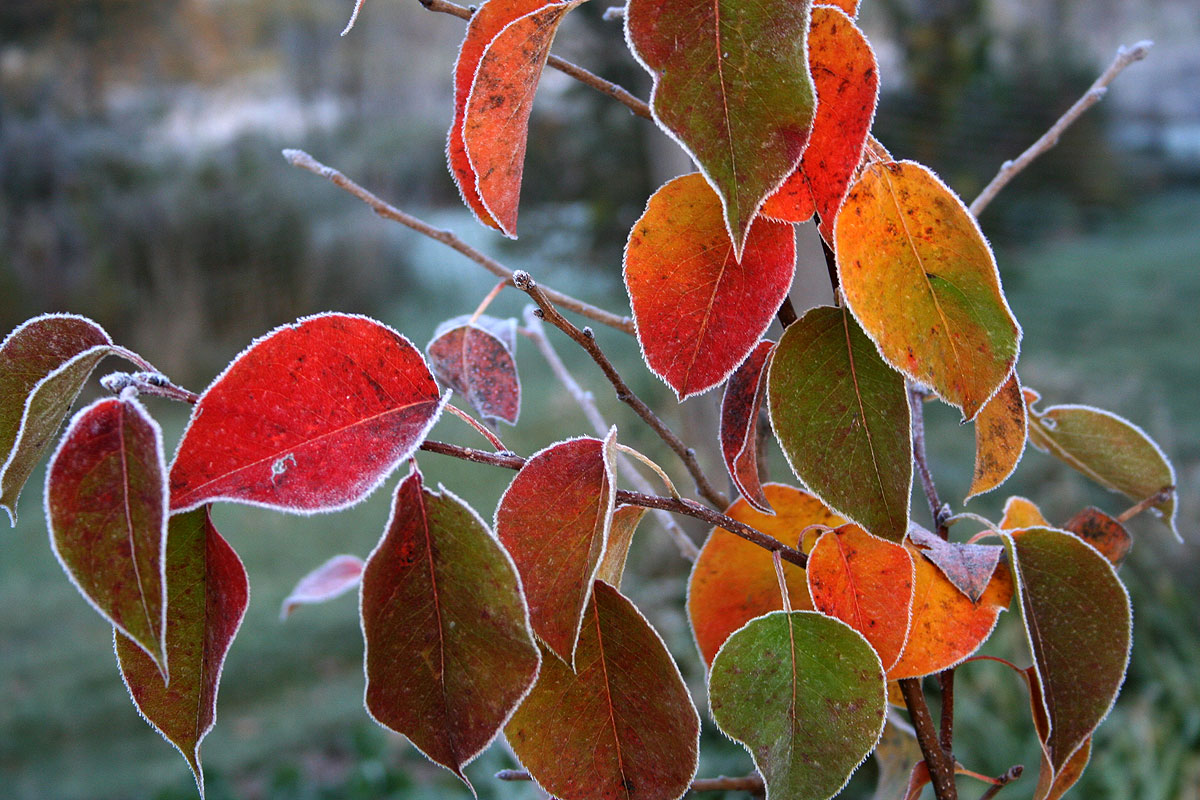
Asian Pear in Autumn after a frost

PHYSICAL CHARACTERISTICS OF THIS PLANT
Size:
  • Chinese Pear (Pyrus pyrifolia): 25-30 feet (7.5-9 meters) tall and 20-25 feet (6-7.5 meters) wide
  • Siberian Pear (Pyrus ussuriensis): 30-50 feet (9-15 meters) tall and 25-30 feet (7.5-9 meters) wide
  • Chinese White Pear (Pyrus x bretschneideris): 20-25 feet (6-7.5 meters) tall and 10-20 feet (3-6 meters) wide

Roots: Fibrous
Growth Rate: Medium
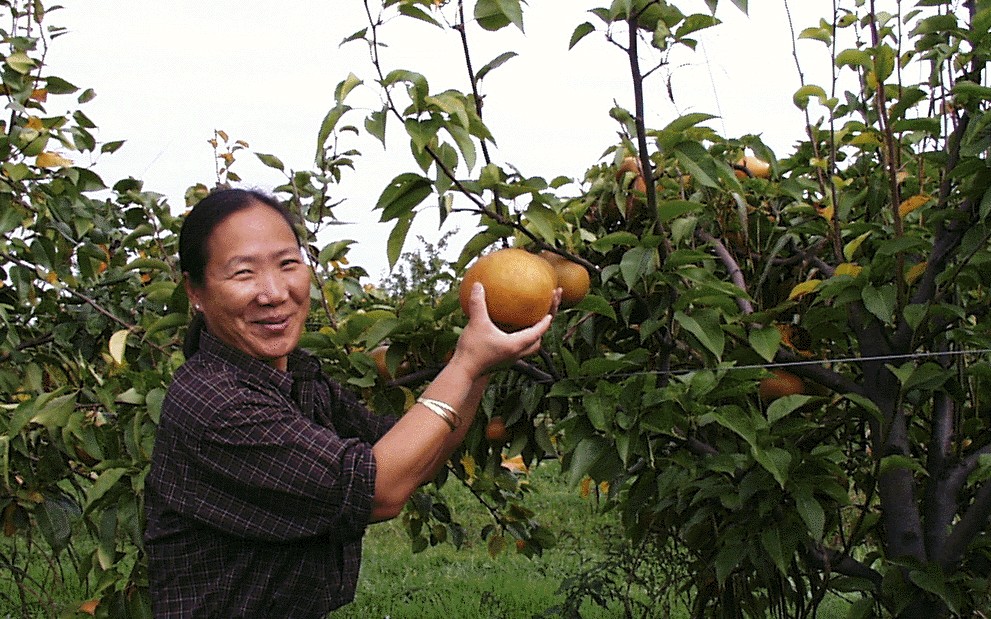

Harvesting a large Asian Pear at Virginia Gold Orchards


GROWING CONDITIONS FOR THIS PLANT
Light: Prefers full sun
Shade: Tolerates very little shade… shade is best avoided with pears
Moisture: Medium soil moisture preferred
pH: most species prefer fairly neutral soil (6.0-7.5), but many can tolerate a bit wider pH ranges

Special Considerations for Growing:
  • Pears to not tolerate juglone (natural growth inhibitor produced by Black Walnut and its relatives). Make sure you have other varieties of  trees and shrubs as a buffer between your walnuts and pears.
  • Pears are susceptible to Fire Blight, Pear Scab, and Canker, so try to choose varieties that are resistant to these diseases.
  • Make sure to consider flowering times when planning which varieties you choose. You need to make sure that you have compatible varieties (i.e. ones that will pollinate each other) flowering at the same time.

Propagation:
Named varieties are usually grafted because pear cultivars do not grow “true to type”, meaning that seeds will grow into trees that produce fruit that is likely to be nothing like the parent stock. If growing from seed, they will need 8-16 weeks cold stratification for germination. Less improved species and non-cultivars are often grown from seed.

Maintenance:
Typically, Asian Pears are pruned once a year to once every 2-3 years.

Concerns:
None

Friday, March 15, 2013

From Floods to Slugs... Garden challenges on a North Atlantic island


Bill Mollison, the founder of Permaculture, has said to wait a year getting to know your land before you do anything on it. There is a lot of wisdom in this idea. However, I have yet to follow it. It is not that I disagree, but with my current life, I have moved every 2-4 years for the past 17 years! Oh, I am ready to settle down in one place in put down some roots!

So, while I agree with this idea, I have chosen to ignore it for now. I want to get a garden in as soon as possible in each new place I live. Especially when I am only there for two years. There are challenges in doing this though. The biggest challenge is not knowing the weather cycles. In many places, I could look up very accurate weather histories, so I could plan my gardening year. Here in the Azores, and at my previous home in Turkey, well... not so much.

 
My current case in point is the non-stop rain and wind over the last week and a half. We had a beautiful day here last Saturday. I spent a large chunk of the day in the garden getting some of my seedlings in the ground. The following day, the wind and rain started. It hasn't really stopped since. We have been extremely fortunate not to be effected by the flooding, but just two villages away, only a few minutes drive, they were not so lucky. You can see in these photos the destruction that took place.

For me to complain about my garden when this is going on so close would be insensitive and frankly ridiculous. It doesn't mean I am not frustrated about the wind that has decimated about half the seedlings I planted. It doesn't mean I am not frustrated about the slugs that are active twenty-four hours a day for the last seven days because the sun has not come out and the ground stays perfectly wet for them and has given them the opportunity to eat holes in many of the remaining seedlings that were planted. I am not exagerating when I say I pulled off over fifty slugs from my two small garden beds in ten minutes after I got home from work. I can be frustrated about these things and still not complain... not to be some pious martyr, but because it is possible to be frustrated yet keep things in perspective.

But the entire time I was doing this, I kept thinking to myself two things. First, "this is the reason Bill Mollison says to wait for a year to do anything." I have spoken with the locals about when Spring really arrives, and I get a different answer from each person with whom I speak. Nothing beats firsthand experience. This is the joy of learning while gardening. Yes it can be frustrating and downright disheartening at times. However, my gardening is an adjuct to my daily meals. My life, and my family's life doesn't depend on it now. Let me practice and make as many mistakes as I can right now, so that I can learn. So that if I ever do need to depend on my garden for food, I will have that much more experience.

 
The second thing I kept thinking was, "why am I the fortunate one who gets to pick slugs off his seedlings, when just one town away, people are picking through the mud to find any of their belongings?" Fortunately, there has been a well-organized relief effort which we have been able to contribute to in a small way. Natural disasters are awful, but when we are not directly effected, they should serve as great tools to remind us of our own blessings.

It is always good to get some perspective.

Thursday, March 14, 2013

Questions from Readers: Help with my Forest Garden plan

Pawpaw (Asimina triloba) is a native to southeastern North America.

We have an existing "forest" area on our property that I was planning on turning into an Edible Forest Garden centered around guilds of Paw Paw trees. I am located in northern Alabama, in zone 7, and the area is full of pine, oak, privet, and honeysuckle. The soil is a rich clay full of organic matter (earthworms abound). But I just got the soil results back and the ph is a strongly acidic 5.3.

I am planning on doing most of my planting in the flat valley area, but I'm thinking that the rain water that runs off of the slopes on both sides of the valley will be acidic due to the pine needles, which has probably been the chief contributing factor to making the soil as acidic as it is now. So, while I could apply lime to the valley area to try to raise the pH there (making it more suitable for the Paw Paw trees), it sounds like keeping it more alkaline will be an "uphill battle." I'm also concerned of what it could do to the existing plant life (would I start killing my pine & oak trees, for instance?).

I pulled out my Edible Forest Gardens book by Jacke & Toensmeier, and it does look like I have a lot of acid-loving fruit-bearing alternatives I could plant. Prunus cerasifera (Myrobalan Plum), Prunus pumila (Eastern Dwarf Cherry), several species from the Ribes genus (currants, gooseberries, and jostaberries), several species from the Rubus genus (blackberries, cloudberries, black raspberries, etc.) and a wide variety of blueberries could be alternative fruit-bearing plants to the Paw Paws. There also does not seem to be a shortage of acid-loving greens (although I really want to plant Stinging Nettle and Good King Henry and they both like the pH to be at least 5.5. I guess I could apply lime to just a small area...

I guess my basic question is, would you work around the current pH of 5.3 and plant things that would work in the existing forest, or would you try to stick with the original plan of planting Paw Paw trees and amend the soil accordingly?

Your feedback would be greatly appreciated. Thank you.

Jennifer


Great question! There is a lot to this, so I am going to break it down a bit.

We have an existing "forest" area on our property that I was planning on turning into an Edible Forest Garden centered around guilds of Paw Paw trees. I am located in northern Alabama, in zone 7, and the area is full of pine, oak, privet, and honeysuckle. The soil is a rich clay full of organic matter (earthworms abound).
Fantastic! The more Forest Gardens we have, the better! I love the idea of Pawpaw (or Paw Paw or Paw-Paw) guilds, but don't limit yourself. There are so many great fruit and nut trees that will grow in your area. Just something to keep in mind. It sounds like you have a variety of trees and shrubs in the area that are tolerant of a wide range of soil pH. It also sounds like you have a very good soil with which to work. This is also very good news for you.


But I just got the soil results back and the ph is a strongly acidic 5.3.
I am very curious how this was tested. You didn't explain how many tests were done or how they were done, and this really matters. We often only test one spot, because this is cheaper. However, what if that one spot was a highly acidic location and the rest was not? What if a dog just urinated there? It is very tough to make a pH determination for a whole area with just a single test. Ideally, we would test multiple spots throughout our planned Forest Garden.  It also matters how we do the testing. We are often told to get a small soil sample from the top few inches of soil or dig a shallow hole, fill it with water, and test the mud. Well, all we are doing is testing that one layer of soil.

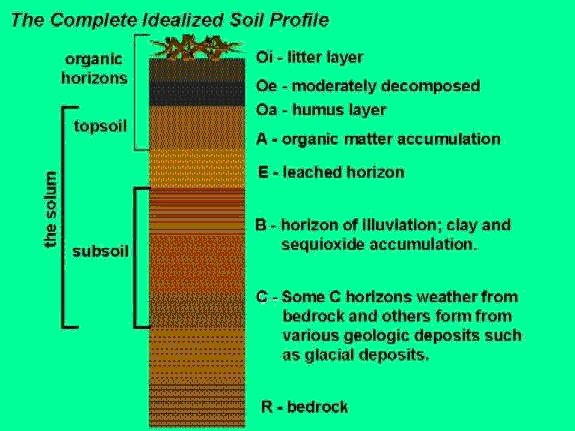
Basic Soil Horizon Layers

There are multiple soil layers in every area. Most locations have standard layers of soil abbreviated as O-A-B-C-R (O=organic layer, A=surface soil, B=subsoil, C=parent rock, R=bedrock). These layers are also called Soil Horizons. Some locations have fewer layers, but most locations have more. These Soil Horizon layers can divided even further:


So, when we are testing soil pH, we need to consider which layer are we testing. Also, very few plants will grow in just the O-layer (which we usually test). Trees and shrubs will put down roots through many of the layers, and some trees will even burrow into the bedrock.

Finally, the pH of each layer is different. Sometimes, they are not drastically different, but oftentimes they are. I tried really hard to find some good references for this, but I was unable to do so quickly as I was writing this response. However, there has been some good research that shows that creating the "ideal soil pH" may not be all that important for perennial plants... IF the soil is a healthy, undisturbed soil. From the description given in this question, it sounds as if the soil is very healthy, and not hard-packed, recently tilled farm fields. Plants that desire specific soil pH, if planted in healthy soil, will seek the layer that meets its demands. So, for instance, if a plant prefers an acidic soil, then it will put out more roots in an acidic Soil Horizon layer.


I am planning on doing most of my planting in the flat valley area, but I'm thinking that the rain water that runs off of the slopes on both sides of the valley will be acidic due to the pine needles, which has probably been the chief contributing factor to making the soil as acidic as it is now. So, while I could apply lime to the valley area to try to raise the pH there (making it more suitable for the Paw Paw trees), it sounds like keeping it more alkaline will be an "uphill battle." I'm also concerned of what it could do to the existing plant life (would I start killing my pine & oak trees, for instance?).
I think you are looking at this with two sets of glasses on, and you are trying to decide which one gives you a clearer picture. The modern agriculture way of handling this issue is to decide what you want to do before you know your land. Then you evaluate the land and make it do what you desire. This requires a lot of initial work and a perpetual fight to prevent the land going back to what it wants to be. The fact you are asking these questions, means you are trying to avoid this path. Good for you!

The Permaculture way is to get to know your land and determine what would be best suited to it while still providing for your needs. This requires significantly less work initially, less money and investment, and significantly less maintenance. But it does require a lot more planning. This is working with nature! Don't get me wrong, there is a place for "working" the land a bit. But you have to balance this with how much work and environmental change (locally, I mean) you are willing to push.

In a sense, it may seem I am talking out of both sides of my mouth: pH doesn't matter... evaluate your land and pick species that suit it. Well, with pH specifically, unless we are dealing with a very sick piece of land that requires regeneration and rehabilitation, then I am really not too worried about pH.

When it comes to temperatures, sun exposure, wind exposure, etc., these factors are a bit more inflexible. But as I explained above, pH is a bit more complex, less predictable, and therefore less worrisome for me. I know I will plant some shrubs or trees that will not find a good niche on my land. I will try to help it get established, but after that, it is mostly on its own. I will help maintain it, but I do not want to spend a lot of time on it. If I did, I would spend more and more time on things that give less and less, or I will spend more money and time to "fix" a problem that would not be an issue for another plant.

So, here is what expect to happen. When setting up a Forest Garden, do your best to select species and varieties as ideally suited to your land as possible. Pick a few plants that fall outside of that range... within reason. Don't grow banana trees from the tropics in a windy tundra field. But we can  try to grow a plant that is best suited one or two USDA Heat Zones north or south in our forest. We can try to grow a few plants that have more or less moisture requirements that we currently have, because this can change and because plants can adapt. We can certainly plant a tree that prefers a more neutral pH in a soil that appears to be a little more acidic.

Expect to lose some of your plants. Some plants will not survive. This is part of gardening and part of forest life in general. I would prefer that this did not happen, but not every plant is going to be ideally suited to your land. You will get some surprises though. That tree that really prefers a bit more heat, may do very well, and that tree species that is growing great on your neighbor's land gets sick and dies within the first year. This is okay. This is part of Forest Gardening. When a plant dies or does not thrive, then remove it and try another variety or another species. This is also mimicking the natural succession in a forest.


I pulled out my Edible Forest Gardens book by Jacke & Toensmeier, and it does look like I have a lot of acid-loving fruit-bearing alternatives I could plant. Prunus cerasifera (Myrobalan Plum), Prunus pumila (Eastern Dwarf Cherry), several species from the Ribes genus (currants, gooseberries, and jostaberries), several species from the Rubus genus (blackberries, cloudberries, black raspberries, etc.) and a wide variety of blueberries could be alternative fruit-bearing plants to the Paw Paws. There also does not seem to be a shortage of acid-loving greens (although I really want to plant Stinging Nettle and Good King Henry and they both like the pH to be at least 5.5. I guess I could apply lime to just a small area...
These are all great species! I would say to try them all! I would avoid liming or adding specific soil amendments if you can, especially when you are talking less than 1 pH point. However, sometimes when you are dealing with very unhealthy soil, amendments will speed the healing process. As I wrote above, plant a variety of plants from a variety of sorces, and they will self-select. The ones that can tolerate a little variation in their requirements will thrive, and the ones that cannot probably do not belong in your forest.


I guess my basic question is, would you work around the current pH of 5.3 and plant things that would work in the existing forest, or would you try to stick with the original plan of planting Paw Paw trees and amend the soil accordingly?
One of the reasons I loved this question was that it showed me I was wrong! I really mean that. I love to learn new things, and new things really stick when I am corrected. I absolutely love the book(s) Edible Forest Gardens. I use it as a reference frequently. I realized I used it as a reference when I put together my article on Pawpaws. This was my mistake. I typically try to verify specific facts like pH requirement with at least three sources. I think since this was one of my early articles, and I was not yet in the habit of doing this. So I passed on this reference's mistake. (You are going to love this!)

Pawpaws prefer acidic soil! Today, I found just over a dozen references, and the most liberal state that Pawpaws prefer soil with a pH in the 4.7-7.2 range. I think conservatively we can say that most Pawpaws will do very well in soil with a pH of 5.1-7.0. I actually just updated my original article because of this.

After thinking about this, it only makes sense. Pawpaws are native to your area in the first place. They originate in the southeastern United States. Most of this area has native soils in the acidic to neutral pH range, so it would seem odd that this native tree would fall so outside that range.

Pawpaws will likely do very well for you in your Forest Garden.

So, the bottom line...
  • Try to work with nature instead of fight against it.
  • Don't worry too much about pH when you have healthy, undisturbed soil, and you are planting perennial shrubs and trees.
  • Expect to lose plants as your forest matures and see this as nature taking some extra work away from you.
  • Variety will give you the best chance for success. Nature doesn't create monoculture.
  • Question all things. Verify with multiple sources. Don't be afraid to be wrong... you just might learn something new!

All the best!
John


Wednesday, March 13, 2013

Video: Sorrel featured on Eat The Weeds

Common Sorrel (Rumex acetosa)


I recently wrote an article on Sorrel. For a follow-up, I am sharing this video by Green Dean from Eat The Weeds. It is great for helping you identify these plants in the wild, and it give a bit more information on the Rumex species.


Monday, March 11, 2013

Permaculture Plants: Sorrel


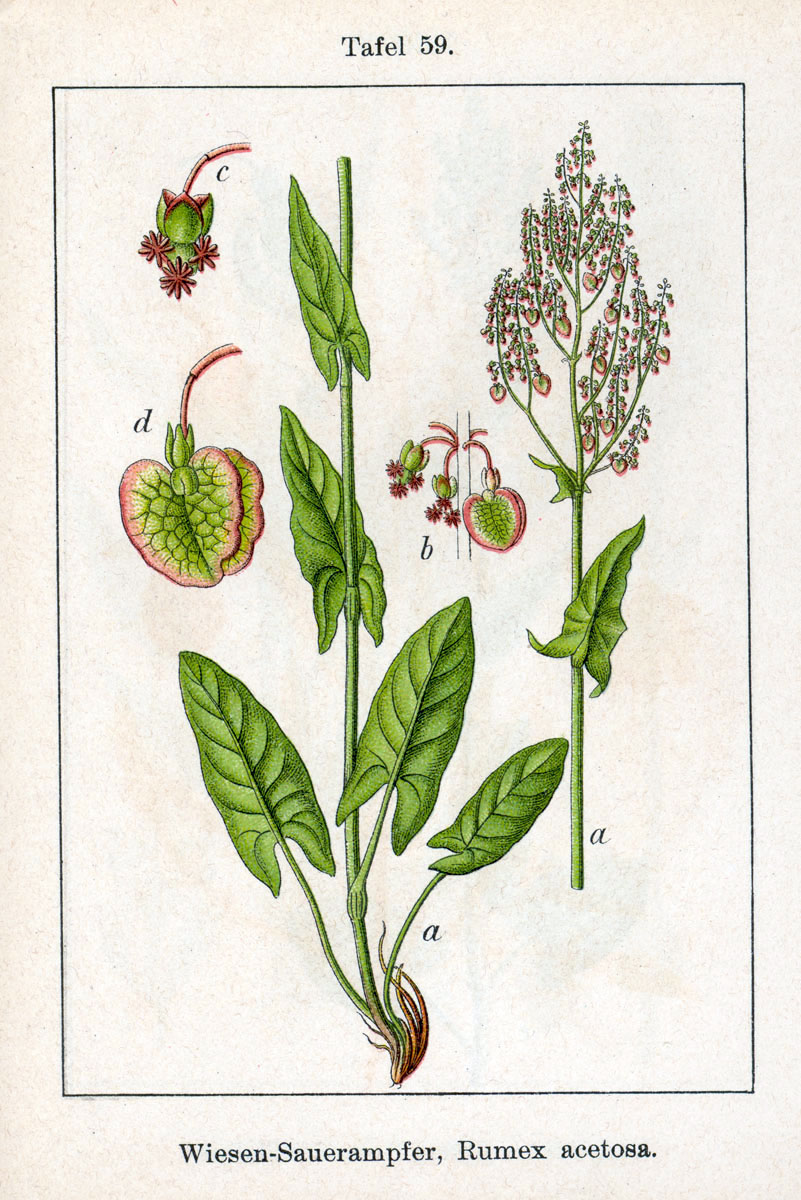
A patch of wild Common Sorrel (Rumex acetosa

Common Name: Sorrel
Scientific Name: Rumex species
Family: Polygonaceae (the Buckwheat or Smartweed family)

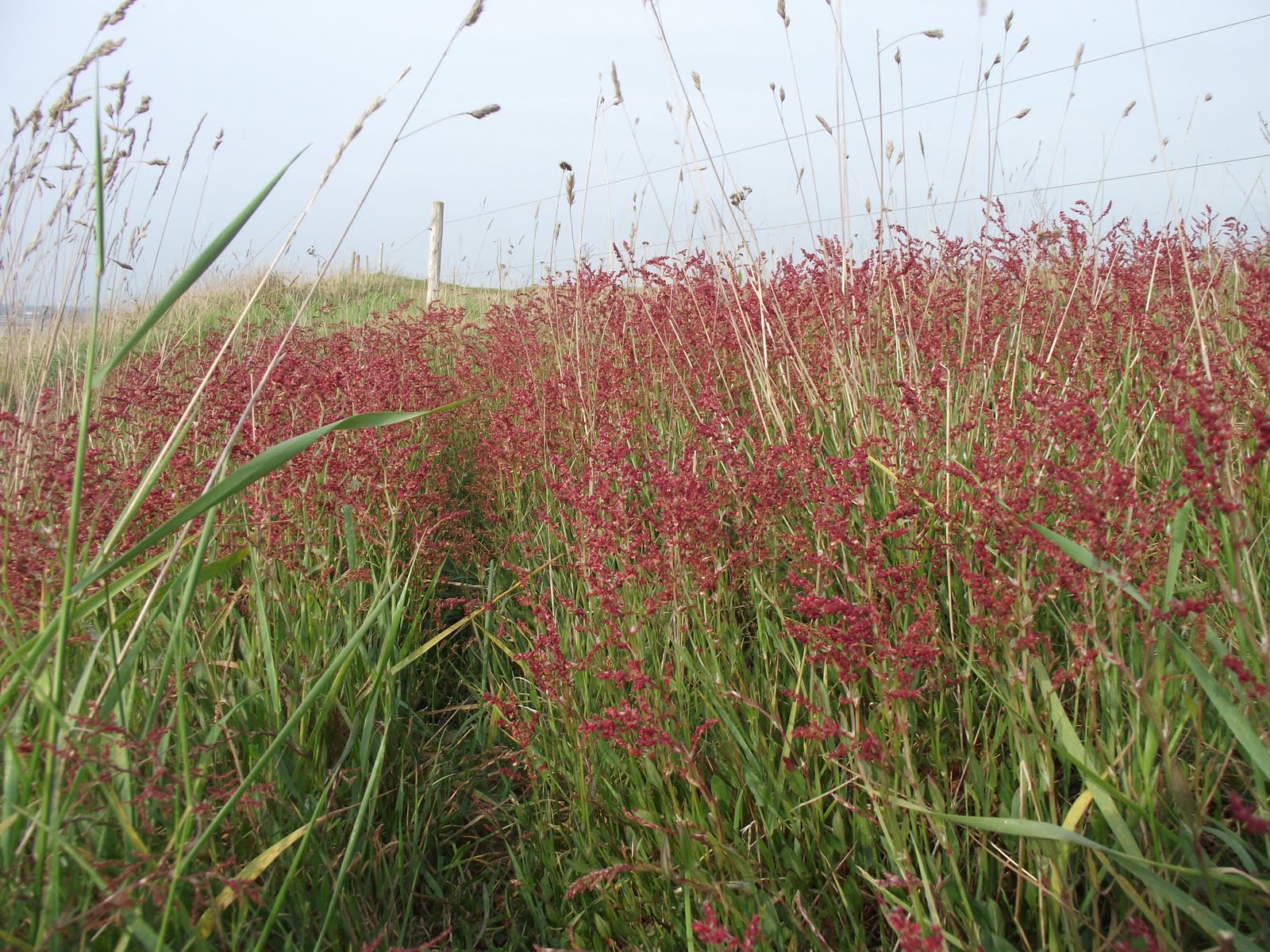
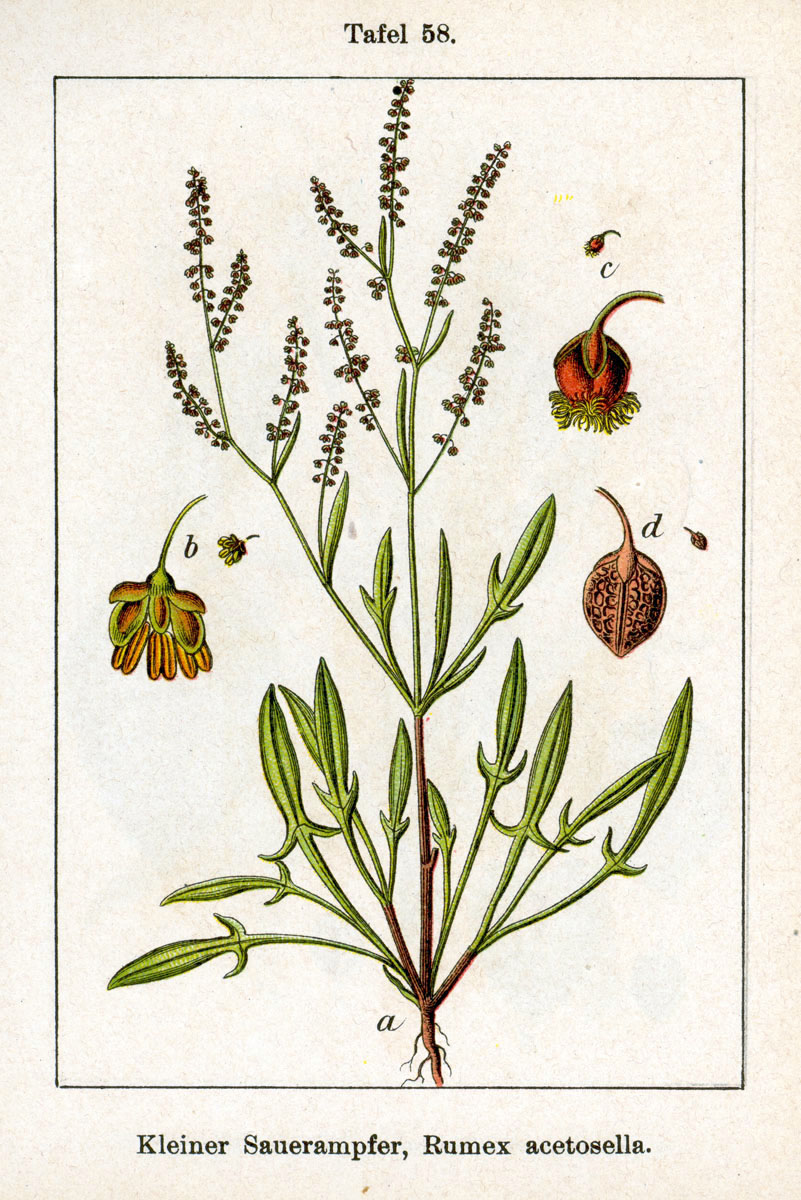
It is easy to see why Sheep's Sorrel (Rumex acetosella) is also called Red Sorrel

Common Species:
  • French or Common Sorrel (Rumex acetosa
  • Sheep's, Red, or Field Sorrel (Rumex acetosella)
  • Monk's Rhubarb (Rumex alpinus)
  • Herb Patience (Rumex patientia)
  • Buckler-Leaved or French Sorrel (Rumex scutatus)


Buckler-Leaved Sorrel (Rumex scutatus) has a more spade-shaped leaf.

Description:
Docks and Sorrels are closely related species belonging to the Rumex genus. Most species are considered "weeds", but the ones listed here have a fantastically refreshing and bright flavor - think lemony lettuce! The flowers, seeds, and even roots are edible as well. They attract beneficial insects, mine for minerals in the soil, and are drought-tolerant to name but a few of their traits. An easy to maintain addition in the Forest Garden.

Common Sorrel (Rumex acetosa

Sheep, Red, or Field Sorrel (Rumex acetosella)

History:
There are over 200 species in the Rumex genus. Where these plants were not native, they were introduced on purpose or on accident, and they can now be found the world over. Only a few species of Sorrel have had much interest by plant breeders, so the wild plants are what we have.

Trivia:
  • "Sorrel" is also used to describe parts or tea from the Hibiscus which is popular around the Equator, but has no relation to the Rumex species
  • Sorrel is used fresh and cooked around the world in traditional cuisine most commonly in Europe, but also Africa and Asia
  • Sheep Sorrel was used to revegetate overgrazed fields in Australia

Sorrel is best picked when leaves are young and tender.

Common Sorrel (Rumex acetosa) - here's a recipe for soup:

USING THIS PLANT
Primary Uses:
  • Edible Leaves - unique fruity, sour (lemony) taste. Can be used raw (salads, on sandwiches, etc.) or cooked like spinach (soups, sauces, stews, pastries, spanakopita, quiches, etc.). The leaves may even be boiled to impart a lemony flavor to the water which is cooled and sweetened and used like lemonade.
  • Edible Flowers - typically used as a garnish for salads, but may be cooked as well.
  • Edible Roots - Some species have a large taproot which can be dried, ground, and used as a flour adjunct
  • Edible Seeds - May be eaten raw or cooked. May be dried, ground, and used as a flour adjunct

Secondary Uses:
  • General insect nectar plant
  • Dynamic Accumulator Plant - Excellent! (Potassium, Phosphorus, Calcium, Iron, Sodium)
  • Groundcover Plant
  • Pioneer Species - the deep roots can help break up hardened soils
  • Drought Tolerant Species
  • Juice from the leaves can be used to curdle milk
  • Juice from the leaves can be used to clean stains in clothing
  • Dye Plant - roots, leaves, and stems
  • Likely a decent feed plant for most domestic animals - chickens will eat the seeds (let them harvest themselves!) and greens sparingly

Harvesting: Spring harvest for leaves. Pick when young as older leaves are more fibrous.
Storage: Used fresh most commonly, but the leaves can be dried and used later.

Monk's Rhubarb is tolerant of cold climates, like alpine regions, hence its scientific name.
(Rumex alpinus

DESIGNING WITH THIS PLANT
USDA Hardiness Zone:
  • French or Common Sorrel (Rumex acetosa) - Zone 3-9
  • Sheep's Sorrel (Rumex acetosella) - Zone 1-9 
  • Buckler-Leaved Sorrel (Rumex scutatus) - Zone 3-9

AHS Heat Zone
  • French or Common Sorrel (Rumex acetosa) - Zone 6-1 
  • Sheep's Sorrel (Rumex acetosella): 10-1 
  • Buckler-Leaved Sorrel (Rumex scutatus) - Zone 6-1

Chill Requirement: No reliable information can be found

Plant Type: Herbaceous perennial
Leaf Type: Deciduous (some varieties are evergreen)
Forest Garden Use: Herbaceous Layer, Groundcover Layer
Cultivars/Varieties: Many species available. Some few have been improved.

Pollination: May be Self-Pollinating/Self-Fertile or Dioecious (male and female plants) depending on the species. Pollinated by wind.
Flowering: May-September

Life Span: No reliable information can be found, but as these plants reseed so easily, it is almost a moot question.

Sorrel's have small flowers that attract small, beneficial insects.
Sheep's Sorrel (Rumex acetosella)

While many species have taproots, all species have deep-growing roots.
Sheep's Sorrel (Rumex acetosella)

PHYSICAL CHARACTERISTICS OF THIS PLANT
Size: 
  • French or Common Sorrel (Rumex acetosa) - 12-36 inches tall and 12 inches wide
  • Sheep's Sorrel (Rumex acetosella) - 6 inches tall and indefinitely wide
  • Buckler-Leaved Sorrel (Rumex scutatus) - 12 inches tall and 12-24 inches wide

Roots: Deep and fibrous, some species have a taproot; Sheep Sorrel (Rumex acetosella) has stolons (stems called "runners" that grow along the ground and produce roots, and then new plants)
Growth Rate: Medium to Fast

While not its main use, Sorrels can produce a decent amount of seed.
Herb Patience (Rumex patientia)

GROWING CONDITIONS FOR THIS PLANT
Light: Prefers full sun
Shade: Most species tolerate light shade, although some can tolerate moderate shade
Moisture: Dry to medium-moisture soils
pH: can tolerate a very wide range of soils (3.5-8.5)

Special Considerations for Growing: None

Propagation: 
Typically, and easily, by seed - direct sow in Spring. Can transplant "wild" specimens. Can divide plants in Spring.

Maintenance:
None. Flowering will stop new leaf growth, so you can encourage young leaf growth by cutting off the flowering stem.

Concerns:
  • Poisonous - Leaves and contain oxalic acid. Large amounts need to be eaten for this to be toxic. When cooked, much of the oxalic acid is reduced.
  • Running types can be expansive - they can grow all over the place.
  • Many varieties of Sorrel reseed very easily, so some consider them a bit invasive... I see this as a great trait!


Sunday, March 10, 2013

A Mini Guild: Beans, Cucumbers, Bougainvillea, Stinging Nettle


Seedlings of Purple Podded Pole Bean (left) and Japanese Climbing Cucumber (right)

My boys (age 4 years and almost 5 years old) wanted to help me in the garden this weekend.  I decided to try a small experiment. I have a spot that gets a few hours of morning sun, and that is it. It is not an ideal location for typical garden vegetables, but I only have a couple of seedlings to lose if it doesn't work.

There was a mixed variety of plants growing under a rather old Bougainvillea: some perennial flowering bulbs that the landlord (or their gardener) planted years ago, a low-growing mat of wispy little-leaved plants, a few shoots of ferns, and a single, small Stinging Nettle. I cleared a spot, and my boys and I planted the seedlings. I left the bulbs and Stinging Nettle. I shredded the other unknown plant and used it as a mulch for the seedlings.

My thought is that if there is enough light there for these plants to survive, then we just created a mini-Permaculture Guild. The bean is a legume and is a nitrogen-fixing plant... it will provide nitrogen (not a lot, but some) for the fast growing cucumber. The cucumber and bean are both climbing plants. They can be trained to grow up the tall Bougainvillea, which will be putting out beautiful blooms later in the Summer close to when the cucumber and beans will be ready to harvest. The flowering bulbs are pretty and will provide a bit of ground cover until the seedlings are taller. The Stinging Nettle is small, but by cutting out the competing ground cover around it, I have given it room to grow. As it does, it will become a ground cover of its own with edible leaves. When the Stinging Nettle gets a bit too big, which they usually do in places you don't specifically want them, I will cut it back and use its leaves... young leaves to eat and old leaves as mulch. Since Stinging Nettle is a Dynamic Accumulator, its mulch is rich in nutrients, specifically potassium, calcium, sulfur, copper, iron, and sodium. 

Seedlings (left), Bougainvillea (back), Stinging Nettle (lower right)

This small patch of soil is now home to a small Permaculture Guild. Our yard is full of very pretty, but not very useful plants. However, this spot with a big, old Bougainvillea with its understory of flowering bulbs, when neglected for a few years so that a few "weeds" spring up, and with the addition of a few annual vegetables, now becomes a very productive spot that requires minimal maintenance. 

This is a tiny glimpse of home-scale Permaculture!

Friday, March 8, 2013

Rocket Stove Kickstarter by Paul Wheaton of Permies.com

Paul Wheaton (big) and Toby Hemenway (little)

Here is a Kickstarter project for Rocket Stoves that I would highly recommend examining.  I have written about Rocket Mass Heaters, and the Rocket Stoves are where the mass heater originated. Take a look and contribute if you feel like it is worthwhile... I do.