Tuesday, December 11, 2012
Duck 5 Ways
A friend sent me this link to a quick, but extremely well done, video on how to prepare a duck in five different ways. Click on that link; it is really good! I've made some of this myself (you can read about the ways I used my smoked duck leftovers here), but I'd really like to try some of the other techniques shown.
Also, take a look at The Perennial Plate website. Fantastic as well!
During the holiday season, I will be doing quite a bit of traveling. I am also going to slow down and spend time with my family. I'll be posting a few things here and there. They will likely be interesting or fun photos or easy to watch videos, but I will not be writing in-depth or time-consuming research articles for a few weeks. So relax and enjoy the holidays. Have a Merry Christmas and a Happy New Year!
Monday, December 10, 2012
More Reasons to Drink Beer
During the holiday season, I will be doing quite a bit of traveling. I am also going to slow down and spend time with my family. I'll be posting a few things here and there. They will likely be interesting or fun photos or easy to watch videos, but I will not be writing in-depth or time-consuming research articles for a few weeks. So relax and enjoy the holidays. Have a Merry Christmas and a Happy New Year!
Friday, December 7, 2012
Trap Plant Species
The French Marigold (Tagetes patula) is one of the more well known Trap Plant Species
http://upload.wikimedia.org/wikipedia/commons/e/e7/French_marigold_Tagetes_patula.jpg
I recently wrote about Trap Plants and Trap Crops. I had said that I would publish a listing of trap plant species, so here it is, but before I begin, I need to say a few things.
First, the chart below lists the Main Crop species in bold first, and then the Trap Plant Species is listed underneath as a bullet. Finally, the pest that is drawn away from the Main Crop is listed after the Trap Plant Species.
Second, this list represents only plant pairings for which I could find solid research. There may be other legitimate trap plant species out there, but I did not find anything that proved it. If you come across a pairing, AND you have some research to back it up, please send it my way, and I will add it to my list.
Third, as I come across more research, I will be adding it to this list.
Fourth, and finally, a word about names. I call these plants (as do many scientists) Trap Plants. Many people may call this Companion Planting, and they would be correct. To me, Companion Planting is any plant pairing that aids the growth of the main crop. It may also aid the growth of the companion plant as well, but that is getting into a whole new subject. Now a Companion Plant may provide nutrients, provide minerals, add fertilizer, attract beneficial insects, provide shade or structural support, or it may repel pests. Trap Plant planting is a specific type of Companion Planting that draws a pest to themselves and away from the main crop. I hope that makes sense. I plan to write about this in more detail in the near future as well.
TRAP PLANT SPECIES
(Listed under their respective Crop Species)
Bean
- Eggplant – Whitefly
- Squash – Whitefly
Cabbage
- Chinese Cabbage – Cabbage Webworm, Fleahopper
- Collards – Diamondback Moth
- Indian Mustard – Cabbage Head Caterpillar
- Marigold - Nematodes
- Mustard – Cabbage Webworm, Mustard Aphid
- Nasturtium – Aphids, Flea Beetle, Cucumber Beetle, Squash Vine Borer
- Radish – Cabbage Webworm, Fleahopper, Flea Bettle, Root Maggot
- Sesamum spp. – Diamondback Moth
- Tomato – Diamondback Moth
- Yellow Rocket – Diamondback Moth
Carrot
- Onion – Carrot Root Fly, Thrips
- Garlic – Carrot Root Fly, Thrips
Cauliflower and Broccoli
- Chinese Cabbage – Cabbage Fly
- Marigold – Pollen Beetle
- Sesamum spp. – Diamondback Moth
- Sunflower – Pollen Beetle
- Turnip – Cabbage Fly
- Wild Mustard – Flea Beetle, Potato Leafhopper
- Yellow Rocket – Flea Beetle
Corn
- Beans and other Legumes – Fall Armyworm, Leafhopper, Leaf Beetles, Stalk Borer
- Desmodium spp – Stemborer, Striga
- Medic – Carrot Root Fly
- Mustard – Stink Bug
- Napier Grass – Stemborer
- Sorghum – Corn Stalk Borer
- Soybeans – Heliotis spp.
- Sudan Grass – Stemborer
- Vertiver Grass – Corn Stalk Borer
Cotton
- Alfalfa – Lygus Bug, Green Stink Bug
- Castor Beans – Heliotis spp.
- Chick Pea – Heliotis spp.
- Corn – Heliotis spp.
- Cowpea – Heliotis spp.
- Fleabane – Tarnished Plant Bug
- Okra – Flower Cotton Weevil (Bollworm)
- Sharpleaf Groundcherry – Whitefly
- Sunflower – Heliotis spp.
- Tobacco – Heliotis spp.
Cowpea
- Desmodium spp – Stemborer, Striga
Cranberry
- Foxtail – Cranberry Girdler
- Red Top – Cranberry Girdler
Cucurbits (Squashes, Melons, Gourds)
- Blue Hubbard Squash (planted around Yellow Summer Squash) – Cucumber Beetle and Squash Vine Borer
- Corn – Fruit Fly
- Squash (planted around Cucumber) – Striped Cucumber Beetle
- Marigold – Nematodes
Garlic
- Basil - Thrips
- Marigold - Thrips
Groundnut
- Castor Bean – leaf eating caterpillars
- Sunflower – leaf eating caterpillars
Leek
- Chives – Leek Moth
Legumes
- Marigold – Nematodes
Lettuce
- Alfalfa – Lygus Bug
- Clover – Lygus Bug
- Crownbeard and other Wildflowers – Thrips
- Melilot – Lygus Bug
- Mugwort – Lygus Bug
- Vetch – Lygus Bug
Millet
- Desmodium spp – Stemborer, Striga
Peach
- Canola – Lygus Bug
Peanuts
- Squash – Corn Rootworm, Cucumber Beetle
Peppers
- Hot Cherry Pepper – Pepper Maggot
- Lupin – Heliotis spp.
Potato
- Horseradish – Colorado Potato Beetle
- Marigold – Nematodes
- Sorghum – Aphid
- Soybean - Aphid
- Tansy – Colorado Potato Beetle
- Wheat – Aphid
Rice
- Marigold – Snails
Rose
- Pelargonium geranium – Japanese Beetles
Sorghum
- Desmodium spp – Stemborer, Striga
Soybean
- Green beans – Mexican Bean Beetle
- Rye – Corn Seedling Maggot
- Sesbania – Stink Bug
- Sickle Pod – Velvet Bean Caterpillar, Green Stink Bug
Strawberries
- Alfalfa – Lygus Bug, Tarnished Plant Bug
- Daisy – Lygus Bug
- Mustard – Lygus Bug
- Scented May Weed – Tarnished Plant Bug
- Wheat and other grains – Dusky Wireworm
- Yarrow – Lygus Bug
Sweet Potato
- Corn – Wireworm
- Wheat – Wireworm
Tomato
- Corn – Fruit Fly
- Cucumber – Tomato Fruit Borer
- Dill – Tomato Hornworm
- Lovage – Tomato hornworm
- Marigold - Nematodes
Vegetables (General)
- Chervil – Slugs
Watermelon
- Squash – Cucumber Beetle, Squash Bugs
Thursday, December 6, 2012
Permaculture Plants: Rhubarb
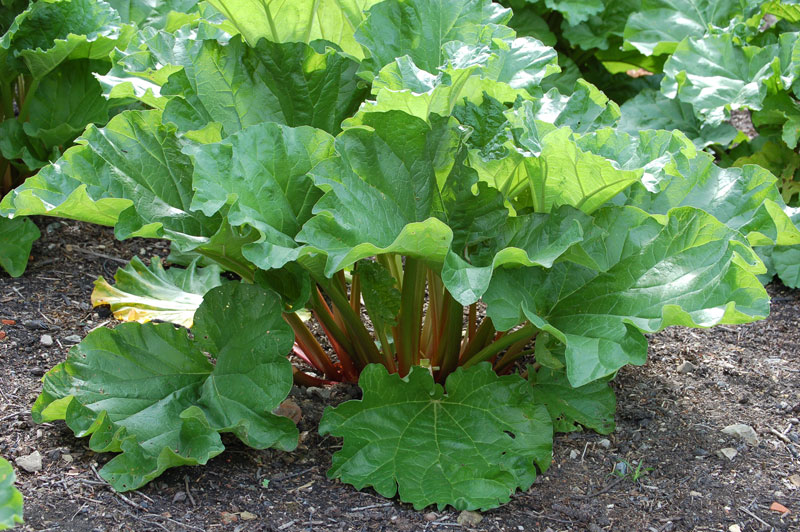
Rhubarb, one of the few well known perennial vegetables.
Common Name: Rhubarb
Scientific Name: Rheum species
Family: Polygonaceae (the Knotweed, Smartweed, Buckwheat family)
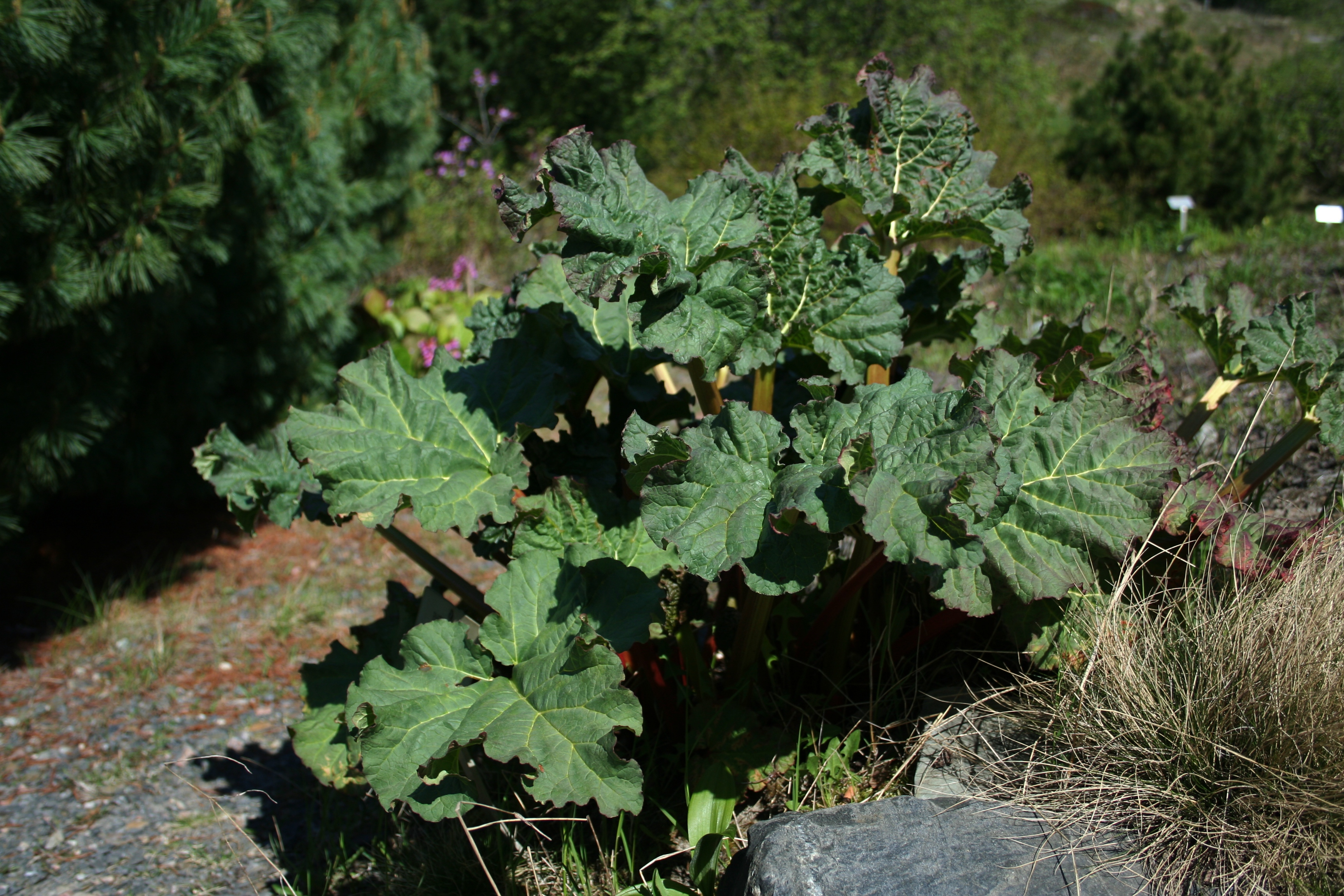
The large leaves are a great biomass accumulator
Common Species:
- Himalayan Rhubarb (Rheum australe)
- Sikkim Rhubarb (Rheum nobile)
- Turkey or Chinese Rhubarb (Rheum palmatum)
- Da Huang (Rheum palmatum tanguticum)
- False Rhubarb (Rheum rhaponticum)
- Common Rhubarb (Rheum rhabarbarum)
- Garden Rhubarb (Rheum x cultorum or Rheum x hybridum)
Remember, only the stalks (aka petioles) are edible
Description:
Rhubarb, along with Asparagus, is one of the more well known perennial vegetables. The large green leaves and red stalks were once a very common site in the home garden. Nowadays, there are probably more people who have heard of this vegetable than have eaten it, although the sour leaf stalks are still commonly used in pies (typically mixed with berries and lots of sugar) or in jams (also with lots of sugar). Few people in the U.S. have eaten Rhubarb as a vegetable as they do in Asia, and even fewer people have eaten the immature flower buds like cauliflower.
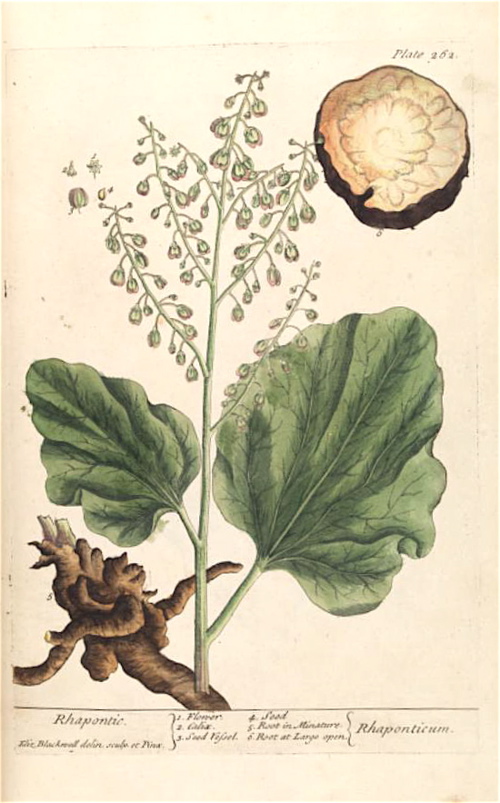
Rheum rhaponticum
History:
Almost all of the nearly 60 species of Rhubarb are used for food, medicine, or both. Originally from Asia, and grown for thousands of years, Rhubarb has been distributed around the world.
Trivia:
- Most commonly found Rhubarb have red stems, but there are a number of varieties (and other Rheum species) that have green or pink stems.
- Rheum palmatum is a large plant that can reach 6-10 feet tall and reportedly has a gooseberry-flavored stalk
- Rheum australe is reported to have an apple-flavored stalk.
Definitely not your grandmother's strawberry-rhubarb pie!
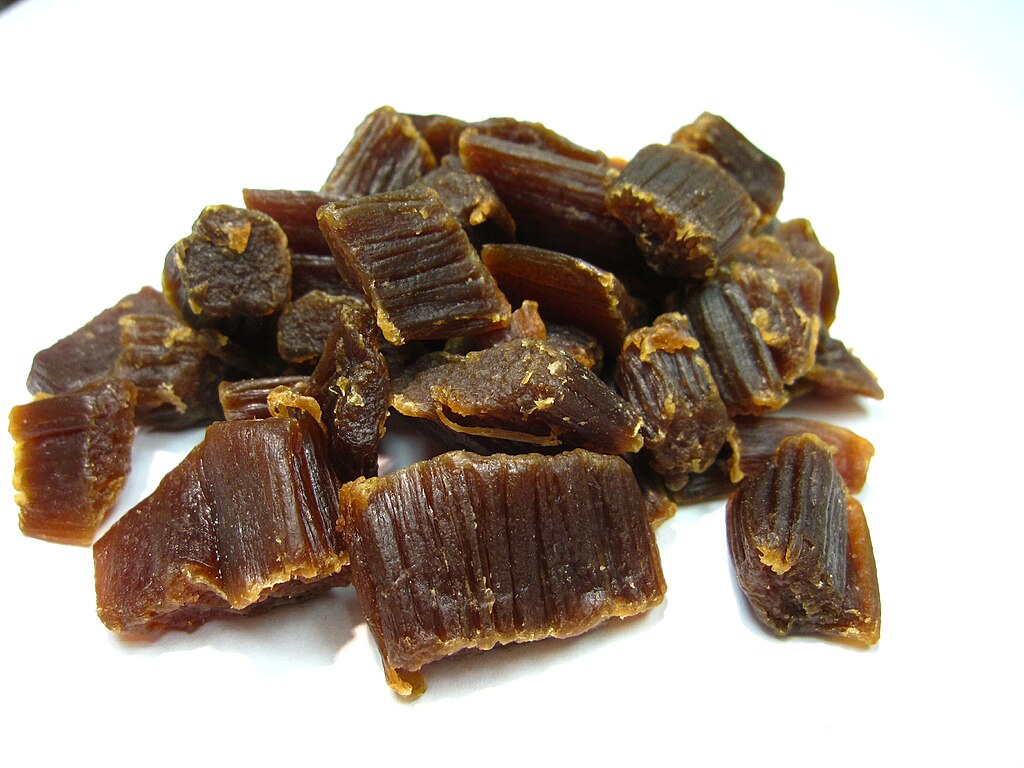
Dried Rhubarb - after it has been soaked in apple juice
USING THIS PLANT
Primary Uses:
- Edible Stalks – very tart. Typically cooked, but some eat them raw. In the United States, Rhubarb is cooked like a tart fruit in pies and jams, with the addition of a lot of sweetener (sugar, honey, etc.), while in Asia, Rhubarb is eaten as a vegetable similar to celery and can be used in soups and stews. Rhubarb stalks have been candied as well.
- Edible Flower Buds – cooked; similar in texture to cauliflower, but very tart.
- NOTE: due to the high amounts of oxalic acid in this plant, Rhubarb should be eaten in moderation. So what does this mean in real life? Don’t eat Rhubarb with every meal for a week. Oxalic acid inhibits the body from absorbing calcium. Over time, this can be harmful. However, considering its tartness, excessive consumption is unlikely.
Secondary Uses:
- Pioneer Plant Species
- Groundcover – plant larger species (Rheum palmatum) at 4 feet (1.2 meters); plant other species at 2.5 feet (0.8 meters)
- Dynamic Accumulator
- Biomass – on the small scale, but the leaves are not eaten, so use them for compost
- Insecticide Plant – simmering leaves in hot water yields an insecticide solution (I can find no recipes or application instructions)
- Dye Plant – some species leaves, stalks, and roots can be used to make yellow to red dyes.
Yield: Depends on the species, variety, growing conditions, and harvesting techniques.
Harvesting: Spring – Early Summer. Cut or twist off the leafstalk. Make sure to avoid the roots and the leaves. By mid to late Summer, the oxalic acid content has climbed, and even the stalks should be avoided or at least eaten in very limited quantity. Many people, mainly commercial growers, will harvest all the stems at once. This likely puts undue stress on the plant and encourages it to go to seed. Instead, remove no more than about a third of the stalks at one time and only mature stalks; harvest the next batch of now mature stalks a few weeks later. This method will also extend the harvesting season. It is time to stop harvesting once the stalks get thin.
Storage: Eat, cook, or process right away. Fully mature stalks will keep in a cool dry place (like a refrigerator) for a few days. Stalks can be frozen as well; pre-cutting and pre-measuring will make using them easier.
Rhubarb can be used as a ground cover since those large leaves shade out weeds
DESIGNING WITH THIS PLANT
USDA Hardiness Zone:
Himalayan Rhubarb (Rheum australe): 5-8
Sikkim Rhubarb (Rheum nobile): 7-9
Turkey or Chinese Rhubarb (Rheum palmatum): 4-7
False Rhubarb (Rheum rhaponticum): 3
Common Rhubarb (Rheum rhabarbarum): 3-8
Garden Rhubarb (Rheum x cultorum or Rheum x hybridum): 1-9
AHS Heat Zone: Garden Rhubarb (Rheum x cultorum or Rheum x hybridum): 8-5
Chill Requirement: No reliable information available.
Plant Type: Herbaceous Perennial
Leaf Type: Deciduous
Forest Garden Use: Herbaceous Layer
Cultivars/Varieties: Many species and many, many varieties available.
Pollination: Self-Pollinating/Self-Fertile. Pollinated by wind.
Flowering: Summer
Life Span:
Years to Begin Bearing: Rubarb will put out stems right away, but they should not be harvested the first year. A few can be harvest the second year.
Years to Maximum Bearing: 3-4 years is when you can start harvesting in earnest
Years of Useful Life: 10-15 years if not divided. If divided, the plant will live indefinitely.
Not many know that Rhubarb's flower buds can be eaten like cauliflower
If not eaten, the flower buds will bloom in shades of white, pink, or red
PHYSICAL CHARACTERISTICS OF THIS PLANT
Size: 3-5 feet (0.9-1.5 meters) tall and wide for R. x cultorum, other species are larger.
Roots: Fibrous and Deep (Rheum nobile has a root that can get to 7 feet (2 meters) long)
Growth Rate: Fast
The almost otherworldly Sikkim Rhubarb, Rheum nobile
The apple-flavored Himalayan Rhubarb, Rheum australe
The large Turkish Rhubarb, Rheum palmatum, has a gooseberry flavor
GROWING CONDITIONS FOR THIS PLANT
Light: Prefers full sun
Shade: Tolerates light shade
Moisture: Medium
pH: most species prefer fairly neutral soil (6.1 - 7.0)
Special Considerations for Growing:
- Being hardy to Zone 1, Rhubarb is one of the most cold hardy perennial vegetables available.
- If you live in areas warmer than Zone 7, consider growing Rhubarb as a Winter annual or consider growing a more heat tolerant species (Rheum palmatum, Rheum nobile).
- The garden varieties are great for gardens and good soil, but consider some of the other species if you are planning on using Rhubarb as a pioneer species or planting in soil that is less than ideal.
Propagation:
Usually by division in Spring. Can be planted from seeds, but seeds do not always produce plants similar to their parents (not true to type) – seeds do not require cold stratification.
Maintenance:
- Almost none. Very resistant to pests and disease.
- Crowns should be divided while dormant (either late Autumn or early Spring) every 4-5 years.
- Consider composting the leaves and stalks that dry up at the end of the season
Concerns:
Poisonous – Leaves and roots are toxic. There is a high amount of oxalic acid in the leaves, but it is likely the presence of an unknown glycoside that is the cause of its toxicity, not the oxalic acid.
Monday, December 3, 2012
Book Review: Pastured Poultry Profits by Joel Salatin
From the Publisher:
A couple working six months per year for 50 hours per week on 20 acres can net $25,000-$30,000 per year with an investment equivalent to the price of one new medium-sized tractor. Seldom has agriculture held out such a plum. In a day when main-line farm experts predict the continued demise of the family farm, the pastured poultry opportunity shines like a beacon in the night, guiding the way to a brighter future.
I have yet to read anything from Joel Salatin that I cannot recommend. This book is no different. The general premise of this book is one of farming, that is, raising food with the intention of selling it. While I may get to that stage at some point in the future, I would suggest that this book is for anyone with some land a bit larger than a small suburban lot and a desire to produce their own healthy food in a sustainable manner. Most of us do not have 20 acres. The beauty of the methods outlined in this book it that they can be scaled down. We could produce some really good chickens in a large backyard. This book will show you how.
Now, if you do happen to have a farm and are looking for a viable revenue stream, I would strongly consider raising chickens by this program. Joel Salatin has spent 20 years perfecting this model. He explains the variations and shortcuts and experiments he has attempted, gives the pros and cons, and deftly outlines his methods.
Maybe it is just me, but I cannot read a book by Joel Salatin without a deep longing to start farming.
Wednesday, November 28, 2012
The Trompe - An Almost Forgotten Air Compression System
The simple, yet brilliant, Trompe
A Trompe (also spelled Trombe) is a water powered air compressor system. This simple device was used for hundreds of years to produce compressed air for furnaces, mining equipment, ventilation systems, and even for air conditioning and ice production. Trompes were almost entirely replaced when fossil fuels, with their high energy potential, came into more general use at the beginning of the twentieth century (I believe the only large scale Trompe still in use is at the Ragged Chute plant on the Montreal River in Ontario, Canada). Unfortunately, the knowledge of these systems has been almost completely forgotten. At this time of increasing energy prices and likely post-peak oil, this is the type of information that needs to be shared and implemented.
The Trompe at the Ragged Chute Plant in Canada.
The function of a Trompe is brilliantly simple. It has no moving parts. Water is directed into a tall, vertical pipe that decreases in diameter. As the column of water is constricted from the piping, air is sucked in through ports. The air bubbles in the water are pressurized – the higher the column of water (i.e. the more head), the higher the pressure. At the end of the vertical pipe, the water with pressurized air bubbles, flows into a larger chamber (called a plenum or reservoir) where the air bubbles are released. The water flows out and the air, now compressed in a tight space, can be harvested.
Correct me if I am wrong, but from my understanding there is a loss of heat energy in this process which cools the air. Actually, the air compression is isothermal (no change in heat energy), but then the air coming out of compression is cooling. This cooling effect can then be utilized for simple air conditioning systems or refined for ice production.
The compressed air can be used directly as a power source to pump pistons or turn gears, or it can be stored in tanks and used elsewhere.
There is a lot of physics involved with a Trompe, but it is really a basic design. The higher the water origin, the greater the potential of energy produced. This is why many of the larger systems were built near waterfalls. However, I think there are plenty of smaller applications in a home or homestead where a Trompe could be used. It is time to bring this almost lost technology back to modern use.
For More Information:
Tuesday, November 27, 2012
Bright Agrotech - Vertical Farming and Aquaponics
The Bright Agrotech team
If you believe in their mission, and you have some extra cash, consider investing with them. Here is their KickStarter page: http://www.kickstarter.com/projects/569973520/grow-up-vertical-farming-for-everyone
Subscribe to:
Posts (Atom)