Showing posts with label Heirloom Foods. Show all posts
Monday, April 1, 2013
Portugal, please say "No!" to the McBifana.
I recently spent a few days in Lisbon, Portugal. I was walking one morning, and I came across this advertisement at a bus stop. I was very disappointed.
A bifana is a traditional Portuguese snack or light meal. It consists of a thinly sliced beef or pork steak placed between a sliced roll. By contrast, a McBifana is the exact opposite of a traditional food. It is a large, international, billion-dollar, food corporation that is coming in and trying to replace a food that is best made locally... by locals with local ingredients.
In reality, I support the free market, so I am not suggesting Portugal ban McDonalds. However, what I would love to see is the Portuguese avoid this food so McDonalds has to take it off their menu. Some things should not be in the realm of fast-food. Okay, pretty much nothing should be in the realm of fast-food if you actually care about quality food and health, but bastardizing a bifana is going a bit too far.
For a bit more information on a similar concept, I wrote a brief article on the Slow Food Movement that you can read here.
Wednesday, February 13, 2013
Spring Garden - Seed Trays are Planted!
Just a quick post to share (and to keep for my own records) what seeds I am starting for this year's Spring garden. As you can see, I am a huge fan of Seed Savers Exchange and heirloom vegetables in general.
This seasonal transition, and the importance it plays in human life, has greatly been lost in our modern world. To get reconnected to it... to the pleasures of the coming Spring are simple, but profound. Plus, it is always fun to get the seeds planted. I always feel like a kid in a candy store when going through my seed collection to pick out what I want to plant this year.
Well, here is my final selection. I'd love to know what you are planting. Let me know!
Tray 1
Tray 2
Tray 3
Tray 4
Tray 5
Tray 6
Tray 7
Wednesday, January 30, 2013
Book Review: Charcuterie
I received this book from one of my siblings at Christmas. In short, I love it! I recently wrote an article about why I enjoy learning and practicing food preservation (read that article here). I have already tried a few recipes from this book. My favorit so far was the pork confit from my own rendered lard... it was the most tender pork I have ever tasted. My 18-month old daughter almost ate as much as I did! I find it more than interesting that a baby can instictually know quality food. I think it is great.
If you are a foodie and a cook and a person who enjoys meat. You will likely love this book as much as I did. I highly recommend it.
I love this review posted on Amazon:
Starred Review. Without the faintest hint of apology, Ruhlman and Polcyn present an arsenal of recipes that take hours, and sometimes days, to prepare; are loaded with fat; and, if ill-prepared, can lead to botulism. The result is one of the most intriguing and important cookbooks published this year. Ruhlman (The Soul of a Chef) is a food poet, and the pig is his muse. On witnessing a plate of cold cuts in Italy, he is awed by "the way the sunlight hit the fat of the dried meats, the way it glistened, the beauty of the meat." He relates and refines the work of Polcyn, a chef-instructor at a college in Livonia, Mich., who butchers a whole hog "every couple weeks for his students." Together, they make holy the art of stuffing a sausage, the brining of a corned beef and the poaching of a salted meat in its own fat. An extensive chapter on pâtés and terrines is entitled "The Cinderella Meat Loaf" and runs the gamut from exotic Venison Terrine with Dried Cherries to hearty English Pork Pie with a crust made from both lard and butter. And while there's no shortage of lyricism, science plays an equally important role. Everyone knows salt is a preservative, for example, but here we learn exactly how it does its job. And a section on safety issues weighs the dangers of nitrites and explains the difference between good white mold and the dangerous, green, fuzzy stuff.
Here are some other reviews of this fine book:
Charcuterie is an important and definitive work which deserves to stand proudly and forever in every serious cook's kitchen. -- Anthony Bourdain, author of Kitchen Confidential
Charcuterie provides an open window on the delicious possibilities available to the home cook and professional chef alike. -- Paul Bertolli, author of Cooking By Hand
Michael Ruhlman and Brian Polcyn have opened the door for home cooks everywhere to experience the thrill of making charcuterie. -- Mario Batali, chef/owner of Babbo Restaurant, New York
Never has the art of charcuterie been handled this thoroughly for the home cook. -- Lynne Rossetto Kasper, host of American Public Media's national radio series The Splendid Table®
The best techniques to cure, smoke and preserve meat in the tradition of the best charcutiers out there. -- Eric Ripert, chef/co-owner of Le Bernardin Restaurant, New York
Monday, January 28, 2013
Why Learn to Preserve Food?
Portuguese-style Cured Iberian Ham - delicious!
For quite some time, I have been intruiged with the idea of food preservation, specfically historic food preservation. Humans have preserved food for thousands of years to make it through lean months, most often for the Winter. It is only in the last generation or two, and really only in "modern" cultures, where we have lost this vital knowledge. The reason? Electric refrigeration. The modern refrigerator and freezer are amazing pieces of technology, and I will have and use them as long as I have electricity. However, I think it is important not to lose the knowledge and skills to preserve food. I have a few reasons for this. (I'll be dramatic and outline my reasons in reverse order of importance):
Fifth - We may not always have electricity.
Therefore, we may not always have refrigerators and freezers. Don't worry. I do not think we are going to have some apocolyptic event or some Mad Max-type world, but I do think we have already reached Peak Oil on a global scale. How much time before we start feeling global oil depletion is still up for debate. Alternate energy sources are still not nearly as readily available as electricity from a city or county municipality. There may be a period of time when petroleum-based electricity is waning and alternative-energy-based electricity is phasing in where we may have gaps in service or the price of electricity is just not worth running high electritical use appliances (i.e. refrigerators, freezers, dryers, air conditioners, etc.). The probability for this may be pretty low, but since it is possible, I would like to be a bit better prepared. Reading about food preservation is one thing, actually doing it is another.
Preserved Lemons... so easy to do!
Fourth - Preserving our own food saves money.
Let's look at blackberries. When you are buying blackberries out of season for your local area, they are very expensive. If you buy berries in the Winter, they are imported from overseas, and are going to cost a lot more... and not taste nearly as good. However, if you buy the blackberries during your local blackberry season, then the cost will be much lower, the taste will be much better, and you can preserve them yourself in a variety of ways... as jams, jellies, preserves, or even frozen. Even with what I just said about electricity and freezers, a freezer is a great tool. If you buy and freeze blackberries during the peak of your local season, you will save significant money. Now some will argue that buying already frozen blackberries from the store can be cheaper than doing it all yourself. Sometimes this may be true, but most often it is not. If you grow your own blackberries, the cost goes down even more. And if you pick wild blackberries and preserve them, then the cost is next to nothing other than time. Spending time outside in nature, preferably with friends and/or family, walking and harvesting wild foods... this is not wasted time, and it is probably a better activity than what many now do on their weekends.
Third - It is fun!
I love to cook, and I really enjoy preserving foods. Fortunately I know I am not alone. There are so many different aspects that make it enjoyable. If you have an interest in cooking, baking, gardening, foraging, history, anthropology, homesteading, preparedness, or health, then you can find some aspect of food preservation which will be enjoyable.
My red cabbage sauerkraut... simple and delicious.
Second - It is healthier.
If you have recently looked at the label of almost any food in a grocery store, especially one that does not require refrigeration, then you know that these foods are full of chemicals we would never add to foods prepared in our own kitchens. In Michael Pollan's book, In Defense of Food, he states a few general rules on buying food. One of these rules states that if you cannot pronounce an ingredient on the label, then you probably shouldn't eat it that food. I whole-heartedly agree. When we preserve our own foods, we know exactly what is it in and why. We can choose to add, or not add, ingredients based on our own tastes and health opinions.
First - Flavor! Flavor! Flavor!
This is my number one reason. Homemade preserved foods can taste far superior to what you can buy in the supermarket. We have the ability to use the best ingredients instead of the leftovers. We have the ability to use homegrown ingredients. We can preserve meats that were organically raised or grass fed or both. We can take the time to "do it right" or make things traditionally, which often take a bit more time and is why mass-produced items don't taste the same. With the widespread use of refrigerators and freezers, we don't need to produce preserved meats or fermented vegetables or even preserved fruits, but we still do. Why? Because we like the taste. When we produce it ourselves, the flavors are better. When we take the time, we can taste it, and we will savor every bite.
Thursday, April 19, 2012
A New Zealand Food Forest
I first saw these videos on the Subsistence Pattern blog. These videos tell the story of the Guytons "who started planting their food forest in 1998 on two acres of bare land in Riverton, New Zealand. This style of gardening was new to Southland so their neighbours did not approve. Now it is an established food forest with hundreds of different plant species. Fruit and nut trees, berries and herbs and wild plants all blended together in a productive and sustainable way."
To me, these videos (especially the first) are inspiring...
Thursday, March 8, 2012
Carrots!
I came across a photo of a bunch of carrots, and I was again reminded about the amazing variety of this common root crop. I was also reminded how sad it is that most people think carrots come in two forms - large and orange ("standard carrot") or small and sealed in plastic ("baby carrots"). Just take a look at the range of colors and sizes that exist... yet another reason for growing my own food.
Oh, and my "Purple Haze" carrots are just beginning to form tubers!
Tuesday, February 14, 2012
Heritage Breeds: Dominique Chickens
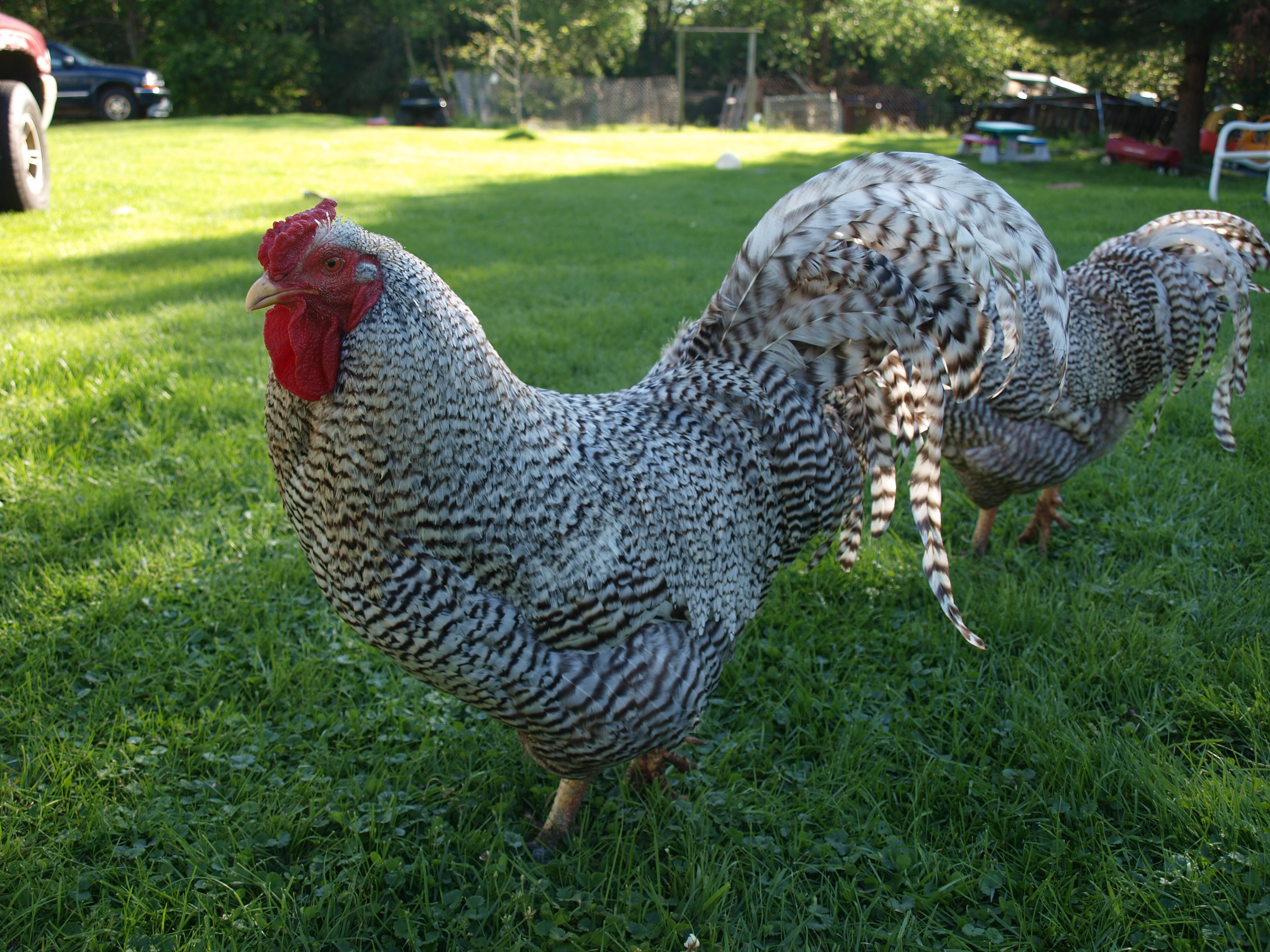
The Dominique was the first U.S. breed of chicken.
The Dominique chicken is primarily an egg laying breed, but many keep it as a dual-purpose (egg and meat) bird. This is a breed I am strongly considering adding to my land. As you read about this chicken, I wouldn't be surprised if you will, too.
Conservation Status: In Watch Status by the American Livestock Breeds Conservancy. "Watch" status means that there are less than 5,000 breeding birds in the U.S. For a full description of Heritage and Heirloom Foods, check out this post.
Description: Laying Breed Chicken or Dual-Purpose Chicken
Class*: American
Origin: United States
APA**: 1874
Size: Medium
Cock 7 lbs (3.2 kg)
Hen 5 lbs (2.25 kg)
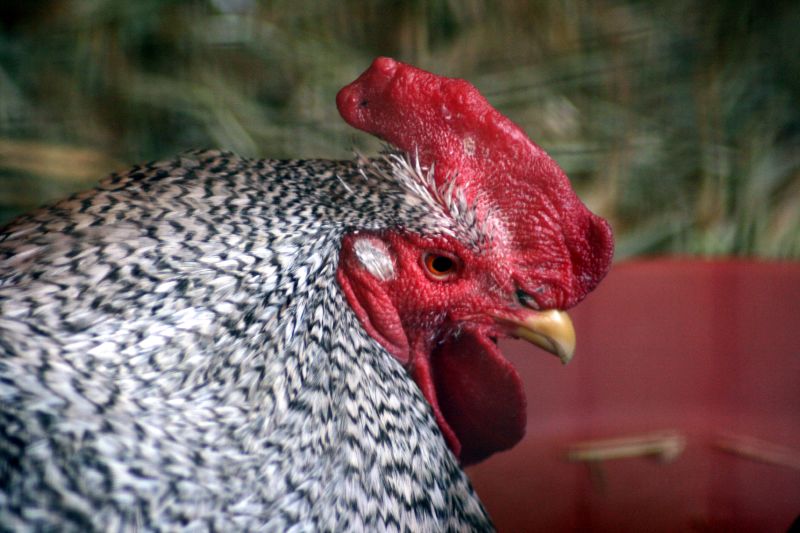
The Dominique's "rose" comb is small enough to minimize risk of frostbite.
Comb (the fleshy thing on top of the chicken's head): Small to medium rose comb - bright red
Wattles (the fleshy thing hanging from the chicken's chin): Small to medium wattles - bright red
Earlobes (the fleshy thing just below and behind the chicken's eyes): Medium-sized, oblong - bright red
Beak: Yellow
Eyes: Deep red
Shanks: Yellow
Toes: Yellow
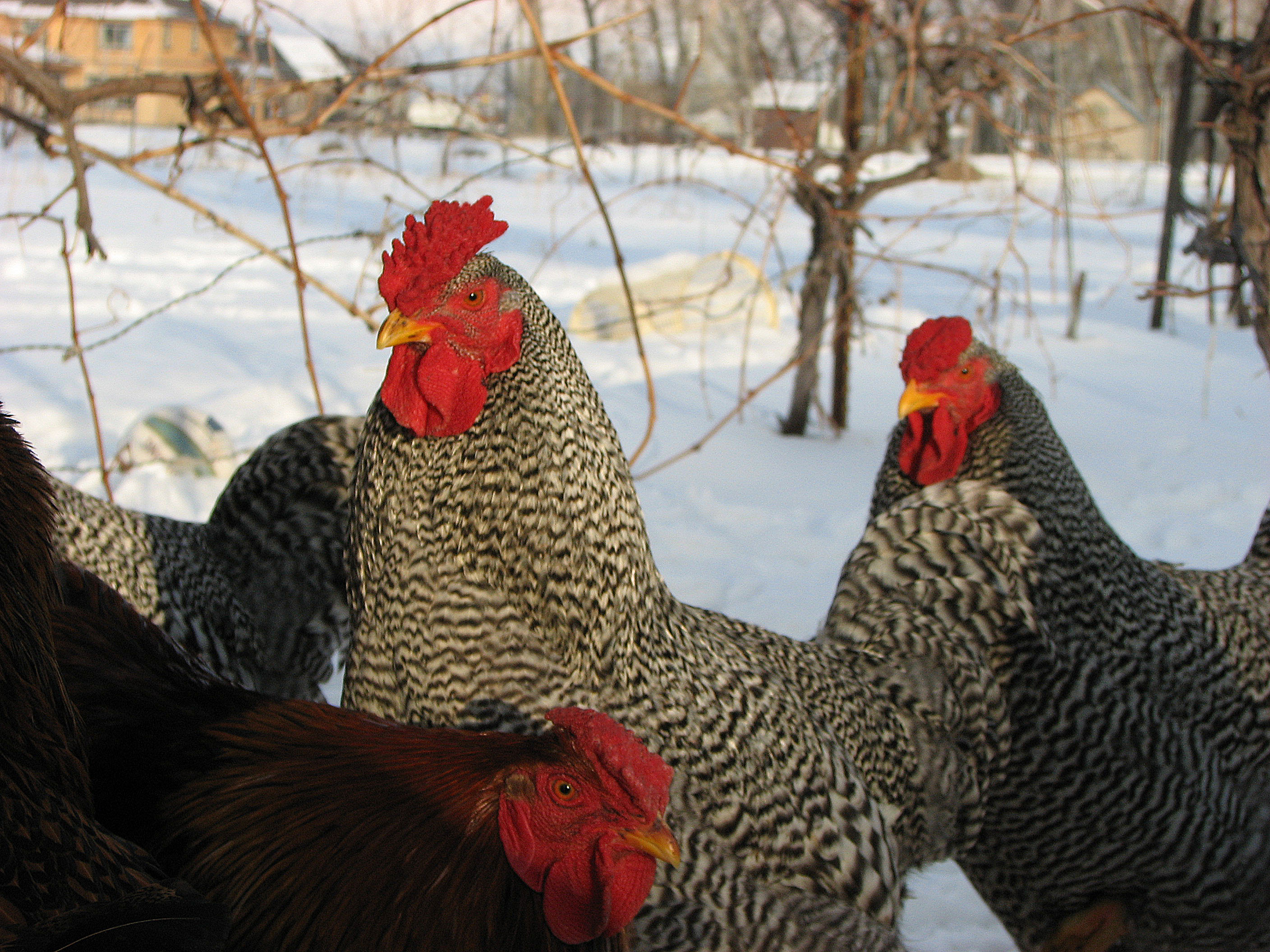
The black and white barred feather pattern, also known as "hawk coloring".
Feathers: Barred black and white (really they are dark gray over off-white)
Eggs: Small-Medium. Brown eggs. 230-275 eggs per year.
The Dominique was once the country's primary backyard chicken.
History
It is the first truly American breed of chicken, although the exact origin is unknown. Likely it was primarily European stock that formed the original breeding stock, and over time there was likely some Asian breeds mixed in as well. The Dominique was the primary barnyard chicken in the U.S. for about a century (1830-1930's), until it was replaced by the Barred Plymouth Rock breed. By the 1950's, it was thought that they Dominique was extinct; however, there were a few breeders out there who kept the breed alive. A full scale restoration took place in the 1970's with only four flocks, and today the breed is in a much safer position.
The name, Dominique, may have come from the French colony Saint-Domingue (a.k.a. Hati) which was a likely source for some of the original breeding stock.
The Dominique's mild manner is just one of its great attributes.
Attributes/Permaculture Planning
- Very hardy birds
- Range well
- Tolerates confinement (but I don't recommend that for any animal!)
- Great forager
- Good egg producer
- Broody tendency (means that the hen will want to hatch the eggs she lays - this is a great attribute when we are trying to improve our stock in a breeding program... who wants a mother that abandons her eggs?)
- Good mothers
- Barred feather pattern provides protection from arial predators - camouflage!
- Feathers used to be highly prized for stuffing pillows and mattresses
- Young birds feather out and mature early - can produce eggs as early as six months
- Hens are calm and friendly
- Cocks can be aggressive - known to kill snakes, mink, even small cats... good protectors!
For more information on Dominique Chickens, check out the Dominique Club of America.
A Dominique cock.
*Note: While there are a number of breeds that have a Bantam (miniature) version in existence, I choose not to discuss them on this site. Most Bantam breeds are show-only birds, and would not be ideal birds for a homestead... and I am not interested in "pets" that take up resources instead of providing for me and my family. There is a lot of very good and helpful information on other sites if you are interested in Bantam breeds.
**APA = American Poultry Association. Founded in 1873, it is the oldest poultry organization in North America.
Wednesday, August 17, 2011
President Obama visits Seed Savers Exchange
President Obama in front of the Seed Savers Exchange barn.
Yesterday, President Obama visited one of my favorite places in the U.S., the Seed Savers Exchange Farm. I wrote about this farm in Decorah, Iowa a few weeks ago in this post. I was watching the news and saw a report on an interesting exchange between a Tea Party member and the President. I thought to myself, "That barn looks really familiar... it almost looks like the Seed Savers Exchange barn..." Then today I received the Seed Savers Exchange email newsletter which reported on the event.
Read more about it President Obama visiting Seed Savers Exchange.
Wednesday, June 15, 2011
Heritage Breeds: Highland Cattle
Highland Cattle
This breed of beef cattle originates from the Scottish Highlands. With its characteristic shaggy hair, long forelocks, and long horns, it is not easily forgotten. It has a unique double hair coat (coarse outer layer and wooly inner layer). This coat helps it to easily handle cold and rainy climates, but it can shed its thick coat to thrive in hot and humid weather as well.
In Recovering Status by the American Livestock Breeds Conservancy. For a full description of Heritage and Heirloom Foods, check out this post.
This is a breed I am strongly considering adding to my land... one day. I had a chance to talk to a couple who raised Highlands on their farm in Minnesota. They loved them. This breed has a lot of attributes that are beneficial for small farmers. On top of that, their beef is delicious!
Award winning cow and her calf.
Description
Medium sized beef cattle
Height
Cows 3 - 3.5 feet at the shoulders
Bulls 3.5 - 4 ft as the shoulders
Weight
Cows 900 - 1,300 lbs
Bulls 1,500 - 2,000 lbs
Calves 60-70 lbs (that's small - makes for easier delivery)
Color
Solid Red is most common
Solid Black, Brindle, Cream, Dun, Yellow, White, and Silver are all traditional colors.
Horns
Cows - sweep out and up
Bulls - horizontal with upturned tips
Highland Bull.
History
Developed mainly through natural selection in the Scottish Highlands and Scottish Western Isles where rugged land, strong winds, and high rainfall produced a sturdy breed. The Highland was standardized and improved in the 1800's. This is a rather unique breed, because the improvement was made using only Highland cattle. No other breeds were cross-breed with the Highland for improving the breed characteristics. The Highland cattle registry was established in 1885. Their other name, Kyloe, comes from the Scottish term for strait, the bodies of water the cattle had to swim across to make it to market.
Of interest, a group of Highlands is called a fold (instead of the more common term, herd).
Highland Calves
Attributes/Permaculture Planning
- Beef is of high flavor
- Lean meat - Most of their insulation comes from their shaggy coat and not fat. According to the Scottish Agricultural College, Highland beef has lower fat and cholesterol and higher protein and iron content than other beef breeds.
- Medium sized cattle
- Easy handling - Scots used to keep the family cow inside their home in the winter!
- Strong maternal abilities - Highly devoted and protective mothers.
- Efficient reproduction - Noted for their ease with calving
- Very hardy
- Long lived
- Thrive in cold, wet climates
- Thrives on rough forage - will graze and browse in areas that other cattle will not and can consume a wide variety of "pest" plants. Often used in Europe to improve pastures before the more developed (i.e. fragile) breeds of cattle are moved in.
Highlands are excellent mothers.
For more information on Highland cattle, check out the American Highland Cattle Association.
Tuesday, June 7, 2011
Resources for Heirloom Foods: Slow Food USA
I discussed Heirloom and Heritage foods in a previous post. Now I would like to share one resource that will give you the opportunity to sample some of these amazing foods for yourself.
Slow Food USA
Slow Food USA is a chapter of Slow Food International. Slow Food was created by Italian, Carlo Petrini in 1986. Its mission is to be everything Fast Food is not. His website states: We believe that everyone has a fundamental right to the pleasure of good food and consequently the responsibility to protect the heritage of food, tradition and culture that make this pleasure possible. At first, Petrini was just trying to resist the building of a McDonald's at the Spanish Steps in Rome. This eventually turned into an international non-profit organization of over 100,000 members with chapters in 132 countries.
The international website is huge. It is well done with really great information. The Slow Food USA site is also done really well. The three pages I want to direct you to are these:
US Ark of Taste. From this page: The US Ark of Taste profiles over 200 rare regional foods, and is a tool that helps farmers, ranchers, fishers, chefs, retail grocers, educators and consumers celebrate our country's diverse biological, cultural and culinary heritage. Be sure to click on the links in the right-hand column to get more information on these amazing foods
Local Chapters. This page has an interactive map that allows you to locate farmers who raise foods that are consistent with the Slow Food Mission.
Slow Food USA Blog. This is updated a few times a month with some interesting and fun posts.
Here are some links to Carlo Petrini's books on Slow Food. I have not read these... yet! They are on my to-read list.
Wednesday, May 25, 2011
What are Heirloom or Heritage Foods?
You want to sell apples. To make money, you need to sell as many apples as you can. But an apple tree is not like a factory with predictable outputs... there are unpredictable harvest times and quantities, there are pests, there are diseases. And the problem with fruit in general is that it can go bad. It doesn't ship well. It has a limited shelf life.
Now what if there was an apple that produced most of its fruit all at the same time? What if it produced apples of all the same size? It was resistant to pests and disease. It could be picked easily. It could handle being processed in modern farm equipment. It would not bruise easily in shipping. It could sit in a grocery bin for a lot longer than other apples.
If such an apple existed, and there are a few that are pretty close to that ideal, then that would be a great product with which to make money. In fact most apples you buy in modern grocery stores were developed to meet these criteria.
But notice that I didn't say anything about taste... hmmm.
Did you know that there are over 7,500 varieties of apple?! If you ate a different apple each day, it would take you over 20 years to try them all. The majority of all apples sold in the U.S. are one of five varieties... FIVE out of 7,500! These are (in order of popularity): Red Delicious, Gala, Golden Delicious, Granny Smith, and Fuji.
Maybe it's just the foodie in me that wants to know what all these other apples taste like. Fortunately, I've had the chance to sample a few dozen varieties. I haven't kept track, but I am probably at around 40 varieties. I have so many left to try!
Okay, I have gotten on a tangent here.
Heirloom and Heritage Foods. What are they? In simplest terms, they are varieties (cultivars) of foods that were raised earlier in human history, but they are not used in modern agriculture. By in large, these are foods that have fallen off of farms, and therefore off our plates, because of the reasons I listed above. They just didn't handle mass production well. Fruits were too soft or bruised too easily or couldn't be transported. Vegetables took too long to grow or ripened at unpredictable times or spoiled too fast. Did you know that 96% of commercial vegetable varieties sold in 1903 are now extinct? Gone forever!
Heirloom and Heritage Foods are not just plants. Did you know that 99% of all turkeys raised in the U.S are one breed, the Broad-Breasted White? There are at least fifteen breeds of turkeys out there, and the average consumer only gets one choice.
How about chickens? No one knows for sure, but there are hundreds of breeds. What do we eat? Only one chicken, the Corinsh-Rock. How sad is that?
Cattle? Over 800 types, and we typically consume only Hereford or Angus. Milking cattle? Typically only Holstein or Jersey.
For you vegetarians and flexitarians out there...
- There are almost 7,500 varieties of tomatoes.
- There are thousands of peppers.
- There are over a thousand types of potatoes.
- There are hundreds of lettuces.
- There are dozens of carrots.
I am going to end here for now. I've got some resources for those of you interested in finding and sampling these foods. I've got some resources for those of you interested in raising these foods. I'll post these soon.
But you'll have to wait for now and dream of all the amazing tastes you haven't yet experienced!
Subscribe to:
Posts (Atom)