Showing posts with label Chickens. Show all posts

Monday, December 3, 2012

Book Review: Pastured Poultry Profits by Joel Salatin


From the Publisher:
A couple working six months per year for 50 hours per week on 20 acres can net $25,000-$30,000 per year with an investment equivalent to the price of one new medium-sized tractor. Seldom has agriculture held out such a plum. In a day when main-line farm experts predict the continued demise of the family farm, the pastured poultry opportunity shines like a beacon in the night, guiding the way to a brighter future.

I have yet to read anything from Joel Salatin that I cannot recommend. This book is no different. The general premise of this book is one of farming, that is, raising food with the intention of selling it. While I may get to that stage at some point in the future, I would suggest that this book is for anyone with some land a bit larger than a small suburban lot and a desire to produce their own healthy food in a sustainable manner. Most of us do not have 20 acres. The beauty of the methods outlined in this book it that they can be scaled down. We could produce some really good chickens in a large backyard. This book will show you how.

Now, if you do happen to have a farm and are looking for a viable revenue stream, I would strongly consider raising chickens by this program. Joel Salatin has spent 20 years perfecting this model. He explains the variations and shortcuts and experiments he has attempted, gives the pros and cons, and deftly outlines his methods.

Maybe it is just me, but I cannot read a book by Joel Salatin without a deep longing to start farming.


Friday, November 16, 2012

Another Great Geoff Lawton Video

Geoff Lawton

Here is yet another great video from Geoff Lawton, the director of the Permaculture Research Institute of Australia. You need to follow the link below and sign-up. The 30+ minute video is well worth it. Very inspirational!

http://www.geofflawton.com/sq/15449-geoff-lawton

Tuesday, February 14, 2012

Heritage Breeds: Dominique Chickens


The Dominique was the first U.S. breed of chicken.

The Dominique chicken is primarily an egg laying breed, but many keep it as a dual-purpose (egg and meat) bird. This is a breed I am strongly considering adding to my land. As you read about this chicken, I wouldn't be surprised if you will, too.

Conservation Status: In Watch Status by the American Livestock Breeds Conservancy.  "Watch" status means that there are less than 5,000 breeding birds in the U.S.  For a full description of Heritage and Heirloom Foods, check out this post.

Description: Laying Breed Chicken or Dual-Purpose Chicken
Class*: American
Origin: United States
APA**: 1874

Size: Medium
Cock 7 lbs (3.2 kg)
Hen 5 lbs (2.25 kg)

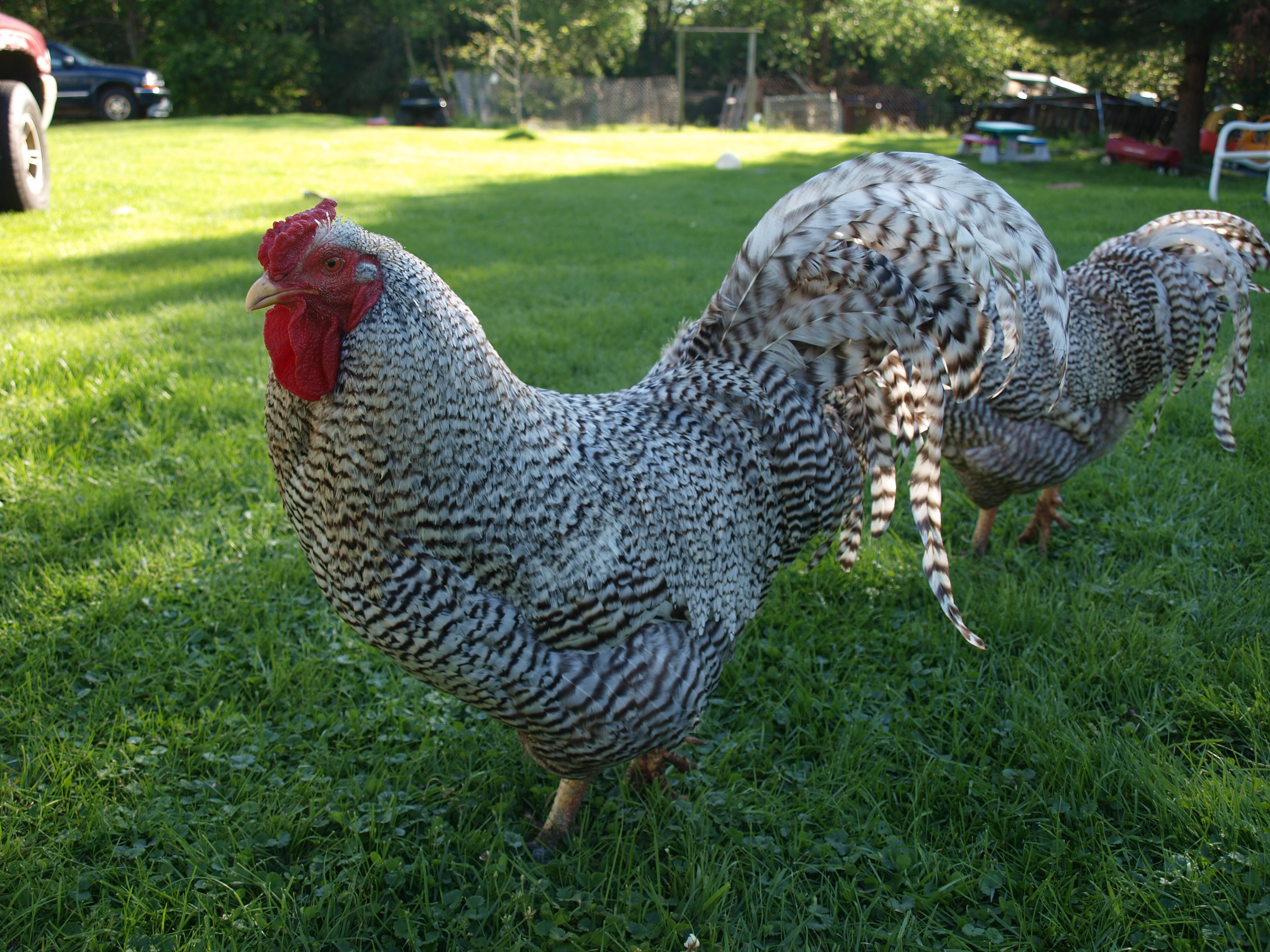
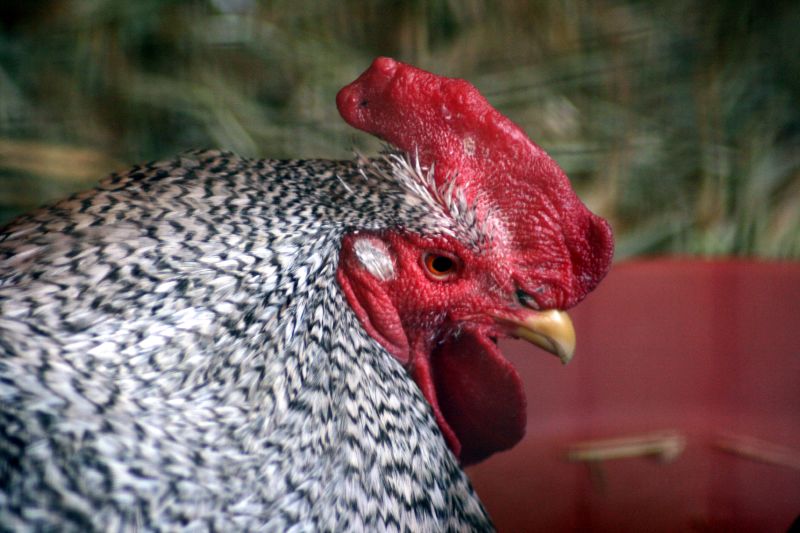
The Dominique's "rose" comb is small enough to minimize risk of frostbite.

Comb (the fleshy thing on top of the chicken's head): Small to medium rose comb - bright red
Wattles (the fleshy thing hanging from the chicken's chin): Small to medium wattles - bright red
Earlobes (the fleshy thing just below and behind the chicken's eyes): Medium-sized, oblong - bright red

Beak: Yellow
Eyes: Deep red
Shanks: Yellow
Toes: Yellow

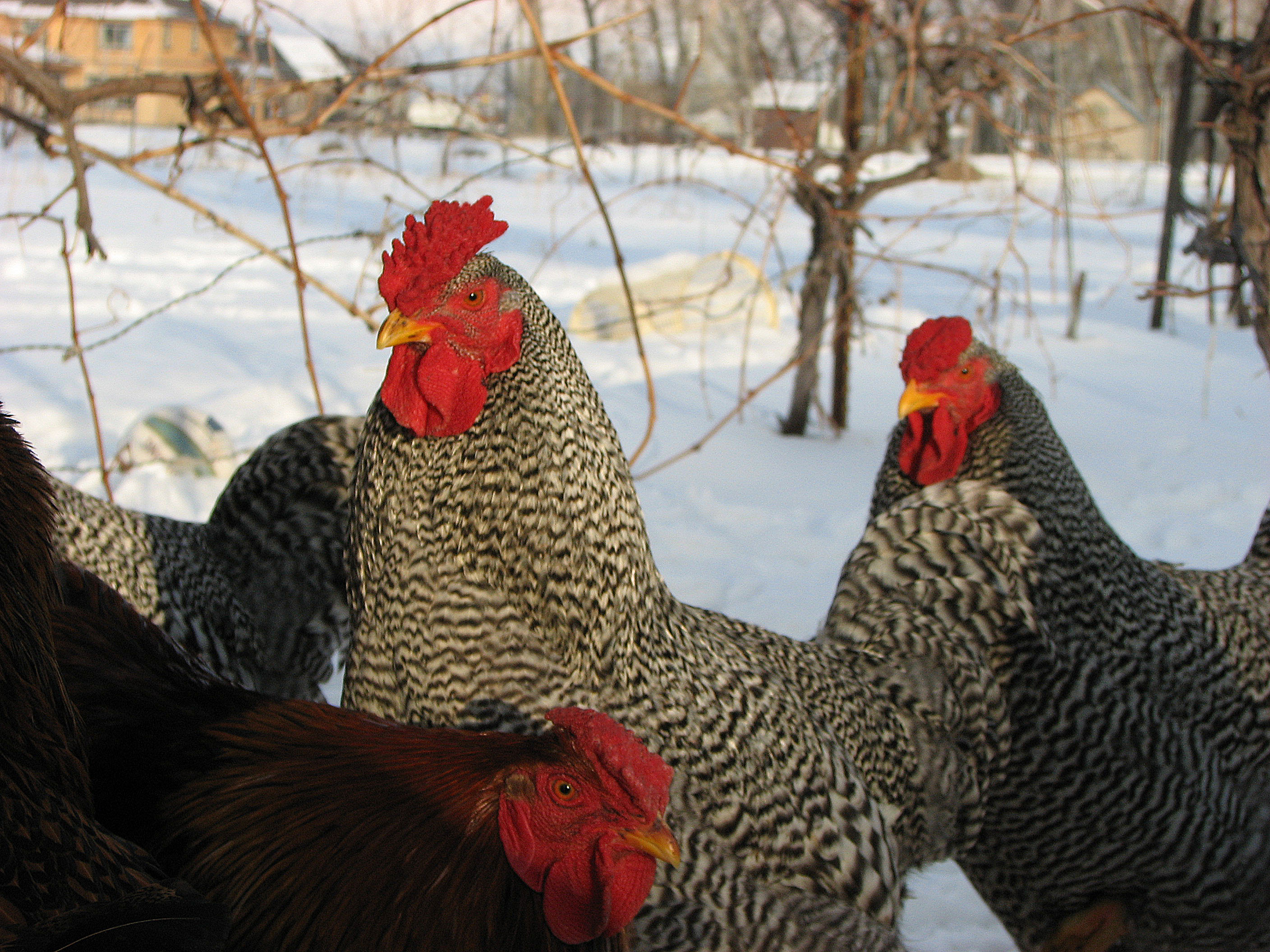
The black and white barred feather pattern, also known as "hawk coloring".

Feathers: Barred black and white (really they are dark gray over off-white)
Eggs: Small-Medium. Brown eggs. 230-275 eggs per year.

The Dominique was once the country's primary backyard chicken.

History
It is the first truly American breed of chicken, although the exact origin is unknown. Likely it was primarily European stock that formed the original breeding stock, and over time there was likely some Asian breeds mixed in as well. The Dominique was the primary barnyard chicken in the U.S. for about a century (1830-1930's), until it was replaced by the Barred Plymouth Rock breed. By the 1950's, it was thought that they Dominique was extinct; however, there were a few breeders out there who kept the breed alive. A full scale restoration took place in the 1970's with only four flocks, and today the breed is in a much safer position.

The name, Dominique, may have come from the French colony Saint-Domingue (a.k.a. Hati) which was a likely source for some of the original breeding stock.

The Dominique's mild manner is just one of its great attributes.

Attributes/Permaculture Planning
  • Very hardy birds
  • Range well
  • Tolerates confinement (but I don't recommend that for any animal!)
  • Great forager
  • Good egg producer
  • Broody tendency (means that the hen will want to hatch the eggs she lays - this is a great attribute when we are trying to improve our stock in a breeding program... who wants a mother that abandons her eggs?)
  • Good mothers
  • Barred feather pattern provides protection from arial predators - camouflage!
  • Feathers used to be highly prized for stuffing pillows and mattresses
  • Young birds feather out and mature early - can produce eggs as early as six months
  • Hens are calm and friendly
  • Cocks can be aggressive - known to kill snakes, mink, even small cats... good protectors!

For more information on Dominique Chickens, check out the Dominique Club of America.

A Dominique cock.

*Note: While there are a number of breeds that have a Bantam (miniature) version in existence, I choose not to discuss them on this site. Most Bantam breeds are show-only birds, and would not be ideal birds for a homestead... and I am not interested in "pets" that take up resources instead of providing for me and my family. There is a lot of very good and helpful information on other sites if you are interested in Bantam breeds.


**APA = American Poultry Association. Founded in 1873, it is the oldest poultry organization in North America.


Wednesday, December 21, 2011

Book Review: Storey's Illustrated Guide to Poultry Breeds


I don't know what is the exact reason, maybe it is my love of animals, my love of agriculture, my interest in science, or just how I am, but I love animal guide books.  And a guide book on animals that can be used on a homestead?  I am captivated!

Carol Ekarius is yet another of my favorite agricultural authors.  She has written about a half-dozen books and quite a bit more articles that are featured in homesteading and small farm magazines.

In her Storey's Illustrated Guide to Poultry Breeds, she takes her passion and talent for writing on raising agricultural animals and has produced a very in-depth guide book on the common homestead poultry (chickens, ducks, geese, turkeys) as well as some brief information on the much less common poultry that may be raised (emus, guinea fowl, ostriches, partridges, peafowl, pheasants, quails, and swans).

The book is fairly exhaustive for breeds of common poultry that can be found in North America.  A few paragraphs, an informative fact box, and fantastic photos of each breed are included.  This is a great reference book if you plan on raising chickens, ducks, geese, or turkeys.  On top of that, Carol Ekarius is donating a portion of her proceeds for this book to the American Livestock Breeds Conservancy.  

I highly recommend this book!


Tuesday, December 6, 2011

Book Review: The Small-Scale Poultry Flock


This is hands-down the best book on raising chickens (and other poultry) that I have read... and I have read a lot.  For a long time, I have been trying to establish systems of raising chickens on permaculture principles - all theoretical of course, since I have yet had the chance to raise my own chickens, but I hope to remedy this within a year.

As is typically the case, whenever I come up with a brilliant concept, I end up finding a person who has not only come up with the brilliant concept, but has been doing if for years, and they have perfected it.  This is what Harvey Ussery has done.  He has once again reinforced my thoughts that I am on the right track with "all this permaculture stuff" (as everyone always tells me).  But he has also saved me a whole lot of time; I don't have to reinvent the wheel.

While not using the word "permaculture" very much, this book is all about modeling the natural biological systems of chickens to produce healthy eggs and meat in a stress-free environment.  Using the principles outlined in this book, we can almost eliminate all harmful chemicals, unnatural activities, and poor health from our home poultry flock.  These principles can and have been expanded to large, commercial-sized flocks as well.

I cannot recommend this book enough.  If you plan on having chickens or waterfowl at your home, homestead, or farm, then I feel that this book is a must have.

For an even stronger endorsement, Joel Salatin wrote the foreword!

From the publisher:

The most comprehensive guide to date on raising all-natural poultry for the small-scale farmer, homesteader, and professional grower. The Small-Scale Poultry Flock offers a practical and integrative model for working with chickens and other domestic fowl, based entirely on natural systems.


Readers will find information on growing (and sourcing) feed on a small scale, brooding (and breeding) at home, and using poultry as insect and weed managers in the garden and orchard. Ussery's model presents an entirely sustainable system that can be adapted and utilized in a variety of scales, and will prove invaluable for beginner homesteaders, growers looking to incorporate poultry into their farm, or poultry farmers seeking to close their loop. Ussery offers extensive information on:

  • The definition of an integrated poultry flock (imitation of natural systems, integrating patterns, and closing the circle)
  • Everything you need to know about your basic chicken (including distinctive points about anatomy and behavior that are critical to management)
  • Extended information on poultry health and holistic health care, with a focus on prevention
  • Planning your flock (flock size, choosing breeds, fowl useful for egg vs. meat production, sourcing stock)
  • How to breed and brood the flock (including breeding for genetic conservation), including the most complete guide to working with broody hens available anywhere
  • Making and mixing your own feed (with tips on equipment, storage, basic ingredients, technique, grinding and mixing)
  • Providing more of the flock's feed from sources grown or self-foraged on the homestead or farm, including production of live protein feeds using earthworms and soldier grubs
  • Using poultry to increase soil fertility, control crop damaging insects, and to make compost-including systems for pasturing and for tillage of cover crops and weeds
  • Recipes for great egg and poultry dishes (including Ussery's famous chicken stock!)
  • And one of the best step-by-step poultry butchering guides available, complete with extensive illustrative photos.

No other book on raising poultry takes an entirely whole-systems approach, or discusses producing homegrown feed and breeding in such detail. This is a truly invaluable guide that will lead farmers and homesteaders into a new world of self-reliance and enjoyment.


Here are some great interviews with the author, Harvey Ussery.

Harvey Ussery on Integrated Systems

Harvey Ussery on Natural Feeds

Harvey Ussery on Nests


Tuesday, November 15, 2011

Permaculture Tips: Diatomaceous Earth and Chicken Parasites

The Red Chicken Mite

If you keep chickens, then you know about keeping a dust box or dust pile available for them.  Chickens coat themselves with fine dust to help rid their bodies of exoparasites (i.e. external parasites: lice, mites, etc.)  The dust creates an inhospitable environment for these pests.

If you add a handful of diatomaceous earth to the dust box every once in a while, it will make the dust significantly more effective.  (You can read more about diatomaceous earth in my previous post.)

This is a very easy technique that keeps your chickens more healthy and more happy.

Happy chickens taking turns in the dust!

A Permaculture Tip is an idea that is derived from observing and interacting with nature.  It is simple.  It is safe.  It is effective.  It helps build a sustainable system of agriculture.  If you have any Permaculture Tips you would like to share, please let me know.  I will post it here, give you the credit, and post a link to your blog or website if you have one.  Email me here: kitsteiner@hotmail.com