Showing posts with label Ladybugs. Show all posts

Monday, October 3, 2011

Permaculture Tips: Duct Tape Cure for Ants/Aphids in Fruit Trees

A Permaculture Tip is an idea that is derived from observing and interacting with nature.  It is simple.  It is safe.  It is effective.  It helps build a sustainable system of agriculture.  If you have any Permaculture Tips you would like to share, please let me know.  I will post it here, give you the credit, and post a link to your blog or website if you have one.  Email me here: kitsteiner@hotmail.com

Ant "harvesting" sugar from an aphid.

The idea for this great tip comes from Steve Sysko in the Sept/Oct issue of Countryside and Small Stock Journal:

Ants climbing in and around your plants are common.  Most of the time, this is not a bad thing at all.  Sometimes, this can even be a good thing.

I recently heard of how one gardener believes that the black ants in his garden have taken care of his squash vine borer pests.  In his previous gardens in another part of the U.S., he had a lot of damage from squash vine borers, and he knew the telltale signs of infestation and damage.  However, upon moving to his new location and starting a garden, he has not had this issue. He has seen the characteristic burrow in the base of the vine, but the burrow was shallow and had black ants going in and out.  His thought is that these black ants find, kill, and eat the young larvae before it does any damage.  Hard to know if that is true, but if it is, this is pretty amazing.

However, you need to pay attention when you see ants climbing around on your fruit trees.  A few here and there are no problem, but if you see a lot, you may need to be concerned.  Check closely at the shoots and small leaves for aphids.

Ant defending his aphid herd from a ladybug.

Ants and aphids can develop a symbiotic relationship.  The aphids excrete a sweet substance that the ants eat, and the ants will protect the aphids from predators.  It is almost like a bunch of dairymen caring and protecting their herds of dairy cattle.

If this is happening in your fruit trees, significant reduction in growth and fruit yield can result.  If you can stop the ants from protecting the aphids, which love to eat your fruit trees, then this allows the natural predators (ladybugs, lacewings, etc.) to kill the aphids.

How can you do this without chemicals, toxins, and poisons?  Duct Tape!

Wrap the base of the tree (about 3-4 feet off the ground) with duct tape, sticky side out, for about 8-10 inches in height.  You may need to change the duct tape every few days if either the duct tape dries out (and becomes less sticky), or if the ants that get stuck create a living bridge for the remaining ants to cross over.  Steve comments that it is easier to place another layer of duct tape over the previous one instead of removing the first and adding the second.  Eventually, the ants give up and move elsewhere.  If you had ant and aphid issues previously, you can set up duct tape protection on your trees in the spring before the ants emerge.  This prevents them from getting established, and hopefully does that same with your aphids.  Steve comments that after doing this for a few seasons, the ants never returned.

I love this idea!  A great Permaculture Tip!

Saturday, May 14, 2011

Beneficial Insects: Ladybugs

Ladybug Eating an Aphid

Ladybugs
aka Ladybirds (if you are in most English speaking areas of the world other than the U.S.),
aka Lady Beetles
aka Ladybird Beetles

Latin Name: Coccinellidea species  (Over 5,000 species in the world.  Over 450 in North America)

Why are they beneficial?
Adults and larvae feed on soft-bodied pests, mites, and pest eggs.
They LOVE aphids!
A larvae will eat about 400 aphid prior to pupating.
An Adult can consume over 5,000 aphids in it lifetime.

What is their life cycle?
The female will lay her eggs in a cluster on a plant leaf or stem.
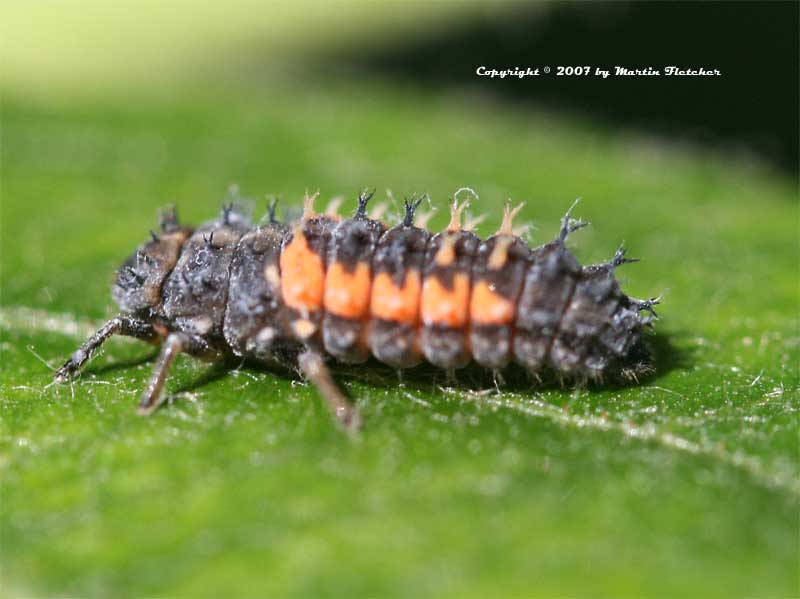
In about a week, the eggs hatch into larvae (they look like little alligators).
The larvae go through four stages (instars) as they mature and grow.
In about a month, the larvae pupate (go into a cocoon-like stage).
In another week, the adults emerge.

What do they look like?
This is important.  Most people only know what the adult looks like.  Here is what to look for in all stages of the life cycle.

Ladybug Laying Eggs

Ladybug Eggs on a Leaf

Ladybug Eggs and Head of a Match (for size)

Newly Hatched Ladybug Larvae

Ladybug Larvae
Note that every species is very similar, but may have slightly different patterns and colors to this one.

Ladybug Pupa
Note that each species has slightly different colors and spot patterns, but they are all basically the same shape.

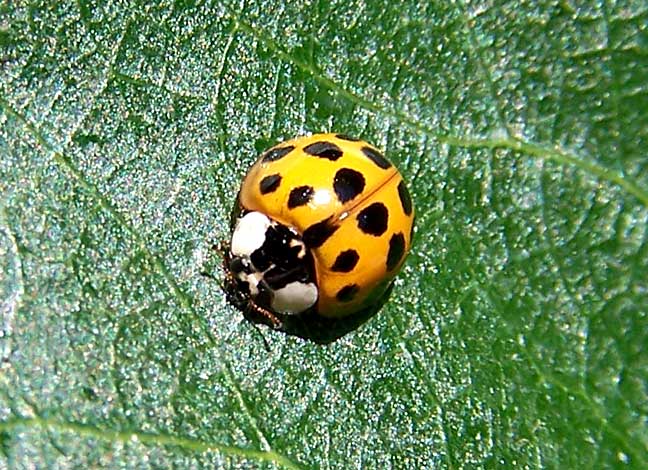
Adult Ladybug

Adult Ladybug

Adult Ladybug
Note that colors and spots may be different with different species, but size and shape are about the same.

This is a great series of images of the life cycle of a Ladybug.

What do they need?
Prey: aphids, mites, soft-bodied insects, and insect eggs
Food: Ladybugs also need nectar and pollen from flowers that have shallow clusters or are umbrella shaped (basket of gold, buckwheat, butterfly weed, carpet bugleweed, chamomile, chervil, chives, clover, cornflower, cosmos, coreopsis, cinquefoil, coriander, dandelion, dill, fennel, four-wing saltbush, golden marguerite, marigold, mustard, parsley, queen anne's lace, scented geraniums, spike speedwell, sunflowers, tansy, vetch, wild carrot, yarrow).
Ladybugs need places to overwinter - loose mulch, leaf litter, under rocks, etc.

NOTE:  The "Asian Lady Beetle", that one that seems to come in swarms inside your house in the fall, is still a beneficial insect for your garden, but it can give a little bite (not poisonous), and can stain skin and other surfaces with its yellowish, foul smelling defense secretion.  Just try to relocate them to your garden.

Check out these other pages on beneficial insects in your garden!
Bees
Lacewings
Ladybugs
Praying Mantis
Trichogramma Wasps