Showing posts with label Perennial Vegetables. Show all posts

Tuesday, March 5, 2013

Permaculture Tip: Perennializing Annual Vegetables - Leeks

The leek is an "annual" vegetable that we may be able to make perennial.

Leeks are one of my favorite vegetables. They are kind of like a mix between an onion and garlic in flavor, a mix of onion and scallion and shallot in use, and a mix of scallion and maybe cabbage in texture. They offer a great flavor addition to many dishes, and I use them quite a bit.

Leeks are biennial plants. This means that they will grow for a full season, winter over, and then flower the next season. Leeks can be harvested whenever you want them. When younger, they are more tender and can be used a bit more like a shallot. When they are older, the leaves are a bit tougher, and they can be used like large onions or almost like cabbage.

I have bought leeks from the grocery store that still had a bit of the roots left on them. I chopped the lower 2-3 inches off (10-15 cm) and let it sit in a jar of water for a few days, then I planted them in the garden. Be warned that this water starts to stink very quickly. I actually do not think this step is necessary, but I have always been too busy to plant them right away. I know it will be a day or two before I will go outside and take the time (okay, it is about one minute!) to plant them, so I stick them in the water. I have left the leek "bulbs" in the water for up to a week. Within a few weeks of planting them in the soil, there are new shoots growing from the center.

This is also a great way to short-cut planting leeks from seeds.

My thought was that this technique could be indefinitely perpetuated. However, I have not lived in a place long enough to test this theory more than a two seasons. But then I listened to an old Permaculture course taught by Bill Mollison, the founder of Permaculture. He had a recommendation that cut out a few of my steps. When a leek is ready to be harvested, instead of pulling the whole plant out, just cut it off at ground level. Then let the plant keep on growing... just as if you harvested it and then replanted the root end.

Perennial Leeks! Fantastic!

If you live in an area that freezes, you can overwinter the leeks by covering them with straw or grass clippings, then in Spring just uncover the mulch. The only concern is that after overwintering, the leek may bolt sooner, but you may be able to stop it by cutting off the flower stalk before it grows too large. I need to experiment with this. I will let you know what I find. If you have done this, please let us know!

A Permaculture Tip is an idea that is derived from observing and interacting with nature.  It is simple.  It is safe.  It is effective.  It helps build a sustainable system of agriculture and life in general.  If you have any Permaculture Tips you would like to share, please let me know.  I will post it here, give you the credit, and post a link to your blog or website if you have one.  Email me here: kitsteiner@hotmail.com


Thursday, October 20, 2011

Permaculture Plants: Malabar Spinach

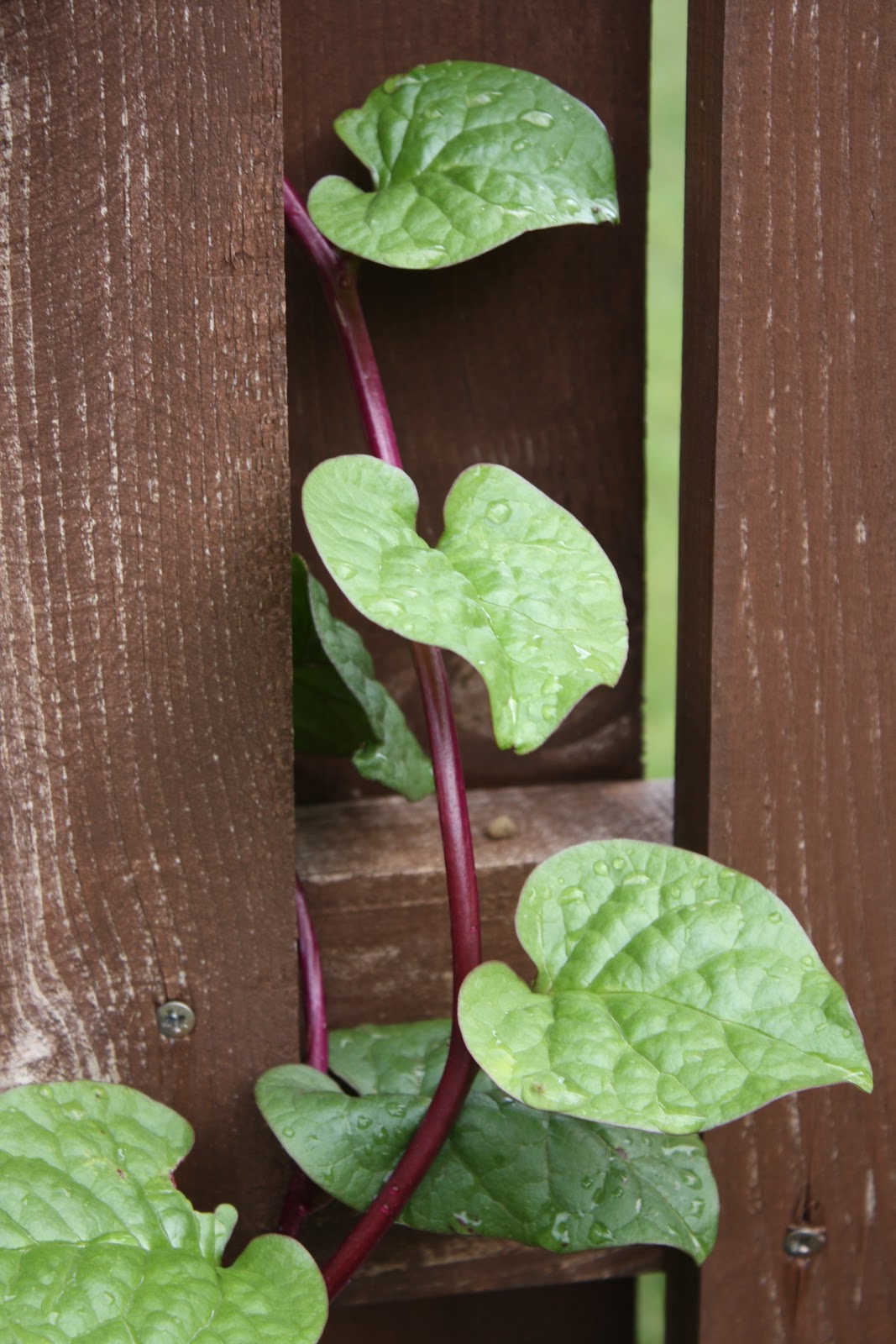
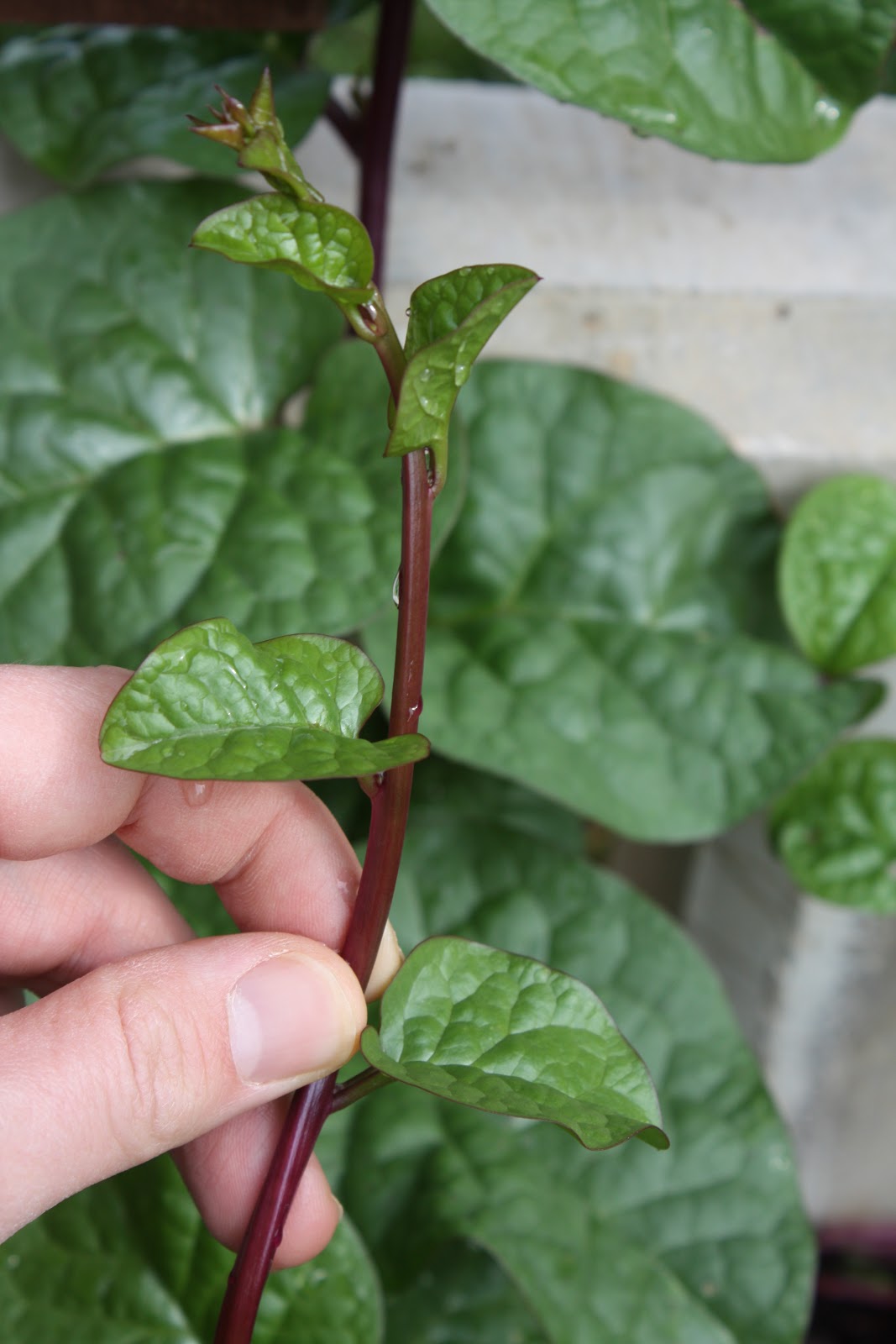
Photos of my Malabar Spinach

Common Name: Malabar Spinach
Scientific Name: Basella alba, Basella rubra
Family: Basellaceae

The tender leaves and shoots of Malabar Spinach are great fresh!

Description:
Malabar spinach is not actually related to spinach at all.  It is a heat-loving, vining, perennial plant with heart-shaped leaves from the tropics and sub-tropics.  It is often grown in more Temperate Climates as a heat-loving annual substitute for spinach.  It is considered a succulent (a plant that stores water in their leaves and stems), and it is used much like spinach, although I believe the taste is not very similar when raw.  Although when cooked, it does indeed taste like spinach.

It is said that Malabar Spinach has a mucilaginous texture.  This has a lot of negative connotations.  I think a better word is "slippery".  It actually has a very pleasant mouth feel to it.  I would describe it as crunchy and juicy when raw.  The taste is slightly peppery with a bit of a citrusy flavor with hints of earthy spinach to it.  Apparently, the red stemmed version (Basella rubra) is more mild in flavor than the green (Basella alba).  I have only grown and tasted Basella rubra, so I cannot speak from experience on the all green version.  As I said above, once cooked, it tastes much like spinach, maybe a little stronger.

History:
The name, Malabar, likely refers to the northern areas of Kerala state in India.  This at least is fitting, since it is thought that Malabar Spinach originated in India (although some research suggests Indonesia).  It is a very popular green vegetable in India, Southeast Asia, China, and Africa.

Trivia:
  • This is a great salad green replacement when the temperatures soar in the summer and our lettuces are wilting and ready to bolt.
  • Malabar Spinach is very high in vitamins A and C.
  • Malabar Spinach is high in calcium and iron.


Malabar Spinach using my fig tree as a trellis.

USING THIS PLANT
Primary Uses:
  • Fresh - Young leaves and the top 5-8 inches of shoots can be eaten raw.  Used in salads.
  • Cooked - Older leaves should be cooked as they have a rougher texture.  It is more like spinach in look and flavor when cooked.  It holds its shape a lot better than spinach when it is cooked.  Can be substituted for cooked spinach or chard.


Secondary Uses:
  • Thickening agent.  Here is where the "mucilaginous" part of Malabar Spinach is very helpful, kind of like okra, in soups, stews, and curries.
  • The red-purple juice from the berries can be used a a food dye and ink - it will stain!


Yield: Higher with more heat and with more pinching off of shoots and flowers
Harvesting: Whenever you want!  
Storage: Should be used immediately.  Does not seem to store well for more than a few days after picked.

The deep red vines and pink flowers contrast beautifully with the dark green leaves.

DESIGNING WITH THIS PLANT
USDA Hardiness Zone: Killed by frost, although some report established plants can withstand 5 F (-14 C).

Plant Type: Vine
Leaf Type: Deciduous 
Forest Garden Use: Fast growing, heat loving annual vine in Temperate Climates.  Perennial vine in Sub-Tropical, Tropical Climates, heated greenhouses, or possibly as a potted indoor plant.  
Cultivars/Varieties: Basella alba is all green.  Basella rubra has red stems, is prettier, and is likely just a variety of Basella alba.
Flowering: Mid-Summer

Malabar Spinach is a fast growing vine.

PHYSICAL CHARACTERISTICS OF THIS PLANT
Size: 5-6 feet in a summer, easily.  Up to 12 feet in a long summer, and some report up to 30 feet if grown as a perennial.
Growth Rate: Fast if there is heat.  Large plant in 8-10 weeks.

Older leaves are a great cooked spinach or chard substitute.


GROWING CONDITIONS FOR THIS PLANT
Light: Prefers full sun
Shade: Tolerates light shade (about 50%), but grows much slower
Moisture: Medium
pH: Prefers fairly neutral soil (6.1 - 7.8)

Special Considerations for Growing: 
Give it something to grow on (trellis or tree) and your yields will be higher, easier, and free from dirt.

Propagation:  Pretty easily grown from seed.  Some will recommend soaking the seed in water overnight to improve germination rates, but I have not found that to be necessary.  Seems to prefer direct seeding when temperatures remain above 60 F (15 C), but I have transplanted with success.  Seeds can be saved from ripened fruit (small dark purple berries) - clean and dry the seeds.  Malabar Spinach is also easily grown from cuttings as it roots easily.

Maintenance:
Minimal.  Cut back severely to keep it in check if you live in a frost-free zone.  If there are no nematodes, then this plant has almost no pests.

Concerns:
  • If you live in a frost-free area, this vine can grow like crazy.  Some may call it invasive.
  • Reportedly susceptible to nematodes.
  • Reportedly susceptible to a fungus that destroys the leaves and can infect beets and chard as well.

Saturday, July 30, 2011

Book Review: Perennial Vegetables


Perennial Vegetables 
by Eric Toensmeier

First, let me define Perennial Vegetables (based on the definition from the book).  Perennial here means any plant that lives for at least 3 years and is not killed by the harvest.  Plants include herbaceous species as well as trees, shrubs, bulbs, cacti, bamboos, grasses, and vines.  These plants are used in a way the common person would consider as a vegetable.  The author did not include "novelty" plants or herbs for flavoring but only plants that can be considered a real food source.

I have some real likes and dislikes about this book.

I'll start with what I don't like.  This book outlines 100 perennial vegetables for United States gardeners.  However, unless you live in the far south of the U.S., only about a third of these plants will be truly perennial for you.  All the others will need to be grown as annuals.  So, in a sense, this book doesn't deliver as well as the marketing would have you believe.  However, I do think the main reason for this is that there are just not that many Temperate Climate perennial vegetables.

With that said, over 30 plants (other than asparagus) that can be grown as perennial vegetables is outstanding!  The other two-thirds of the plants that can be grown as annuals are also great. There is good information on the growing of these plants along with how to use them in your kitchen.

In Permaculture, diversity is one of the keys to success.  The addition of many of these plants will provide increased diversity to your garden and your table.  While I was hoping for a bit more, this book is really the first of its kind and a good read at that.

Here are a couple of the plants highlighted that really piqued my interest.  You may have heard of some of them before, but most people do not know you can grow them in your garden or Forest Garden.

Skirret (Sium sisarum)
Root Crop
Similar to a carrot, but you can harvest some of the roots and the plant keeps growing.

Turkish Rocket (Bunias orientalis) - this is not arugula!
Fresh/cooked greens, flowerbuds (like broccoli raab)
I've had this while in Turkey, and it has a strong flavor

Sea Kale (Crambe maritima)
Shoots, leaves, flowerbuds

Ramps (Allium tricoccum)
Greens
An Appalachian favorite.

Japanese Yams (Dioscorea japonica)
Tubers, shoots (like asparagus)
This plant has small arial tubers that are edible, too!

Ostrich Fern (Matteuccia struthiopteris)
Shoots (called "fiddleheads)
A New England forager's delicacy.