Showing posts with label Greens. Show all posts

Monday, November 26, 2012

Permaculture Plants: Chicory

Chicory is a plant with many faces.

Common Name: Common Chicory
Scientific Name: Cichorium intybus
Family: Asteraceae (the Aster, Daisy, or Sunflower family)

The "wild" Chicory is an unassuming plant and a great addition to the Forest Garden.

Belgian Endive is just one of many forms of Chicory.

Description:
In a similar way that Great Danes and Chihuahuas are very different forms of the same species (Canis lupus familiaris) the Chicory plant (Cichorium intybus) has been developed for a variety of uses. It may be a leaf vegetable in green, red/purple, or white/yellow that comes in a head or a dandelion-like leaf, a root crop used as a coffee substitute, and a forage plant for pasturing animals. It is a pioneer plant, a beneficial insect attractor, and helps build the soil. There is not much more we can ask from one plant!

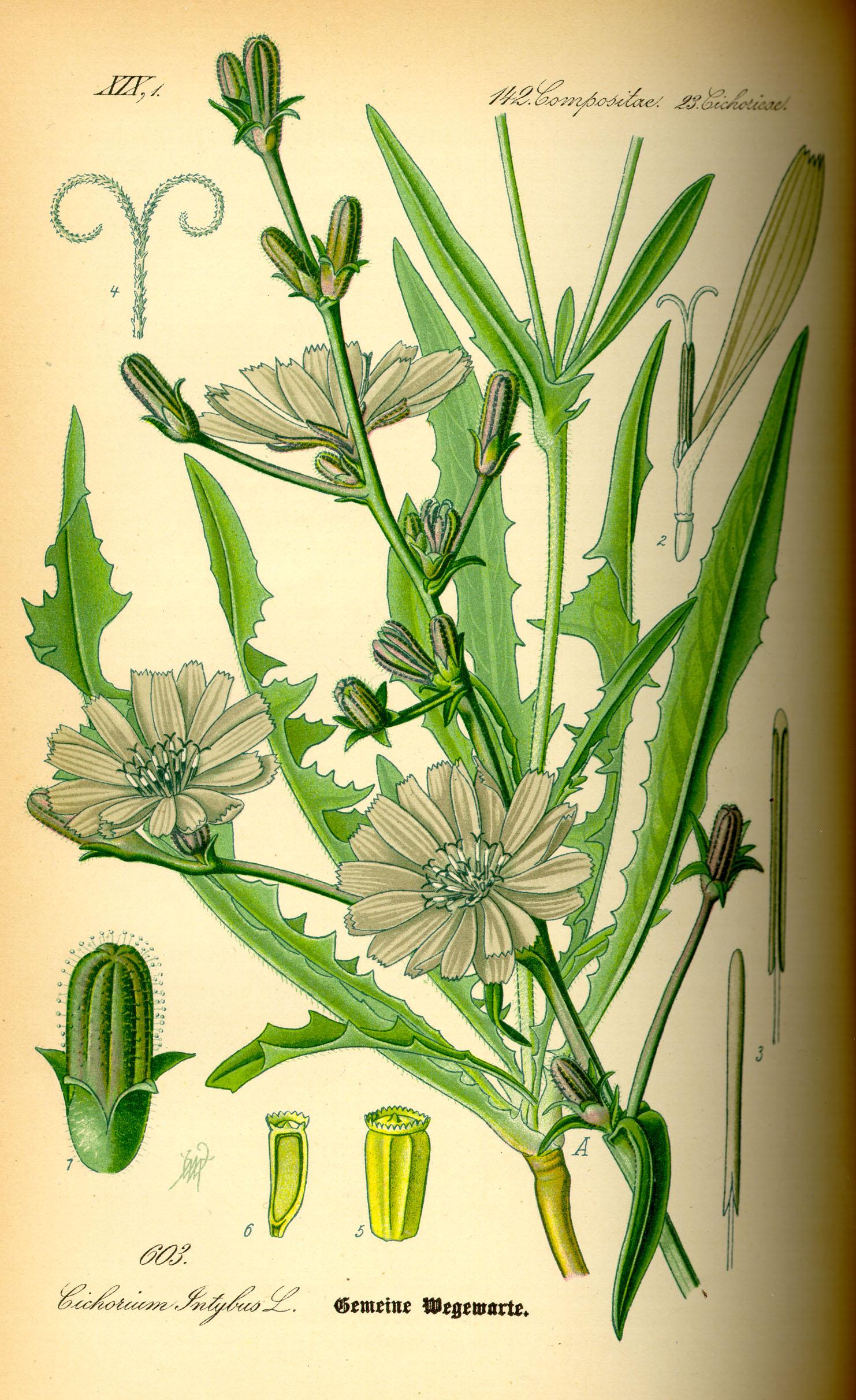
Cichorium intybus

History:
Well known throughout recorded history, the Chicory plant was prevalent through ancient Egypt, Greece, and Rome. Over the years, it has spread and naturalized over the world. There is likely a variety well suited to almost all but the most extreme locations on Earth.

Trivia:
  • The Common Chicory (Cichorium intybus) has many varieties of leaf vegetable including Radicchio, Sugarloaf, Belgian Endive (aka French Endive or Witlof).
  • True Endive (Cichorium endive) is a closely related plant, but is a separate species.
  • Root Chicory (Cichorium intybus var. sativum) is a variety of Common Chicory cultivated for its root which is used as a coffee substitute.
  • Some forms of Chicory will form heads, but these are usually annual or biennial varieties and not perennial species.
  • Some perennial species of Chicory will form a head in the first year, but after that the plant ceases to form tight heads.
  • The tight heads of Chicory are called "chicons".

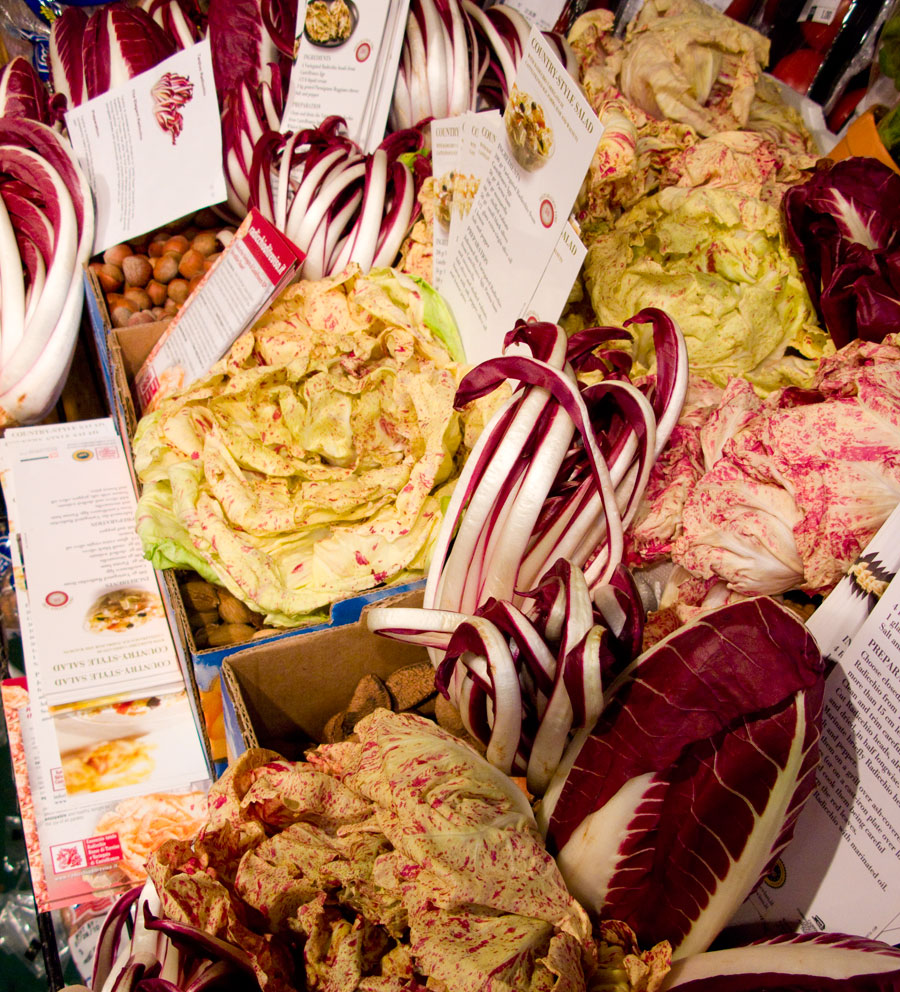
Radicchio, a type of Chicory, comes in many varieties.

Grilled Radicchio (here with goat cheese and balsamic vinegar) is one of my favorites!

USING THIS PLANT
Primary Uses:
  • Edible Greens – some varieties are developed for commercial production of salad leaves; a great, bitter, nutty-tasting leaf – perfect addition to mixed green salads; leaves can be cooked as any other green (just don't cook too long), and this reduces the bitterness. 
  • Edible Roots – roasted, ground, and used as a coffee substitute

Secondary Uses:
  • General insect (especially bees) nectar and pollen plant
  • Insect shelter plant (especially hover flies, spiders, and parasitic wasps)
  • Dynamic Accumulator – Especially potassium and calcium
  • Pioneer Species
  • Dye Plant - blue-ish dye from the leaves
  • Pasture/Forage Species for ruminant animals

Yield: Not applicable
Harvesting: Year round. Greens are most tender and less bitter before flowering (Spring), but can be harvest through the growing season. The roots are best harvested Autumn through Winter.
Storage: Use fresh, may be stored as lettuce for up to a week. While there is no reliable information on storage of roots, I would imagine that roasted roots should last for some time before needing to be ground for coffee, although the flavor likely diminishes with time.

Chicory flowers are typically blue, but white and pink are possible.

Chicory flowers attract many beneficial insects like this Hoverfly.

DESIGNING WITH THIS PLANT
USDA Hardiness Zone: 3-9
AHS Heat Zone: 9-1
Chill Requirement: Not likely, but no reliable information available.

Plant Type: Small to Medium-sized Herbaceous Perennial
Leaf Type: Deciduous
Forest Garden Use: Herbaceous Layer
Cultivars/Varieties: Many varieties available.

Pollination: Self-Pollinating/Self-Fertile. Also pollinated by bees.
Flowering: April - October (varies tremendously on the variety and zone)

Life Span:
No reliable information available, but as this plant self-seeds so easily, life span for an individual plant is not very relevant. Keep a patch healthy, and we’ll always have some available.

The roots of some Chicory (Cichorium intybus var. sativum) are grown as a coffee substitute.

The "wild" Chicory leaf strongly resembles the Dandelion.

PHYSICAL CHARACTERISTICS OF THIS PLANT
Size: 1-4 feet (30-120 centimeters) tall and 1-2 feet (30-60 centimeters) wide; not typically very small, but the flower spike can climb to 4 feet (120 cm).
Roots: Tuberous
Growth Rate: Fast

Some Chicory, like Puna II picture here, are used for animals on forage.

GROWING CONDITIONS FOR THIS PLANT
Light: Prefers full sun
Shade: Tolerates light to moderate shade
Moisture: Medium moisture requirements
pH: tolerates a wide variety of soils (4.5-8.5)

Special Considerations for Growing:
Consider cutting back the flower stalks to extend the harvest of greens.

Propagation:  
Typically from seed. Self-seeds easily.  Large plants may be divided.

Maintenance:
Almost none. Consider cutting back the seed heads if you don’t want seedlings to spread. Although, this is a plus in a Forest Garden almost all the time.

Concerns:
Spreads easily through self-sowing of seed.

Tuesday, October 23, 2012

Permaculture Plants: Horseradish


Horseradish - a root that yields strong opinions... I love it!

Common Name: Horseradish
Scientific Name: Amoracia rusticana
Family: Brassicaceae (the Mustard and Broccoli family)


A well tended Horseradish patch

Description:
Horseradish is a fairly well known condiment with its spicy, sinus-clearing, pungent flavor. This plant, with its famous roots, also has edible leaves, confuses garden pests with its scent, and can be grown in almost any location. A perfect plant for the Edible Food Forest.


"Horseradish, plate 415 from 'A Curious Herbal'" oil on Canvas


History:
Likely originating from southeastern Europe and western Asia, horseradish was popular with the ancient Greeks, Egyptians, and Romans. It was popular during medieval times in Europe and Britain as a food and medicine. European colonists brought horseradish to North America. Today it is used all over the world.


Trivia:

  • Whole Horseradish roots have almost no aroma, but once the root’s cells are ruptured (from cutting or grating), the enzymes released will convert the naturally produced root compound sinigrin into the highly aromatic allyl isothiocyanate (a.k.a. mustard oil).
  • The English name “Horseradish” likely came about through ignorance. The German name for this plant is meerrettich (meer = sea; rettich = radish). At some point this was mistakenly called mahrrettich (mahr = mare (female horse); rettich = radish). It is not a far leap for someone to mistakenly translate the mare radish to horse radish.


Processing Horseradish requires a well-ventilated location!

USING THIS PLANT
Primary Uses:

  • Roots – typically grated raw and mixed with vinegar; may be sliced and cooked like other tubers or carrots/parsnips; can be dried, then ground to a powder, but it is not as strongly flavored as fresh.
  • Leaves – “Horseradish Greens” are edible, and reportedly have a horseradish flavor. I’ve never tried them, but I think they could be used raw in small amounts in a mixed green salad or used cooked as a spinach replacement. Also used in pickling cucumbers to keep the cucumbers crunchy (as are grape leaves).


Secondary Uses:


Yield: Variable, but roots can grow to over 20 inches (50 cm) long and 2 inches (5 cm) thick.

Harvesting:

  • Leaves – smaller, new growth ideal for salads; older growth best cooked.
  • Roots – As desired. The plant grows the most during late Summer and early Autumn, so waiting until just before the ground freezes (depending on your location) will give you the maximum yield. Alternatively, you can harvest in the Spring. Dig a hole or trench 12-24 inches (30-60 cm) deep along the plant, then from the opposite side dig the roots back to the hole. Grab the base of the greens and pull the roots out laterally toward the hole. Use the largest taproots for processing, and use the smaller roots for Spring planting stock if harvested in Autumn or immediately if harvested in Spring. NOTE – Horseradish roots older than 2 years can get stringy and woody. In a Forest Garden, we can harvest in the Spring and replant smaller roots immediately, or we can leave a patch of horseradish growing and harvest from the outer ring or just toss the woody roots in the compost bin or in the forest to compost in place.


Prepared Horseradish, grated with vinegar and salt

Processing:

  • Leaves – use as any other green
  • Roots – peel the brown “skin” off the root; roughly chop; add to a food processor or blender with a little bit of water or you can use a simple vegetable grater or food grinder (whatever way you choose, do so where you have a breeze to blow the fumes away!); add a tablespoon of white vinegar (white wine or distilled vinegar) and a pinch of salt for every 10 inches (25 cm) of root (or 2-3 tablespoons vinegar and ¼ - ½ teaspoon salt per each 1 cup grated horseradish). Vinegar stops the enzymes from converting the sinigrin to the hot mustard oil, so add vinegar immediately after grating for mild and wait for about 3 minutes for hot horseradish.


Storage:

  • Leaves – use immediately
  • Roots – Use immediately for best flavor. Can be stored in dry sand for a few months (a cooler location will keep for longer – ideally under 40 F (4 C) but above freezing); this dry sand storage is a great place to put Spring planting stock. If wrapped in plastic and placed in the coldest part of the refrigerator, it may stay good for a few months. Light will turn the roots green. Processed, refrigerated horseradish will last about a month.


Braised Horseradish Greens with Bacon

DESIGNING WITH THIS PLANT
USDA Hardiness Zone: 2-10 (although some sources are more conservative at 5-8)
AHS Heat Zone: 12-1
Chill Requirement: Not likely, but not good information available


Plant Type: Large Herbaceous Plant
Leaf Type: Deciduous
Forest Garden Use: Underground Layer, Herbaceous Layer
Cultivars/Varieties: There are only a few named cultivars.


Pollination: Self-fertile
Flowering: Late Spring to early Summer (May-June)


Life Span: No good information available as we typically harvest roots of plants less than 2 years old.


When Horseradish blooms, it attracts beneficial insects

PHYSICAL CHARACTERISTICS OF THIS PLANT
Size: 3 feet (0.9 meters) tall and as wide as you allow it to grow
Roots: Large taproots
Growth Rate: Fast


Horseradish can be grown in a wide variety of soils and locations

GROWING CONDITIONS FOR THIS PLANT
Light: Prefers full sun
Shade: Tolerates moderate shade
Moisture: Dry to moist soils, but prefers soil a bit more damp
pH: 5.1-8.5 (tolerates a wide range of soil conditions)


Special Considerations for Growing:
Reported to inhibit brown rot if planted under apple trees.


Propagation:
Typically from root cuttings or divisions in Spring; ideally at least 8 inches (20 cm) in length. Any root will likely grow to a new plant. Seed is not typically produced in plants grown in modern cultivation, but if a patch is allowed to mature, then seed will likely form. Seed is best sown in place.


Maintenance:

  • Minimal.
  • Root Rot can develop – just replant strong roots and compost the rest.
  • Some insects can cause extensive leaf damage in traditional gardens; this doesn’t affect the roots much and should be less of a problem in a Forest Garden.
  • A thorough digging and dividing of the roots every 3-4 years will keep a patch healthy, growing strong, and productive.


Concerns:

  • Poisonous – Reportedly, if one consumes a large amount of fresh roots the strong, volatile oils can be poisonous. This is not well researched, nor do I think people typically consume large amounts at any one time!
  • Spreading Habit – some sources state this plant can become invasive by spreading too fast, and other sources state that this rarely occurs.


Monday, October 1, 2012

Permaculture Plants: Plantain

Plantain is a weed I would welcome.
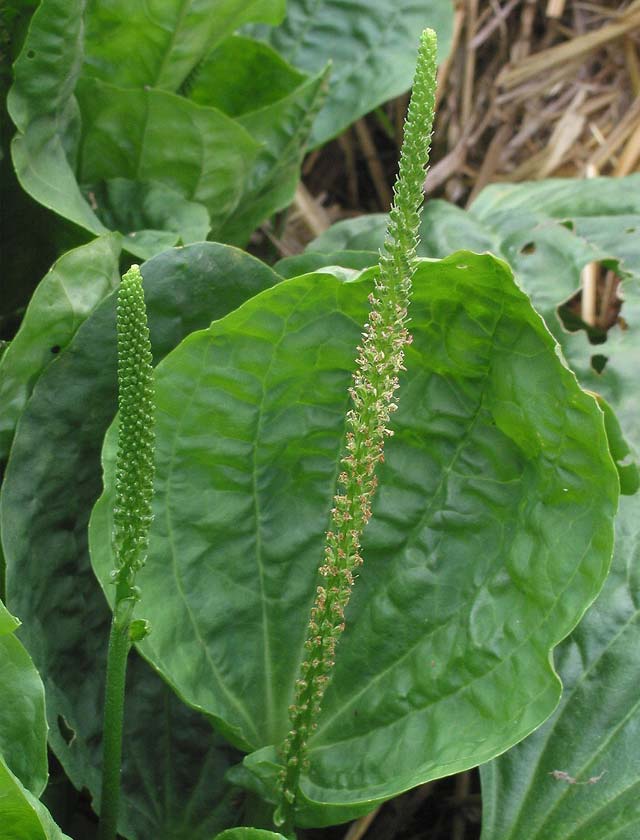
Common Plantain (Plantago major)

Common Name: Plantain
Scientific Name: Plantago species
Family: Plantaginaceae (the Plantain family)

Common Species:
  • Psyllium (Plantago afra)
  • Che Qian Zi (Plantago asiatica)
  • Buck’s-Horn Plantain (Plantago coronopus)
  • Ribwort/Buckhorn Plantain (Plantago lanceolata)
  • Common/Broadleaf/Greater Plantain (Plantago major)
  • Sea Plantain (Plantago maritima)
  • Hoary Plantain (Plantago media)
  • Blond Plantain (Plantago ovate)
  • Fleawort (Plantago psyllium)

Sea Plantain (Plantago maritima) is considered one of the best tasting Plantains
Description:
Plantain is considered a common lawn weed. However, it has been used for thousands of years as a medicinal plant (for inflammation, bleeding, and infections) as well as a potherb and salad green. It is also a great addition to the Forest Garden, as it attracts beneficial insects, is a dynamic mineral accumulator, is tolerant of drought, and is a great forage crop for animals.
History:
Native to Europe and Asia, and used for thousands of years as a medicinal (primarily) and food (secondarily) plant. It has spread easily, typically with accidental introduction of seeds, and found new homes around the world. It is seen as a lawn weed in most "modern" cultures, but is still used by traditional, or tradionally-minded, people as food and medicine.

Trivia:
  • Many of the Plantago species are used in the commercial preparation of dietary fiber supplements known as Psyllium.
  • Plantain, while originally from Europe, was introduced to North America with European settlers, hence the name “white man’s foot.”
The fibrous stands in Plantain can be removed before eating.
USING THIS PLANT
Primary Uses:
  • Edible Leaves – decent taste, but most species are fibrous unless strands removed first (young leaves are most tender), often blanched to make more tender. Most often used as flavor/nutrition addition to mixed salads (reportedly the best eating are Buck’s-Horn and Sea Plantain)
  • Edible Seeds – takes lots of time to harvest, but can be eaten raw or cooked or ground as flour addition. Considered a great fiber source.
  • Medicinal Species – long history as anti-bleeding and anti-swelling
Secondary Uses:
  • General insect (especially bees) nectar plant
  • Maritime Species
  • Drought-Tolerant Species
  • Wildlife food
  • Feed plant for domestic animals – chickens will eat the seeds (let them harvest themselves!) and greens sparingly
  • Dye Plant
  • Tea Plant – dried or fresh leaves

Yield: Not applicable/No good information available
Harvesting: Anytime there are green leaves on the plant. Seeds are harvested Summer-Autumn
Storage: Use leaves fresh or dry immediately. Seeds are used fresh or dried immediately.

Platain flowers attract numerous beneficial insects
Common Plantain (Plantago major)

DESIGNING WITH THIS PLANT
USDA Hardiness Zone: 2-15 (although some species are less cold tolerant)
Chill Requirement: Unlikely, but no reliable information available

Plant Type: Herbaceous perennial
Leaf Type: Deciduous
Forest Garden Use: Herbaceous Layer
Cultivars/Varieties: Many species available. Some have been improved as ornamentals.

Pollination: Self-Pollinating/Self-Fertile
Flowering: May-September

Life Span:
No good information, but likely irrelevant as Plantago species reseed on their own so easily... just ask any lawn-Nazi!

Ribwort/Buckhorn Plantain (Plantago lanceolata) has longer thinner leaves than Common Plantain (Plantago major)
PHYSICAL CHARACTERISTICS OF THIS PLANT
Size: 4-24 inches (10-60 centimeters) tall and wide – depending on the species
Roots: Many species have fibrous roots, but some (Plantago lanceolata) have a taproot
Growth Rate: Fast

Plantain seed heads harvested and ready for further processing... or feed like this to chickens!

GROWING CONDITIONS FOR THIS PLANT
Light: Prefers full sun
Shade: Does not tolerate much shade
Moisture: Medium to Wet soils
pH: can tolerate a wide range of soils

Special Considerations for Growing:
Plantago species are considered weeds because they can grow almost anywhere at anytime. This is a great problem to have, in my opinion; but neighbors with highly manicured lawns may not agree. Of course, I will never live that close to a neighbor again if I can help it!

Propagation: Typically by seed – direct sow in Spring. Can transplant “wild” specimens. Many locations already have their own populations; just encourage their growth.

Maintenance:
None

Concerns:
As with many "weed" species, Platain may cause an allergic reaction in some people (very few). Always try a new food in small amounts to see how you will react.


Another image of Common Plantain (Plantago major)

Thursday, December 1, 2011

Salad Greens

Some fresh salad clippings from my garden.

I love being able to go to my back porch and snip some greens for a salad.  This quick post is just an encouragement to go grow something.  One of the easiest things to do is to grow salad greens.  Just get a few flower pots or window boxes, fill them up with good potting soil and compost, and plant a mix of salad greens.  You can either buy a premixed packet of seeds or build your own.  Keep them well watered.  Before you know it, you'll have to snip out some of the tender leaves just so the other plants have room to grow.

I have about 8-10 different varieties of greens growing in two window boxes and two flower pots (seven of them are shown in the photo above).  At this time of year in my climate, in just this little space, I grow enough for a small side salad for me and my wife every night, one main salad for me every other day, or a main salad for both of us about once a week (maybe twice).  The variety of colors and textures is great.  The flavor is so much better than store bought.  I don't have to worry about what chemicals were sprayed on my food, because I grew it (... no chemicals by the way!).  And I get the satisfaction of producing my own food... even just this little bit.

So, what are you waiting for?  Get out and grow some food!


Thursday, October 20, 2011

Permaculture Plants: Malabar Spinach

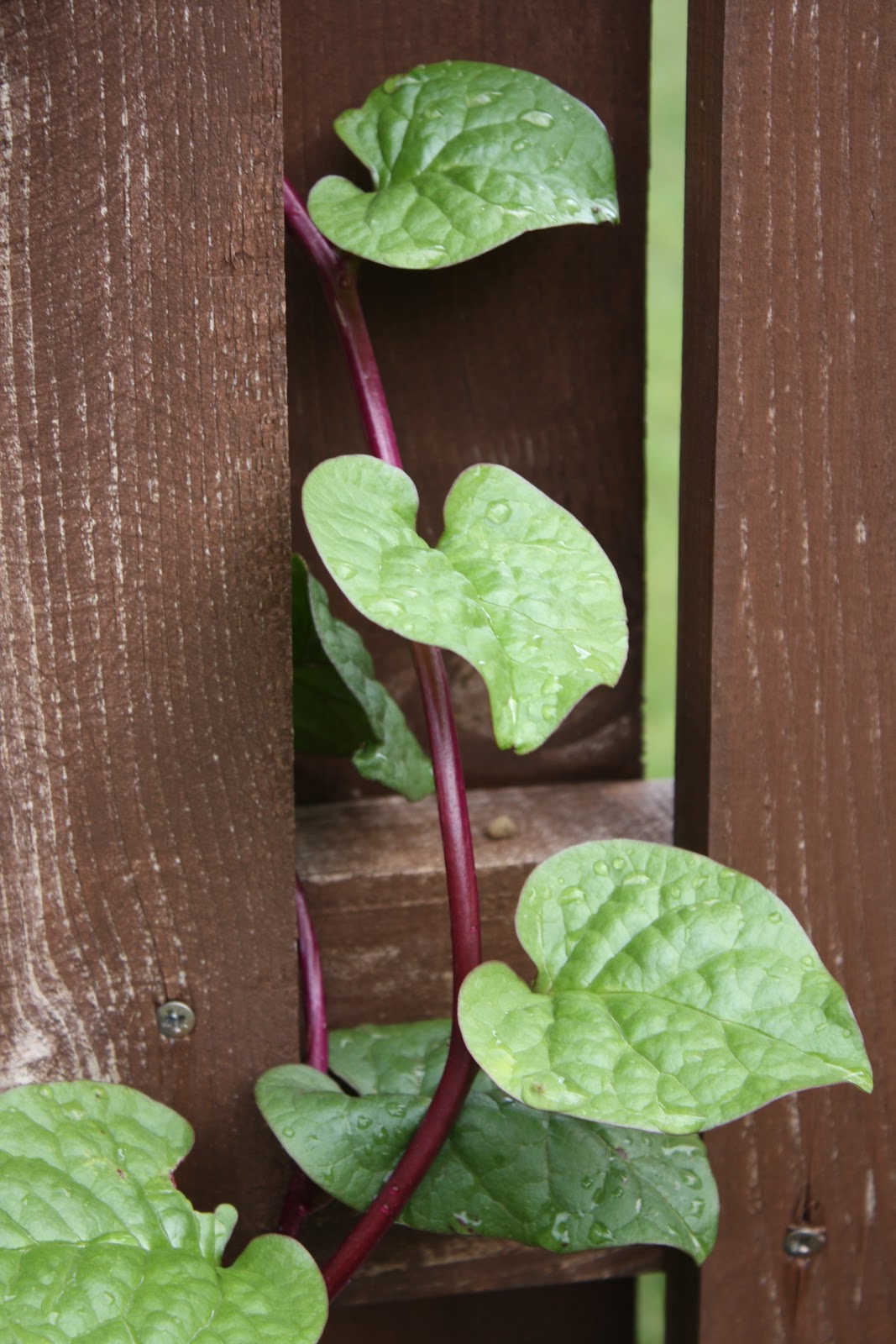
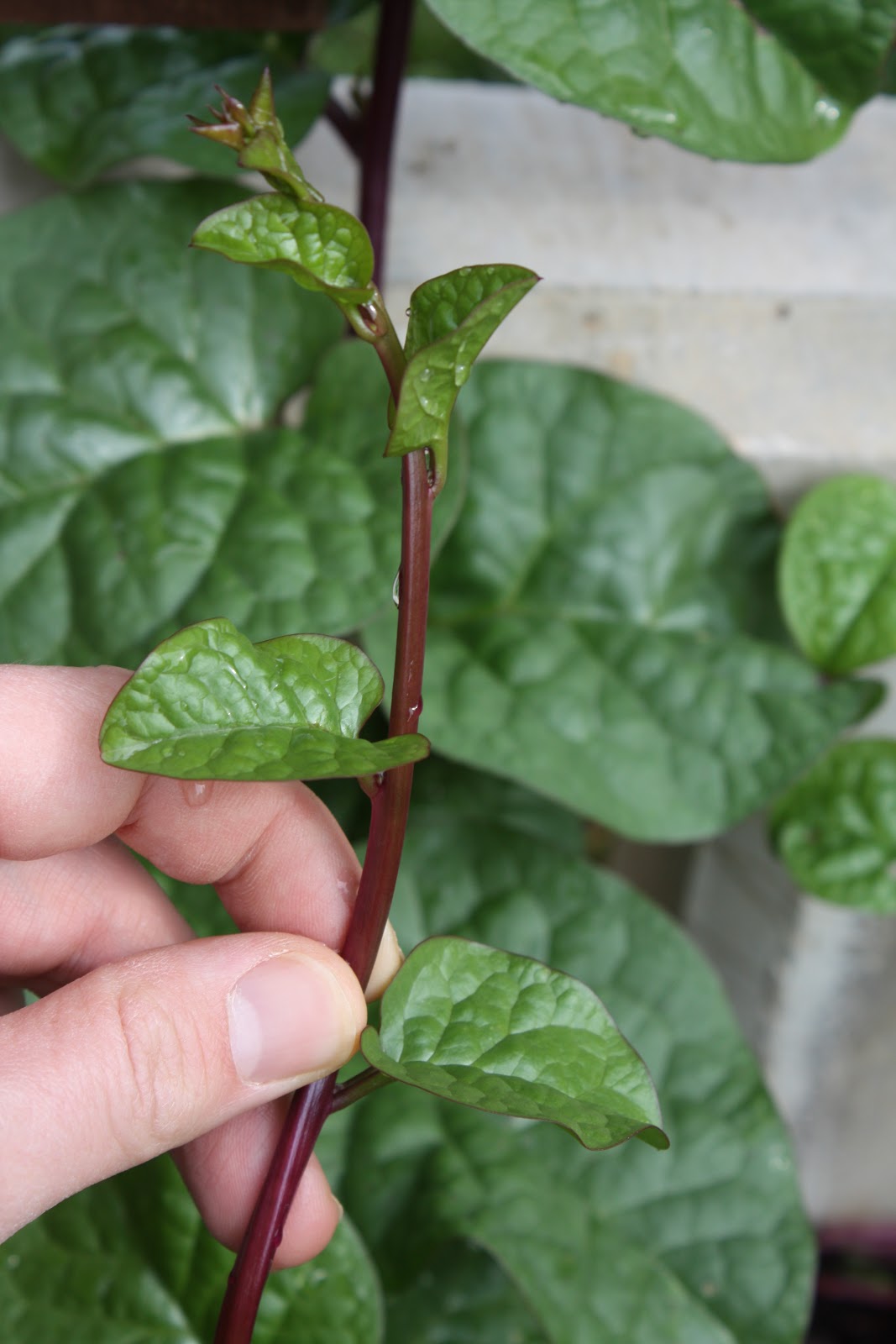
Photos of my Malabar Spinach

Common Name: Malabar Spinach
Scientific Name: Basella alba, Basella rubra
Family: Basellaceae

The tender leaves and shoots of Malabar Spinach are great fresh!

Description:
Malabar spinach is not actually related to spinach at all.  It is a heat-loving, vining, perennial plant with heart-shaped leaves from the tropics and sub-tropics.  It is often grown in more Temperate Climates as a heat-loving annual substitute for spinach.  It is considered a succulent (a plant that stores water in their leaves and stems), and it is used much like spinach, although I believe the taste is not very similar when raw.  Although when cooked, it does indeed taste like spinach.

It is said that Malabar Spinach has a mucilaginous texture.  This has a lot of negative connotations.  I think a better word is "slippery".  It actually has a very pleasant mouth feel to it.  I would describe it as crunchy and juicy when raw.  The taste is slightly peppery with a bit of a citrusy flavor with hints of earthy spinach to it.  Apparently, the red stemmed version (Basella rubra) is more mild in flavor than the green (Basella alba).  I have only grown and tasted Basella rubra, so I cannot speak from experience on the all green version.  As I said above, once cooked, it tastes much like spinach, maybe a little stronger.

History:
The name, Malabar, likely refers to the northern areas of Kerala state in India.  This at least is fitting, since it is thought that Malabar Spinach originated in India (although some research suggests Indonesia).  It is a very popular green vegetable in India, Southeast Asia, China, and Africa.

Trivia:
  • This is a great salad green replacement when the temperatures soar in the summer and our lettuces are wilting and ready to bolt.
  • Malabar Spinach is very high in vitamins A and C.
  • Malabar Spinach is high in calcium and iron.


Malabar Spinach using my fig tree as a trellis.

USING THIS PLANT
Primary Uses:
  • Fresh - Young leaves and the top 5-8 inches of shoots can be eaten raw.  Used in salads.
  • Cooked - Older leaves should be cooked as they have a rougher texture.  It is more like spinach in look and flavor when cooked.  It holds its shape a lot better than spinach when it is cooked.  Can be substituted for cooked spinach or chard.


Secondary Uses:
  • Thickening agent.  Here is where the "mucilaginous" part of Malabar Spinach is very helpful, kind of like okra, in soups, stews, and curries.
  • The red-purple juice from the berries can be used a a food dye and ink - it will stain!


Yield: Higher with more heat and with more pinching off of shoots and flowers
Harvesting: Whenever you want!  
Storage: Should be used immediately.  Does not seem to store well for more than a few days after picked.

The deep red vines and pink flowers contrast beautifully with the dark green leaves.

DESIGNING WITH THIS PLANT
USDA Hardiness Zone: Killed by frost, although some report established plants can withstand 5 F (-14 C).

Plant Type: Vine
Leaf Type: Deciduous 
Forest Garden Use: Fast growing, heat loving annual vine in Temperate Climates.  Perennial vine in Sub-Tropical, Tropical Climates, heated greenhouses, or possibly as a potted indoor plant.  
Cultivars/Varieties: Basella alba is all green.  Basella rubra has red stems, is prettier, and is likely just a variety of Basella alba.
Flowering: Mid-Summer

Malabar Spinach is a fast growing vine.

PHYSICAL CHARACTERISTICS OF THIS PLANT
Size: 5-6 feet in a summer, easily.  Up to 12 feet in a long summer, and some report up to 30 feet if grown as a perennial.
Growth Rate: Fast if there is heat.  Large plant in 8-10 weeks.

Older leaves are a great cooked spinach or chard substitute.


GROWING CONDITIONS FOR THIS PLANT
Light: Prefers full sun
Shade: Tolerates light shade (about 50%), but grows much slower
Moisture: Medium
pH: Prefers fairly neutral soil (6.1 - 7.8)

Special Considerations for Growing: 
Give it something to grow on (trellis or tree) and your yields will be higher, easier, and free from dirt.

Propagation:  Pretty easily grown from seed.  Some will recommend soaking the seed in water overnight to improve germination rates, but I have not found that to be necessary.  Seems to prefer direct seeding when temperatures remain above 60 F (15 C), but I have transplanted with success.  Seeds can be saved from ripened fruit (small dark purple berries) - clean and dry the seeds.  Malabar Spinach is also easily grown from cuttings as it roots easily.

Maintenance:
Minimal.  Cut back severely to keep it in check if you live in a frost-free zone.  If there are no nematodes, then this plant has almost no pests.

Concerns:
  • If you live in a frost-free area, this vine can grow like crazy.  Some may call it invasive.
  • Reportedly susceptible to nematodes.
  • Reportedly susceptible to a fungus that destroys the leaves and can infect beets and chard as well.