Showing posts with label Peak Oil. Show all posts

Wednesday, November 28, 2012

The Trompe - An Almost Forgotten Air Compression System

The simple, yet brilliant, Trompe

A Trompe (also spelled Trombe) is a water powered air compressor system. This simple device was used for hundreds of years to produce compressed air for furnaces, mining equipment, ventilation systems, and even for air conditioning and ice production. Trompes were almost entirely replaced when fossil fuels, with their high energy potential, came into more general use at the beginning of the twentieth century (I believe the only large scale Trompe still in use is at the Ragged Chute plant on the Montreal River in Ontario, Canada). Unfortunately, the knowledge of these systems has been almost completely forgotten. At this time of increasing energy prices and likely post-peak oil, this is the type of information that needs to be shared and implemented.
The function of a Trompe is brilliantly simple. It has no moving parts. Water is directed into a tall, vertical pipe that decreases in diameter. As the column of water is constricted from the piping, air is sucked in through ports. The air bubbles in the water are pressurized – the higher the column of water (i.e. the more head), the higher the pressure. At the end of the vertical pipe, the water with pressurized air bubbles, flows into a larger chamber (called a plenum or reservoir) where the air bubbles are released. The water flows out and the air, now compressed in a tight space, can be harvested.

Correct me if I am wrong, but from my understanding there is a loss of heat energy in this process which cools the air. Actually, the air compression is isothermal (no change in heat energy), but then the air coming out of compression is cooling. This cooling effect can then be utilized for simple air conditioning systems or refined for ice production.

The compressed air can be used directly as a power source to pump pistons or turn gears, or it can be stored in tanks and used elsewhere.

There is a lot of physics involved with a Trompe, but it is really a basic design. The higher the water origin, the greater the potential of energy produced. This is why many of the larger systems were built near waterfalls. However, I think there are plenty of smaller applications in a home or homestead where a Trompe could be used. It is time to bring this almost lost technology back to modern use.

For More Information:

Wednesday, March 7, 2012

Video: There's No Tomorrow


This video takes a look at the future of energy and food production in the world. I have not seen a presentation that takes the the problems we face and explains them so well. I highly recommend taking the 33 minutes to watch this video. I fear too many will start to watch it and turn it off too quickly (and stick their heads back in the sand), because they don't like the message. I have studied the facts behind this video for a long time, and I cannot find one overt error in the information presented. All I am asking is for you to become aware of the issues, become knowledgeable on the information. This is the only way out of the crash I see coming our way. Yeah... it's a bit of a downer, but unless we actually understand the problems, we will never create a solution or an alternative.

Saturday, June 25, 2011

Peak Oil

Is Peak Oil already here?


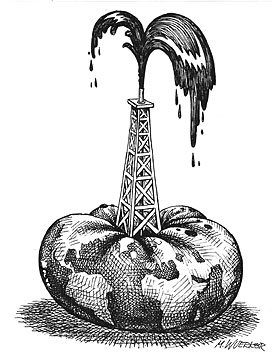
Peak Oil is a simple concept.  Many of you may have already heard of it.  Peak Oil is the point in time when the world reaches the maximum extraction of oil from the earth.  After Peak Oil, the extraction of oil will become less and less.

Peak Oil is not the same as Oil Depletion.  Oil Depletion is when the earth feels the scarcity of oil, and is associated with rapidly rising prices and limited supply (i.e. you can't buy it anymore).

The concept of Peak Oil came from the American geophysicist, M. King Hubbert.  In 1956, he proposed ("predicted") that the U.S. would reach peak oil production between 1965 and 1970.  In the early 1970's the U.S. maxed out its extraction/production of oil.  Since that time, there has been a gradual, but steady, decline.  He was right.

Hubbert's theory, now known as Hubbert Peak Theory, can be applied to any region, country, or the planet as a whole.  It states that oil production will always follow a bell-shaped curve.

Graph showing Hubbert's prediction (blue) with actual data (dots).

So, where are we at today on a global level?  Here is a graph that shows the majority of the world's oil producing counties and their oil production curves.  Most countries in the world have already reached Peak Oil.  There are only a handful of countries (in the Middle East) that have not yet reached Peak Oil.

Graph showing countries in the world that have already reached Peak Oil.


No one knows for sure when Global Peak Oil will take place.  Some people think it has already occurred.  Others, though not many, think that it will not happen for at least another hundred years.  As you can see from the chart below, there are a lot of different theories/models out there that are attempting to answer the question of when Global Peak Oil will occur.

Graph showing different models of prediction for global Peak Oil.

In science, when you see so many models without consensus, you can be sure that the scientist truly do not know.  What you can take out of this is the common trend showing Peak Oil is coming sooner than we would like.  The International Energy Agency, which is a pretty legitimate intergovernmental organization, believes we reached Global Peak Oil in 2006.  There are other organizations who believe that Global Peak Oil will not occur until after 2020.  These organizations also believe that through the period of Oil Depletion, alternative energy scientists will make major breakthroughs that will allow the major oil-dependant countries to smoothly transition to an oil-free world.

I don't know if I am quite so confident.  I don't believe we will have a world-wide societal meltdown, but I don't think the transition to an oil-free world is going to be very smooth.

This is yet another reason I am a huge proponent of Permaculture.  With proper design, so many of our dependancies on oil start to diminish.  If we have the ability to produce the majority of our own food and energy needs, then Peak Oil is an inconvenience, and not the end of the world as we know it.