Showing posts with label Permaculture Principles. Show all posts

Tuesday, January 22, 2013

Lessons Learned This Week About: Fireplaces, Reeds, and Tires

Over the last few days I learned a few valuable lessons. 

Antique Ash Bucket from 19th Century England

My Ash Bucket... the fact it says "Homer"on it should have been a clue!

Lesson 1: Never put ashes from a fireplace into anything other than a metal container or you may come really close to starting a house fire.
First, in my defense, I did not grow up in a rural area. I did not grow up in a cold area. I grew up in the sprawling suburbia of southern Florida. We did not have fireplaces. There were a few people who did, but these fireplaces were for show. Heck, there were only a few days a year you could actually light a fire in a fireplace, and then you probably had to open a window due to overheating. The last few months, living on a rainy, windblown island in the North Atlantic in a house with no central heat, we have relied on the fireplace to warm up our living room. And true to its name, this is the room where we have lived the most due to the fireplace and its warmth.

So, back to the lesson... I cleaned out the fireplace a few mornings ago, and just like every other time for the last few months, I placed the ashes into a plastic bucket. I typically carry it outside and dump it in the compost bin. This time, because it was raining and cold and windy, I didn't bring it out right away. In fact, I placed the bucket in a big box where I keep old packing paper that I use for kindling. Later that evening, about 10 hours later, I went upstairs and smelled something burning. It smelled a bit like wood and a bit like plastic. I wasn't really sure. My wife and I walked all around the room trying to locate the smell, but we couldn't locate it. Another hour passed, and I sat down to read, but the smell was stronger. I climbed around the room, smelling receptacles and light sockets. And then I came to the box with the bucket of ashes in it. The smell was really strong in there. I lifted the bucket up, and the entire bottom of the bucket fell off. Strands of melted plastic, like cheese on a pizza, dripped all over. In the center of it all was a big pile of ashes and a few dozen bright orange embers, still very much alive. In fact, my lifting the bucket gave those embers new oxygen and a new life. The paper in the box, now covered with hot embers started smoldering. I carried the box outside to the concrete porch just in time for some of the papers to ignite. Now I see why I always saw metal buckets for ashes in old movies and at historical sites.

House fire barely avoided. Lesson learned.


Giant Reed (Arundo donax) patch near my house.
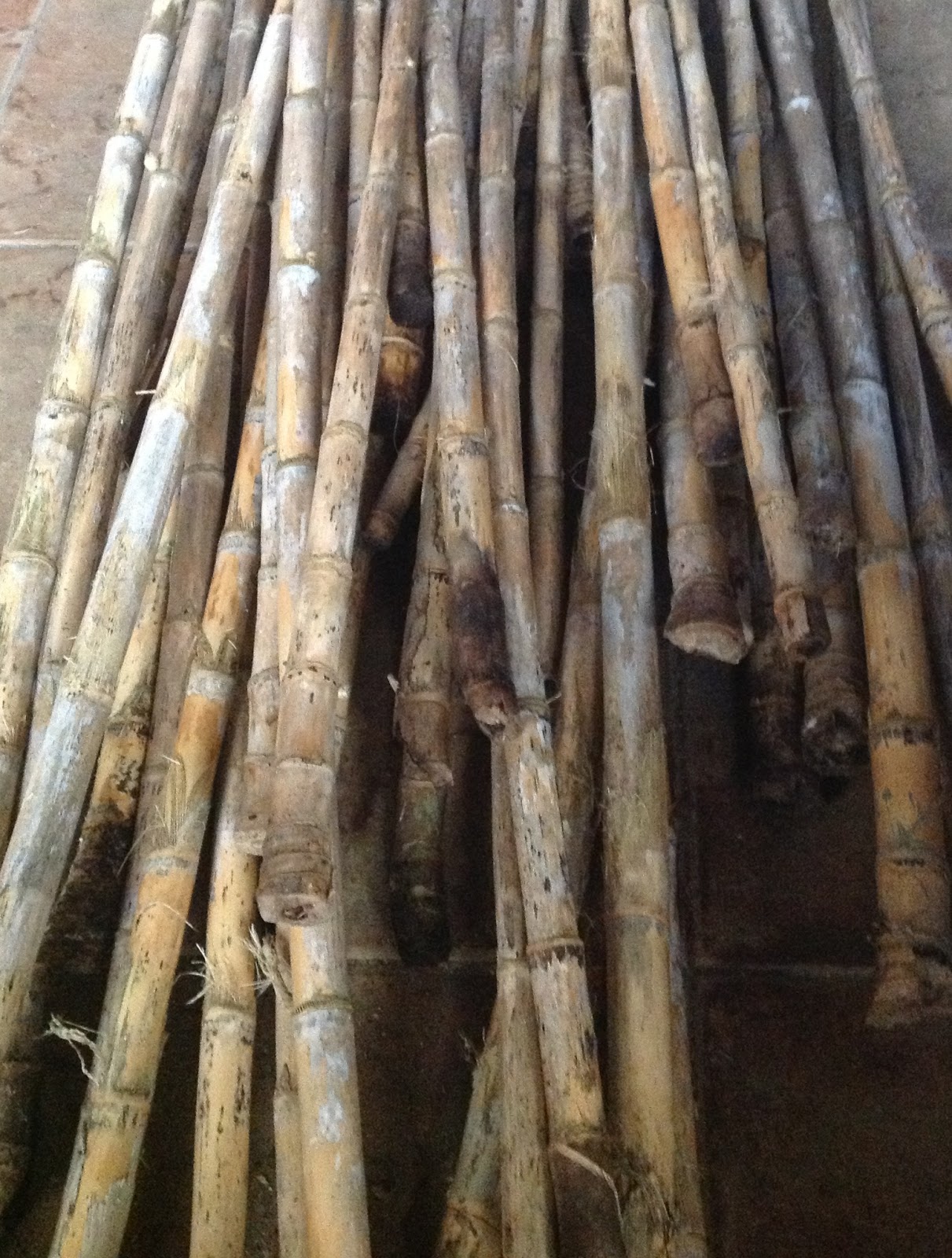
Cleaned and partially dried reeds.

Lesson 2: You can find free gardening material all over the place if you take the time to observe, but if you are lazy you may come really close to missing out.
This is a perfect illustration of Permaculture Principle #: Observe and Interact. Within a one minute walk from my front door is a patch of giant reeds. The top photo was taken the past summer. I had been telling myself to go over there for months and get some. Well, fast forward about 6 months, and the patch is only about half green. The cold and wind has killed off most of the reeds. Unfortunately, about half of the dead reeds were blown to the ground and are mostly rotted. Luckily, there were still quite a few in good shape. I grabbed a bunch and brought them back to my house. I cleaned them, stacked them, and I am letting them dry out some more until I need stakes and supports for my Spring and Summer garden. It cost me all of twenty minutes! If I waited another few weeks until after the next big wind storm, I may have missed this opportunity. So the key here is to not just observe, but get off my butt and interact!


My stockpile of kindling, gathered and made.

Lesson 3: You can find uses for "waste" items if you really try, or if you have someone give you the idea first.
I have been running out of kindling for the past month. I had a few boxes of kindling that my father had prepared and saved for me this Summer when he visited, but I finally ran out a week ago. Again, I never used a fireplace on a regular basis until now. I had no idea how much kindling I was going to need. For the past week, I have been using all kinds of scraps of wood and cardboard. I have been getting pretty good at starting fires with less and less. In fact, I have been pretty proud of how good I have become at starting roaring fires with almost no kindling. But my meager supplies have been getting pretty thin. Finally, I spent half a day chopping firewood with a hatchet (no, I don't own an axe yet!) into smaller and smaller pieces for kindling. I rather enjoyed the work, but it took quite a while. Then my neighbor told me to use the dried reeds for kindling. "They burn great!" she said. This is what finally got me off my butt to go get the reeds mentioned in Lesson 2 above. Well, I kept all the trimmings from the reeds I cleaned. What I would have put in my compost bin is now perfect kindling. And it took me about ten minutes to get a full box. Perfect use of Permaculture Principle #6: Produce No Waste. Great ideas don't have to be your own!


My new stacks of firewood and my dog.


Lesson 4: Firewood has to be stacked right if you want it to get dry and stay dry, and moving a whole truckload of firewood twice is a lot of work.
This was something I knew if I would have thought about it for more than a few seconds, but I did not. I recently purchased a pick-up truck of firewood from a local family. It was very good quality wood for an excellent price (about $45 US Dollars). The three guys who delivered it dumped it in a relatively neat pile in my garage. They wouldn't let me help them unload it. I tried, but they kept waving me off as if this was part of the delivery price and I had better not try to help or I would greatly and deeply offend them. So I let them pile it in the garage. Unfortunately, the pile of logs did not allow good airflow. After finding a bunch of mold and fungus growing on some of the logs, I decided to restack the pile. This meant I had to move the whole pile away from the wall first and then restack it the right way in the same spot. That was just a little frustrating. However, within just a few days, the logs have already started to dry. Next time, I'll have this great family pile the wood outside. Then I will only have to stack the firewood once!


My bike pump is close to, but not nearly as nice, as this one.

Lesson 5: A bicycle pump will inflate a flat spare tire... eventually.
This was a beat-myself-over-the-head moment. My van got a flat tire. I jacked up the car and took off the flat. I easily put on the spare. My boys were hanging out in the driveway with me having fun and laughing that small spare tires are sometimes called "donuts". I lowered the jack and heard my oldest son, who is four years old say, "Daddy, the donut is flat too!" I have to be honest. I have been giving my friend a hard time for the last few months because his jeep got a flat tire after we had dropped him off at the airport, then his jack wasn't large enough for his jeep (I had to use the jack from my van), and then his spare was flat! How clueless? How unprepared? How... ironic! Fortunately, I had my trusty Power Box in the back of the van! (You can read about how I bragged on this machine in this article) Well, as it turns out, the Power Box is pretty lousy at inflating tires even if it is good at jumping dead batteries, but maybe I just have a bad pump in mine. Either way, it didn't work. Now what? Well, I thought I would give the bike pump a try. Note that I did keep the spare up on the jack while I inflated it, so I didn't have the weight of the car on the tire at the same time. As it turns out, this will work. It took me about 10 minutes, but it resulted in a fully inflated spare tire... and some really burning muscles. Another side lesson: check the air in your spare tire from time to time.


Wednesday, November 9, 2011

Principles of Permaculture: Principle Twelve - Creatively Use and Respond to Change


Holmgren's Twelve Principles of Permaculture
1.  Observe and Interact
2.  Catch and Store Energy
3.  Obtain a Yield
4.  Apply Self Regulation and Accept Feedback
5.  Use and Value Renewable Resources and Services
6.  Produce No Waste
7.  Design from Patterns to Details
8.  Integrate Rather than Segregate
9.  Use Small and Slow Solutions
10. Use and Value Diversity
11. Use the Edges and Value the Margin
12. Creatively Use and Respond to Change


Principle Twelve: Creatively Use and Respond to Change
Holmgren's Proverb for this Principle:  Vision is not seeing things as they are but as they will be.

I believe that this principle is really talking about two types of change and our reaction to it.  The first is change that is seen or anticipated.  A prime example of this is the concept of succession.  In ecology, succession is the change that an environment will go through as it progresses toward maturity or climax.  An idealized illustration is how an abandoned farm field will become overgrown with weeds and grasses and then become a meadow then an early forest and then a mature forest.  Another example is the progression of the seasons from Summer to Autumn to Winter to Spring and back around again.  If we are managing our land and garden for this change, which comes as no surprise, then we can incorporate these changes into our Permaculture design.  One quick design example is how we can sow an area that has poor quality soil with a non-frost-resistant nitrogen-fixing plant.  Come winter, the plant will die back providing a mulch, organic material, and nitrogen to the soil.  We don't have to do the work that nature can do for us instead.  That is smart design!

The other type of change is the change that is unforeseen.  The change for which we did not plan.  This can be anything from a tree that is killed by lightning, wind, or pest to the death of your chickens by a raccoon.  It can be as big as the death of a loved on or a house fire or as small as a flat tire or seeds that didn't sprout.  Also, remember that not all unforeseen change is negative.  We may have a bumper crop of tomatoes or peppers, a sheep that bears triplets, or an unexpected inheritance.  The key to success with this type of change is how we handle it, our ability to adapt.  The overused adage, "When life gives you lemons, make lemonade" is very applicable.  There is a famous quote from Bill Mollison, the co-founder of Permaculture, when discussing pests in the garden.  He said, "You don't have a slug problem, you have a duck deficiency!" That is the attitude and the creativity we need to have in the face of unforeseen change.

"Vision is not seeing things as they are but as they will be" (an old Japanese proverb) reminds us that there is usually an opportunity in all change, unforeseen and expected.  It is up to us to have the vision to plan for or adapt to that change to come out better, or at least not as bad as others in a similar situation, on the other side.

We can have a positive impact on inevitable change by carefully observing, and then intervening at the right time.
- David Holmgren

Tuesday, September 27, 2011

Permaculture Principles: Principle Eleven - Use the Edges and Value the Margin


Holmgren's Twelve Principles of Permaculture


Principle Eleven: Use the Edges and Value the Margin
Holmgren's Proverb for this Principle:  Don't think you are on the right track just because it's a well beaten path.

This principle highlights a vital component to Permaculture design itself... the edge.  I wrote about the Importance of Edge more extensively in this post.  The main thing to consider is that if there is more life and richer biodiversity in the edge, then we should do all we can to increase the edge.  While the fastest route from point A to point B is a straight line, nature doesn't do straight lines.  If we are truly trying to mimic nature, then we should avoid straight lines as much as possible.  Of course, sometimes we need straight lines with certain design elements (roads, piping, wires, etc.), but the point is to question it when you see it.  Make sure it is vital and not just for us to impart our perception of "order" on the natural world.

Valuing the Margin reminds us that the mainstream is not always right.  There have been many things that have been abandoned, left on the margin, for reasons that have more to to with mass commercialism than wisdom or prudence or sustainability.  I often think about the loss of all the genetic diversity and flavor in our extinct varieties of plants and animals that we call Heirloom or Heritage Food.  The main reasons for their absence on our dinner plates is mainly due to shipping and storage and not flavor or consumer desire.  What else on the Margin have we passed by because everyone else has ignored... ideas, tools, design, people?

"Don't think you are on the right track just because it's a well beaten path" reminds us to reevaluate what we consider not worth considering.

The interface between things is where the most interesting events take place, these are often the most valuable, diverse and productive elements in the system.
- David Holmgren

Wednesday, September 14, 2011

Permaculture Principles: Principle Ten - Use and Value Diversity


Holmgren's Twelve Principles of Permaculture


Principle Ten: Use and Value Diversity
Holmgren's Proverb for this Principle:  Don't put all your eggs in one basket.

Variety is the spice of life!  It is also the key to sustainability.  Nowhere in nature do you see just one thing, one plant, one environment.  Our Permaculture Design should be no different.

Our plants should be diverse - this allows more variety in our diets which is healthy, more redundancy in our harvest which is prudent, less monoculture which is great for pest confusion, healthier soil, and creates habitats and microclimates which in turn lead to increased diversity of insects, birds, mammals, fungi, and all life in general.  One way to utilize diversity in plants as a design element is with the concept of Permaculture Guilds.

Our plant species themselves should be diverse - besides diversity in flavors, different varieties also provide diversity in pest and disease resistance.  Early season, mid season, and late season varieties also provides much needed and desired redundancy.  It helps ensure a crop regardless of late frosts, droughts, pests, or any other unforeseen calamity that strikes at the perfect, or worst possible, time.

Our systems should be diverse - again this also allows for greater redundancy, which again provides more stability in our total system.  Water harvesting is one of the most important systems that need to have diversification.

Finally, this diversity can also apply to many things non-agricultural: investing, skills, education, transportation, communication, communities, etc.

"Don't put all your eggs in one basket" reminds us that when we rely on only one method or system, if that system fails, then we have guaranteed failure instead of success and sustainability.

Diversity reduces vulnerability to a variety of threats and takes advantage of the unique nature of the environment in which it resides.
- David Holmgren

Tuesday, September 6, 2011

Permaculture Principles: Principle Nine - Use Small and Slow Solutions


Holmgren's Twelve Principles of Permaculture


Principle Nine: Use Small and Slow Solutions
Holmgren's Proverb for this Principle:  Slow and steady wins the race.
                                                             The bigger they are, the harder they fall.

It's funny how each time I start to write my views on each of these Principles of Permaculture, I end up thinking, "This is so important!  It is one of the most important aspects of Permaculture!"  Duh!  That is why it is one of the main principles!   And this principle is no different.

There are a number of aspects to this principle.  For me, the most important aspect has to do with our actions on the land or in our projects.  It is so easy to get carried away and build a massive system before you truly know if you will use it or if it will even work.  I think it is part of human nature to over-build.  The problem with over-building is that it is often a waste.  A waste of energy.  A waste of time.  A waste of resources that were not needed for the project or that will be pumped into the system because we don't want to admit we over-built it!  This principle keeps that urge to over-build in check.

This also ties into an older idea by Bill Mollison, the co-founder of Permaculture along with David Holmgren.  This idea is known as Appropriate Scale.  The solution should fit the problem exactly, not too big or too small... just appropriate.

Another important aspect of this principle is that when we make small changes (and then observe as we are instructed to do in Principle One), we can see if that small change made any difference or not.  If it was a bad idea to make that small change, thank goodness it was just a small change and not a very large one.  Small mistakes are much easier to repair than large mistakes.  If that small change was good, maybe we learn that a small change was all that was really needed - again reminding us that over-building is usually not necessary.  "The bigger they are, the harder they fall" reminds us of this aspect of using small and slow solutions.

"Slow and steady wins the race" reminds us that we just need to keep moving.  We should do it slowly to avoid the mistakes discussed above, but it is important to keep moving.  Keep striving.  Keep improving.  Principle One tells us to observe and interact, not just observe.  We need to be engaged in the world around us, constantly trying to improve it and ourselves, while keeping the other Principles of Permaculture and Ethics of Permaculture in mind.

Make the least change for the greatest possible effect.
- Bill Mollison

Small and slow systems are easier to maintain than big ones, make better use of local resources, and produce more sustainable outcomes.
- David Holmgren

Tuesday, August 30, 2011

Permaculture Principles: Principle Eight - Integrate Rather than Segregate


Holmgren's Twelve Principles of Permaculture


Principle Eight: Integrate Rather than Segregate
Holmgren's Proverb for this Principle:  Many hands make light work.

It is amazing to me that this principle has not been adopted more in modern agriculture.  I understand why.  It has to do with dogma and profit and simplicity.  However, it has been proven time and again that an acre of land (for instance) will produce more total or combined yield if planted in polyculture (multiple species) than if planted in monoculture (single species).  Yet farmers the world over have adopted the idea that they need to produce one item at a time and maximize that single harvest, whether it be corn, wheat, or soybeans.

This principle's best example is the Edible Forest Garden which I have gone into greater detail on previous posts.  Please take some time to review this post to truly understand the benefits of integration from an agricultural perspective.  The benefits that we know of are truly colossal: reduced work, reduced pesticides, reduced herbicides, greater food variety, greater nutrition, greater biodiversity, reduced watering, greater beauty, and the list goes on.  These are just some of the benefits we are aware of; there are likely more that we are yet to discover.

I believe there are two (or three depending on how you look at it) concepts of this principle that were expressed independently in previous iterations of the "principles of permaculture" as the science of Permaculture was being developed.  Each component, while not absolutely required, provides an idealized goal in the design process.  It allows us to critically think about each element we are adding.  If we have a choice between two elements (e.g. canopy trees), then the one that rates higher or contributes more to each of these components should likely be the element chosen.  Here they are:

Relative Location - This components seems like common sense to me.  Place an element where it will be most beneficial to other elements and vice versa.  Very obvious examples are solar panels on the roof or rain barrels at downspouts.  Other less obvious examples would be placing the pond at a higher elevation than your home so we have enough water pressure or placing tall, canopy trees on the north side of the food forest to prevent shading the other plants (or on the south side if you are in the southern hemisphere).

Stacking Functions - This concept is best explained by its component parts below.

Each Element Performs Many Functions - The classic example to describe this component is the chicken.  Sorry if you have read this before (or many, many times before as I have), but it is used so often because it is such a great example.  Here goes:  The chicken can function to provide meat, eggs, feathers, stock, bones, manure, tilling, pest control, heat (e.g. attaching a greenhouse to the hen house), and probably many more functions.  This is just quickly off the top of my head.  The goal of this concept is to make sure we are utilizing all parts or functions of an element, and that we choose elements that have multiple functions.  Again, it is not mandatory, but it provides much greater integration into the Permaculture System we are designing.

Each Important Function is Supported by Many Elements - This is really looking at things from the other perspective.  If we want to water our gardens then relying only on city water is less redundant than collecting rain water, having ponds, swales, dew ponds, gabions, and practicing hugelkultur.  Obviously, when there are many elements that are all working toward the same goal, if only half achieve that goal at any time, then that function is sustained.  A four-legged stool is much safer to sit on than a one-legged stool.

"Many hands make light work" reminds us that our Permaculture Design should incorporate as much diversity to create truly sustainable systems.

By putting the right things in the right place, relationships develop between those things, and they work together to support each other.
- David Holmgren

Monday, August 22, 2011

Permaculture Principles: Principle Seven - Design from Patterns to Details


Holmgren's Twelve Principles of Permaculture


Principle Seven: Design from Patterns to Details
Holmgren's Proverb for this Principle:  Can't see the forest for the trees.

The icon for this principle, the spider web, provides a great example.  Each spider web is easily recognized by its pattern of multiple radial threads with numerous circular threads.  However, the details of the specific location of each spider web mandates small variations in how the basic pattern is implemented.  The exact same relationship of patterns and details exist when designing a Permaculture System.

The most useful and recommended patterns in all land based Permaculture Systems are those of Permaculture Zones, Permaculture Sectors, and Permaculture Guilds.  I have elaborated on these design patterns in much greater detail; just follow the links to read more.  Zones, Sectors, and Guilds are all patterns which are more conceptual in initial design, yet, like the spiderweb, the implementation or application of these patterns are shaped by the unique details of the relative location at which you are working.

"Can't see the forest for the trees" reminds us that in design we need to start with the big picture first.  What are we trying to achieve?  How will the components interact with each other?  What are the consequences, good and bad?  Should we be doing this in the first place?  By designing Permaculture Systems with the end goal in mind, while staying true to the Ethical Principles of Permaculture, and using the tools of Zones, Sectors, and Guilds, we can create truly sustainable Permaculture Systems.

By stepping back, we can observe patterns in nature and society.  These can form the backbone of our designs, with the details filled in as we go.
- David Holmgren

Tuesday, August 9, 2011

Permaculture Principles: Principle Six - Produce No Waste


Holmgren's Twelve Principles of Permaculture


Principle Six: Produce No Waste
Holmgren's Proverb for this Principle:  A stitch in time saves nine, and Waste not, want not.

This may be one of my favorite Principles of Permaculture.  Why?  Because it is kind of like figuring out a big puzzle.  Basically, all this principle is saying is that everything can be a positive resource if we know how to utilize it.  Almost every by-product can have a use if we think hard enough about it.  That is the fun part!

Another aspect of this principle, and one that we need to think about just as hard, is unless we know how to utilize a by-product maybe we shouldn't be producing the primary product in the first place.  The classic example of this is a nuclear energy power plant with the by-product of spent nuclear fuel.  I am not saying that we should not use nuclear energy, but we do have a very dangerous "waste" product that is not being used as a resource for anything yet.

When discussing this principle, someone always says, "Yeah, but what about..."  It doesn't matter.  There should always be a use for every by-product.  Bill Mollison often said, "The problem is the solution."  The first few times I read this quote, it was always as a stand alone statement.  Once put in context of multiple interconnected systems, I realized how simple and brilliant this statement really is.  Another way of saying this is, "The problem, or by-product, of one system, is often the solution, or answer, for another system."

The classic "waste" product most people think of is manure.  Whether this is animal or human manure, many people see this as disgusting filth that needs to be buried in a deep hole (where it pollutes ground water), diluted with so much water that it is almost non-existant (depleting too much water and still maintaining risk of pathogen spread), or treated with chemicals that kill everything in it (polluting our environment with caustic substances).  If we viewed manure as a great resource for organic matter and fertility for the land, we realize that this "waste" is actually a resource.  Granted, most farmers already understand this to an extent with some animal manures, but are still terrified of human manure.  I'll get into humanure more in a future post, but suffice it to say there are very safe and easy ways to deal with humanure that results in us having a great resource instead of "waste".

The key with this principle is to always keep your eyes and mind open.  You never know when a great solution will come, but if you are not looking for it, you will never see it.

"A stitch in time saves nine" reminds us that we need care for the things we have.  This quote comes from the idea that a timely effort to repair an item will often prevent more work later.  So a stitch in time saves nine stitches (why nine? because it rhymes with time).  It also reminds us to steer clear of the consumer mentality of buy it, use it, dump it.  As I have said in previous posts, spend a bit more money and buy a higher quality item.  It will last longer, and if it starts to break, it is often much more easily repaired.

"Waste not want not" reminds us that when we design a Permaculture System, we need to account for every by-product of each system we are creating.  This can get extremely complex, but the time in planning will pay off in less work for us if we design interconnected systems that recycle each system's "wastes" and use them as resources for the other system's sustainment.

By valuing and making use of all the resources that are available to us, nothing goes to waste.
- David Holmgren

Sunday, July 31, 2011

Permaculture Principles: Principle Five - Use and Value Renewable Resources and Services


Holmgren's Twelve Principles of Permaculture


Principle Five: Use and Value Renewable Resources and Services
Holmgren's Proverb for this Principle:  Let nature take its course.

This principle makes sense to me on two levels: ethical and financial.  Let's start with the ethical.  As I have said many times before, I am an evidence-based environmentalist.  I need to see proof... hard scientific proof... not flashy, pseudo-science by some talking head with a good powerpoint or with the backing of some college dropout celebrity who thinks he has a platform to talk because he is a good actor.  I want to see that action A results in outcome B.

For far too long, there has been, and still are, a number of non-renewable resources that have been depleted either completely or to the point that it will take hundreds to thousands of years to replenish.  The first two that come to mind are rain forests and freshwater aquifers.  Probably the most disturbing, and really just sad to me, are the hundreds of species that have been wiped out forever.  Unfortunately, things often come to a point of, "Well, I am not going to lose my job or my house or my farm all because of some spotted owl or speckled minnow!"  The crazy liberal eco-fanatics push one way, and the misguided Christian capitalists push the other way.   My point is that it should have never come to that in the first place.  If we truly took care of the earth as God asked man to do in Genesis 2, then the prior discussion would never arise (for more detail see this post on Permaculture Ethics).  How much genetic diversity has been lost already?  Maybe there was a cure to cancer in a plant that was burned or dozed in the quest for a nice veneer on a kitchen cabinet in New York.  Who knows?  However, from my point of view, from an ethical basis, we need to use and value renewable resources as much as possible.

From a financial basis, this also makes good financial sense.  When I am shopping for almost anything, I will usually save up and buy one of the best products available.  Why?  Because I know that it will last a much longer time than the cheaper alternative (usually).  So, for a bit of a larger investment initially, I have saved more money in the long run in buying replacements and in time lost without that broken product.  Now, let's apply this to renewable resources, and let's just use water for irrigation as an example.  It will be cheaper in the short term to just use the hose and city water.  However, if I invested in a good rainwater collection system (as I outlined in this post on Rain Harvesting from your Roof), then the money I save in the long run will likely surpass the smaller daily charges from the water utility company.  On top of that, I am one step closer to independence, especially in times of trouble where city water might be unavailable (a broken water main, a biological terrorist attack, etc.).  Finally, I have also avoided depleting the source from which the city draws its water.  So in the end, for a long-sighted financial reason, I end up on the right side of the ethical line.  If everyone did this, then costs would continue to drop and non-renewable resources would begin to replenish.

This principle also ties in the ideas of conservation and cycling of energy (nutrients and resources).  When we are aware that the decisions we make have lasting ethical and financial impacts, we usually end up taking care of what we have in a more responsible manner.  We also find ways to use less energy, or we develop a way to reuse nutrients and resources more efficiently.  For example, I've seen a person who uses rain water to fill up irrigation cisterns and buckets.  What overflows from that is directed to his hot tub (so water is constantly being changed and no caustic chemicals are being used).  When he is done with the hot tub water, it is used to soak logs for mushroom production.  After that, the water is drained and used for irrigation.  What an amazing way to conserve and cycle a water resource!

Finally, this principle of using and valuing renewable resources also ties into principle six (Produce No Waste).  When our minds are open and our eyes are looking for renewable resources, we will often find a use for what others (and ourselves) previously see as waste.

"Let nature take its course" reminds us that when we design a Permaculture System, we are modeling and using natural processes and natural animal behavior to assist us in our goals.  Capitalize on what nature has already perfected, whether that is in building soil fertility or building self-sustaining forests, and harvest sustainably from plant and animal and wind and sun, to create a continuous bounty for yourself and your family.

Make the best use of nature's abundance to reduce our consumptive behavior and dependence on non-renewable resources.
- David Holmgren

Friday, July 22, 2011

Permaculture Principles: Principle Four - Apply Self Regulation and Accept Feedback


Holmgren's Twelve Principles of Permaculture


Principle Four: Apply Self Regulation and Accept Feedback
Holmgren's Proverb for this Principle: The sins of the father are visited on the children to the seventh generation.

There are many biological systems that exhibit self regulation (similar concepts are autoregulation and homeostasis).  In the human body, the brain and heart are great examples of autoregulation.  Depending on what their needs are, these organs can alter the rest of the system to influence blood flow to themselves.  For instance, if the body starts to exercise, the heart will pump harder and faster to increase blood flow through the body and back to itself.  The brain is very sensitive to blood pressures, and it will influence the whole body to alter blood pressures to itself. 

Homeostasis is another term frequently used in Systems Theory.  It is the idea that a system will regulate itself to minimize change.  In general, living systems do not like change, and they will do what they can to prevent it.  Anybody who has tried to lose weight will know that it seems as if their own body is trying to sabatoge itself when attempting to drop some pounds.  This is the human body fighting change.

Remember that Permaculture Systems are models of biological systems.  We as the designers need to understand that if designed well our system will have many seen and unseen, planned and unplanned methods of self regulation all trying to minimize change. This is fantastic when the system is working well and some environmental influence tries to alter our system (e.g. drought, flooding, late frosts, etc.).  It is also important to keep this in mind when we are trying to establish a Permaculture System.  It can be hard work to get the new system put in place and working before a new homeostasis is achieved.  On a side note, this is really true of any system whether it is in buisiness or government or agriculture.

When designing a new Permaculture System, when we are thinking about Auto-Regulation, there are two related concepts we need to implement:
1) Each element must perform many functions.  This allows us to have multiple yields and support from one element.  If we can maintain three elements to perform three functions or maintain one element that performs those same three functions, then our work is minimized by chosing to maintain the element that performs many functions.
2) Each important function is supported by many elements.  This allows each function to have many elements that support it and sustain it if one element fails.  A net is much more efficient at catching fish than a single fishing line.  A net still maintains most of its efficiency when many of its individual lines are cut.  This is due to the network of support, and this should be the model of any system we design.

The second part of this priciple is to Accept Feedback.  This seems pretty straightforward, but it is so easy to let our pride get in the way of accepting feedback.  For instance, we really want to raise peaches, but the trees keep dying or we have another season with no fruit.  Maybe we need to accept feedback from our lack of results and do something different... or maybe not raise peaches at all.  But often we will just keep doing the same thing or wasting a lot of energy (too much?) to accomplish something, because we think we are smart enough to figure it out.  We may eventually figure it out, but at what cost?  Keep in mind what Albert Einstein said:  Insanity: doing the same thing over and over and expecting different results.

Holmgren's proverb for this principle, "The sins of the father are visited on the children to the seventh generation" (a Biblical reference) reminds us that it is easy to waste energy overcoming natural self regulation and ignore feedback until some very negative consequenses of our actions are made evident.  A generation is considered to be between 30 and 40 years, so seven generations is 210-280 years.  How many things are we "paying" for now that were started, and mismanaged, over 200 years ago?  Deforestation.  Acid Rain.  Countless Extinction of Species.  Pollution of our Seas.  Depletion of our Fresh Water Aquifers.  All of these issues are a direct result of not accepting feedback (mostly not even looking for feedback).  All are, or were, preventable.

When designing Permaculture Systems, if we keep in mind Principle 9 (Use Small and Slow Solutions), we will be better able to Apply Self Regulation and Accept Feedback.

The only ethical decision is to take responsibility for our own existence and that of our children.
- Bill Mollison

 We need to discourage inappropriate activity to ensure that systems can continue to function well.
- David Holmgren

Friday, July 8, 2011

Permaculture Principles: Principle Three - Obtain a Yield


Holmgren's Twelve Principles of Permaculture


Principle Three: Obtain a Yield
Holmgren's Proverb for this Principle: You can't work on an empty stomach.

While it may be a nice concept to do something for nothing, that is almost unheard of.  Even donating anonymously to a charity leaves us feeling good that we helped.  In Permaculture, we are looking to obtain more tangible yields, although the intangibles make us feel pretty good, too.  

Principle Three (Obtain a Yield) dovetails nicely with the second part of Principle Two (Catch and Store Energy).  The yield that we take is typically in the form of stored energy.  Whether it is in the form of flower, fruit, wood, or fibre, the yield provides us with the ability to continue working, caring for ourselves, our family, and our land... which allows us to continue caring for ourselves, our family, and our land... it is a continuous cycle.  (I'll skip singing The Circle of Life if you don't mind :)  ).  Note that while this principle primarily refers to self-reliance, for some the yield may only be in beauty or time spend outdoors.

Remember, when we Obtain a Yield, we have to keep in mind principle four (Apply Self-Regulation) so that we do not over-harvest and break the cycle.  However, with some small scale, intensive systems, we have the ability to produce yields that are extremely large.  Bill Mollison, when discussing this concept, said, "The yield of a system is theoretically unlimited, or, limited only by the information and imagination of the designer."

"You can't work on an empty stomach" reminds us that with no yield, there is no sustaining ability (or sustainability) in our projects.

Ensure that you are getting truly useful rewards as part of the work that you are doing.
- David Holmgren