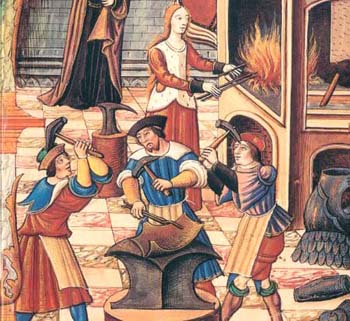
A Blacksmith Guild
A guild, according to Webster's Dictionary, is an association of people with similar interests or pursuits, also, or more particularly, a guild is a medieval association of merchants or craftsmen. The word guild comes from the Old English and means
Payment or
Tribute.
Historically, for example, a carpenter could pay tribute to join a carpenter's guild. He would then be protected by the society of fellow carpenters... protected from price gouging, unfair trade, etc. and protected from others stealing their "secrets", i.e. skills or "tradesecrets". This is where a lot of the secret societies were initially formed (like the Masons... initially, stonemasons). That carpenter could then focus on being the best carpenter he could be while making a good living for himself and his family. But enough of the history...
This term has been applied to Permaculture to describe a collection of plants (a
polyculture) that individually could survive on their own, but perform much better when grouped together.
One of the first, and most well known, Permaculture Guilds... the Three Sisters.
The classic
Permaculture Guild is called the "
three sisters" named by the Iroquois (native American tribe). The three sisters are corn, beans, and squash. The corn provides support for the beans. The bean is a legume and pulls nitrogen from the air and puts (fixes) it in the soil with the help of bacteria and fungi. The nitrogen fertilizes the corn and squash. The squash, with its large leaves, shades out weeds and prevents moisture evaporation, and has prickly leaves which deter animal pests. Finally, squash, beans, and corn are nutritionally complementary.
Permaculture Guilds then are
"groups of species that support each other in beneficial ways, aiding self-maintenance, and reducing the work required to maintain the system." - Martin Crawford (Creating a Forest Garden)
An Apple Guild design by Bill Mollison
Polycultures (as opposed to monocultures like a field of corn) offer many benefits according to
Dave Jacke (Edible Forest Gardens):
- As a whole, yield more than comparable monocultures
- Require fewer labor, energy, and material inputs
- Minimize stress, competition, and herbivory
- Maximize harmony and cooperation
- Generate self-renewing fertility
- Live within a sustainable water budget
- Remain stable with little to no maintenance
Ideally, a
Permaculture Guild will provide the following:
- Increase vital nutrients: mainly nitrogen with nitrogen fixing plants, but also phosphorus, potassium, calcium, and other minerals with mineral accumulating plants, and general fertility plants.
- Attract Beneficial Insects (like ladybugs, lacewings, mantises, predatory wasps, etc.) to reduce pests.
- Attract Bees (including honey bees) through the use of honey plants (nectar producing plants) to increase pollination.
- Confuse pests with strongly aromatic plants (so pest can't find the one plant they normally prey on).
- Give support to a diverse population of bacteria, fungi, insects, and animals which increases diversity.
- Contain plants with differing soil profiles (plants with different root patterns and systems, i.e. shallow vs tap roots... so the plants are not competing for the same soil space).
- Contain ground cover plants that suppress unwanted species, i.e. "weeds".
- Contain plants with the genetic diversity and/or selective breeding that resist pests and disease

There is so much to building and designing guilds, and so many benefits from them, that it is impossible to convey it all in one post. I'll add more, a bit at a time, about constructing Permaculture Guilds and provide as many examples as I can. I just wanted to introduce the concept in this post.