Showing posts with label Edge. Show all posts
Wednesday, July 13, 2011
Permaculture Projects: Free Bird Manure
I was running through my neighborhood this morning, and I noticed something. There are trees lining the road through one area I was running, and on the road under every tree was a fairly substantial ring of bird droppings. I looked ahead down the road, and there appeared to be little white halos on the ground surrounding the trunk base of every tree. Between the trees, the road was clean. It hasn't rained here for quite a while, so the droppings have had some time to build up.
This made me think of a few things things.
First, it reinforced the concept of Edge. The individual bird droppings were very small. That means it was the manure of the small finches, sparrows, and chickadees that are all over the place right now. I am thinking that they must be roosting in these trees at night. In nature, these small birds are the inhabitants of the edges between field and forest. From my previous post on the Importance of Edge, I discussed how the edge is booming with life. Well, this is just another reason why. These small birds are constantly fertilizing the edge. What a brilliant design for us to model.
Second, along the lines of modeling nature... which is what Permaculture is all about! I have heard of many people who have bird feeders and bird waterers and bird houses and bird perches scattered throughout their yards. But these individuals have noticed that the plants (usually grass) growing under these structures will grow much better than the surrounding areas. So every year, they will move the locations of these structures to spread the fertilizer around a bit. Then they also get the added benefits of pest control (birds eating the pests), increased biodiversity (every addition of another species will almost always be beneficial), and increased beauty (these birds are just fun to watch!).
Third, this is is why Principle One: Observe and Interact is so important. If I was just in my running zone listening to my Ipod, I never would have noticed this and been spurred to share. Now, I also saw a small crab on the road. Yeah, a crab. We are nowhere near a body of water... I'll have to think about that one. :)
Finally, I thought what a waste. All that rich nitrogen is going to be washed down the sewer system with the next rain. This also reminds me of another thing... My boys are little right now and are just getting potty trained. We can be outside playing and they will have to pee two or three times an hour sometimes. I have taught them that if we are in a natural setting, they can pee in the bushes or behind a tree. Our interaction goes something like this: "Daddy, I need to go pee-pee!" "Again? Right now?" "YES!" "Okay" "I want to go pee-pee in the bushes (or on a tree)" "Okay, which bush needs your nitrogen?" (yes, :) I actually say that!) They will look around and say "Hmmmm, I think this one is a good one." And then the nitrogen delivery is made. I love it. My boys love it. And I am pretty sure the plant enjoys it as well.
Observe nature. Smart design. Minimal work (interaction) on our part. Let nature do the bulk of the work. Great results. That is Permaculture!
Sunday, June 26, 2011
The Importance of Edge
Love this photo of the Wood's Edge.
From Katya Horner's blog: http://scphotography.blogspot.com/
The classic ecological definition of Edge is the juxtaposition of contrasting environments. The Edge Effect is the the impact the edge has on the ecology of these two environments and the edge environment itself. As Edge Effect increases, biodiversity increases.
What does all this mean? Basically, it means that everything happens at the edge.
In more layman's terms, the edge is the boundary of two different habitats. This can be Field/Forest, or Lake/Shoreline, or Undisturbed Land/Farmland. Pretty much, any place that two habitats meet, an edge exists. It is here that biodiversity booms. There is always more life and more variety of species at the edge of two habitats than there is in each individual habitat. This is true in the natural world and the human world as well. Just look at this map:
Population Density of the World in 1990
You will notice that the vast majority of the world's population lives at the edge of water and land. This isn't random. It is because there is more biodiversity in species of food (plant and animal) in the areas at the edge. It provides more resources as well as transportation opportunities.
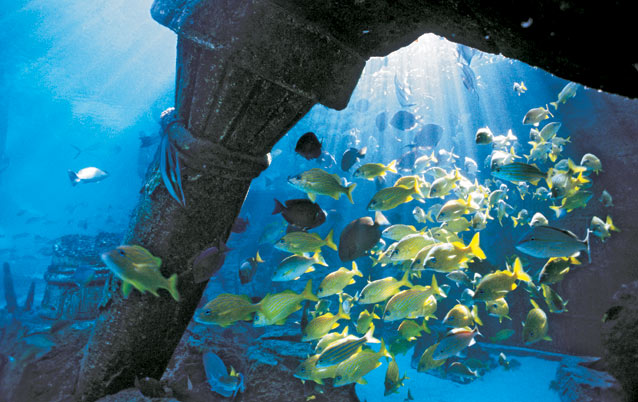
The same is true with natural habitat edges. Have you ever tried to enter a forest where the edge has not been cleared away. It is overgrown with brambles and shrubs and vines. There are insects and birds all over the place. But once you get into the forest, everything opens up again... the biodiversity drops. If you like to fish or hunt, you should already know this. Fish hang out at the edge of banks, at the edge of drop offs, at the edge of underwater obstruction, at the shadow edge of a dock. Deer hang out at the edge of the fields.
Fish at the edge of an underwater structure.
In designing a Permaculture System, you need to keep in mind the importance of edge. Increasing your edge in a Forest Garden, especially when also mimicking the biodiversity of plants typically found at the edge, will increase the beneficial insects, the birds which prey on damaging insects, it will not allow diseases to take hold and wipe out a garden, it will provide more vigorous growth in your plants, and it will likely produce better tasting fruits and vegetables.
This garden is full of edges.
Existing EdgesThere are likely a number of edges that already exist where you live; you just need to realize they are there.
- Wall/Yard
- House/Yard
- Sidewalk/Yard
- Fence/Yard
- Driveway/Yard
- Planting Bed/Yard
- Planting Bed/Fence
- Planting Bed/Wall
- Planting Bed/House
- Pond/Yard
Ways to Increase Edge
Keyholes
Keyhole Garden Bed
The Keyhole is a classic way to increase edge in a garden bed. Simple to design. Not only does it provide more edge, it provides easier access to the plants to tend them as needed.
A Mandala Garden - nested Keyholes (from Gaia's Garden)
Make straight lines wavy.
A circle
A wavy circle has much more edge than the circle above.
This will allow more water-loving plants to be grown, more water edge for frogs to enjoy, etc.
This winding path is probably 6-7 times longer than a straight path would be.
That means it provides 6-7 times as much edge than a straight path. It also helps prevent erosion, collects more rainfall, and turns the trip up the hillside into a leisurely walk instead of a climb.
Other Edges to Consider
There are many other types of edge to consider. Here are just a few off the top of my head:
- Shady Spot/Sunny Spot: Either permanent or partial shade vs full sun
- Low pH soil (acid)/Neutral soil: Occurs at the edge of pine trees for instance
- Planting Bed/Large Rock: The large rock with its heat retention and moisture collection capabilities creates its own microclimate and therefore another habitat edge
Increasing edge is a simple concept with huge benefits. Consider the importance of edge when designing your Permaculture System.
Subscribe to:
Posts (Atom)