Showing posts with label Permaculture Basics. Show all posts

Monday, February 18, 2013

Free E-Book: Introduction to Permaculture by Bill Mollison

Bill Mollison, the co-founder of Permaculture

This downloadable PDF (which opens great in any e-book reader) is a collection of "pamphlets" dealing with many aspects of Permaculture... all from Bill Mollison, the founder of Permaculture. Well, to be honest, it is not quite from him. It is the transcript of a Permaculture Design Course he was teaching in 1981 in New Hampshire. The good folks from Barking Frogs Permaculture taped the course and then typed it all. On top of that, they made it a public resource...free public domain! This compliation of all 15 pamphlets is free to anyone who wants it. A fantastic resource.


Friday, August 31, 2012

Free Permaculture Design Course Videos


Following is a link to free videos from a Permaculture Design Course taught by Bill Mollison, the co-founder of Permaculture. Thanks to my long lost friend Jake for sending me this link. The videos are from 1994 and 1995, so over 15 years later they are admittedly a bit dated (with a very corny intro), but the informational content is still high quality and valid... nature doesn't change. You can watch these online or download them and keep them on your computer. Highly recommend watching these if you get the chance.

http://www.networkearth.org/perma/culture.html#Permaculture

Monday, August 27, 2012

Managing Pseudo-Primary Succession (a.k.a. “planting an empty field”)

Large scale reforestation in Brazil. We can do the same... just a little smaller.
 
I have been writing a lot lately about succession and its phases/stages and how we can use this knowledge to create more diverse and resilient ecosystems and Forest Gardens. If you remember, Primary Succession is the creation of an ecosystem from bare soil with no life in it. Secondary Succession is the regeneration of an ecosystem after a disturbance.

Now in reality, there is no place on earth that is devoid of life but for a very few places which we would not be living anyway. Every location likely had forest or meadow or prairie on it at some point in the past. Often what we find though is a place which one to two hundred years ago was a forest, but now is an abandoned corn or hayfield. The disturbance has been so large and repeated so often that we are almost starting from scratch in these locations. Trying to recreate a vibrant ecosystem, and in our case a food forest woodland, in this scenario is what I call pseudo-primary succession. The most extreme example of this that I have seen is what Geoff Lawton has done in Jordan and is well documented in his Greening the Desert video.

Many people have attempted to create a full forest garden in an abandoned farm field by planting all the fruit trees they wanted at one time. What they often end up with is a large die-off of these plants or lack of vigor in growth. It may take two or three times as long for these plantings to turn into a viable ecosystem than if they would have understood the power of succession. Many of the plants may be stunted or producing a fraction of what they have the potential to produce.

One of the big reasons that the plants do not do well in the above scenario is that they are competing with pioneer species. Pioneer species are plants, often considered weeds, which are just waiting to grow in newly turned soil. An abandoned field is full of these dormant seeds. In nature, pioneer plants are a vital part of succession. They cover the soil quickly and reduce erosion. They often have deep taproots that pull nutrients from the depths. They do well in droughty, full sun, bare soil conditions. As described previously in the stages of succession, the first plants are annuals and herbaceous perennials. Eventually shrubs and then trees appear. Pioneer species can be all of these types of plants, but the larger shrubs and trees often take many years to appear.

Let’s face it. Many of the plants we would want in a forest garden (apples, pears, peaches, etc.; a.k.a. “goal species”) are not known for their ability to withstand harsh environments of poor soil, high evaporation, and low moisture. So when we plant these somewhat weak species in a field that has limited natural fertility and is full of plants made for this environment, our weak plants are just not going to do very well. If they do well, it is because they happened to get placed in a very forgiving microclimate or because we have done a lot of work to provide for their exacting needs.

But I don’t want to do a lot of work if I can let nature do it for me.

This is where managing the pseudo-primary succession comes in to play. We can choose the pioneer species that grow on our land. Granted, there will always be other pioneer species that we did not plant or did not desire, but we will tip the balance in our favor by seeding and direct planting of our desired species.

So what makes a pioneer species desirable? Here is a partial list of attributes we are looking for in pioneer species:
 

ATTRIBUTES FOR PIONEER SPECIES
  • Grows Well in the Soil we Have – “poor” soils have different meanings around the world)
  • Grows Well with Moisture We Have – typically this is low to very low moisture
  • Fast Growing
  • Nitrogen Fixing – Having a high proportion of plants that put nitrogen back into the soil will enhance soil fertility; nitrogen fixing trees are strongly recommended
  • Produces High Levels of Biomass – leaves and branches that fall off every year which increase the organic components of the soil
  • Dynamic Accumulators – plants that put nutrients into their leaves, often mined from well below the soil surface through deep taproots, and then lose those leaves each year increasing the mineral content of the topsoil
  • Producer – if the plant can provide us a harvest, all the better!
  • Tolerates Frequent Pruning – we can build soil faster by chopping back leaves and spreading them around on the ground (a.k.a. “chop and drop”) when a plant can quickly regrow those leaves. Some plants can tolerate quite heavy prunings two or three times a growing season.
  • Intolerant of Shade – I’ll explain why this is important in just a bit

Once we have our bare land ready, and this may take some earthworks (pond creation, swale creation, etc.) which I have and will discuss in other articles, then we can plant our chosen pioneer species. As I said, pioneer species can range in form from annuals to trees. We can blanket the ground in seeds of annuals and herbaceous perennials to start, but we can fast forward the natural progression which can take over a decade, by directly planting pioneer shrubs and trees species as well.

Some people will give anywhere from one to three seasons for the pioneering woodland to mature. Others will just plant the goal species at the same time. I don’t think there has been enough research yet to know which method is better. I think giving things at least one season makes sense. This allows the barren site to begin resembling a small woodland (Oldfield Mosaic stage). Then the goal species are planted near the nitrogen fixing trees. Our goal species then have what is known as a nurse tree growing near it providing wind protection, excessive sun protection, evaporation protection, and excess nutrients primarily of nitrogen but also other nutrients from the other pioneer species near it.

Within a few more years, the goal species are growing vigorously alongside their nurse trees. Eventually, often only after two or three years, our goal species are getting crowded. This is when we cut back or cut down our nurse trees. These trees can be used for firewood, lumber, mulch, mushrooms, etc. Now the goal species has a sudden increase in light and below ground biomass (i.e. nutrient load), and there is often another surge of growth as our goal species become the new canopy layer in our woodland.

Some of the reseeding annuals, herbaceous perennials, and shrubs will continue growing in patches of sunlight, but all the other plants will eventually find themselves in shade. If we chose plants intolerant of shade, which was one of our goals, then they will die out. This leaves us room to plant other goal species of reseeding annuals, herbaceous perennials, and shrubs that thrive in the understory yet still provide us with direct or indirect uses. Direct use would be the harvest of fruit, vegetable, wood, fuel, cordage, medicinals, animal feeds, etc. Indirect use would be beneficial insect attractors, dynamic accumulators, mulch plants, windbreak plants, barrier plants, etc.

Using succession, or what I call managed pseudo-primary succession, will give us a more vibrant, diverse, and fertile ecosystem which is typically established much sooner than a forest garden planted without regard to succession.

I’ll be providing a list of Pioneer Species soon, so stay tuned.
 

Thursday, August 23, 2012

Using Succession in Permaculture

Martin Crawford, the UK's premier Forest Gardener in his own Forest Garden.
 
 
I recently wrote about succession in ecosystems. So, how do we apply that knowledge? This is a great place to utilize Permaculture Principle One: Observe and Interact. Now that we have a better understanding of succession, we can answer an important question when we are evaluating or “observing” a piece of land. What state of succession is this land in right now? Likely, our answer will be something like this: The section over here is in a Steady State (or close to it). The section over there is Oldfield Mosaic. This area that used to be a corn field is just entering Soil Initiation.

The “interact” portion of Permaculture Principle One has a bit more to it. It really depends on our goals. Most people would naturally think that our goal should be do develop and design for a Climax or Steady State. However, we now know that production peaks in mid-succession. When exactly this occurs is a lot more difficult to pin down, but it is typically somewhere from the Oldfield Mosaic stage to the Transition to early Climax stage. We also know that diversity increases with more disturbances. In a sense, we never want our land to arrive at the Climax stage, but we would rather it continuously cycle between disturbance and secondary succession.

It is those disturbances that we will create and manage to keep our ecosystem productive. We don’t do this with burning down our forest or bulldozing all the fruit trees, but we do it with pruning, culling, coppicing, and harvesting. We can also manage the secondary succession, give it direction, and help it on its way.

So how is this done? Let’s take a closer look at each of these methods.

Pruning – this is trimming a plant to accomplish a number of goals. It can be used to trim away diseased portions of the plant. It can be used to trim away dead or old non-productive branches. It can be used to open up space for a view or to cut back overgrowth on a trail or path. It can be used to allow more sunlight through the branches. It can be used to thin a tree to allow more wind to go through the plant than over and around it. It can be used to shorten the plant for easier harvest or to prevent it from growing over a roof or into electric lines. It can be used to train a plant to grow in a certain pattern or direction. The list can go on and on. Whatever the reason for our pruning, it allows more sun and rainfall through, and therefore changes the microclimate underneath. We can plant species that will grow well in this new microclimate or let the understory change on its own.

Culling – this is removing a plant for a number of reasons. We cull plants because they are too big, too small, too expansive, too much work, not productive enough, not a species or variety we like (appearance, fruit, etc.), if it was planted in the wrong place years ago, if it is casting too much shade, blocking too much wind, blocking a view, too disease or pest prone, etc. When we cull a plant, especially a large shrub or tree, we suddenly have a very large area underneath no exposed to sunlight, rainfall, evaporation, decreased shade, decreased leaf fall, etc. This is an opportunity for sun loving plants fill that void. We can let nature decide, but better yet (since this is typically a much larger space) we can immediately fill that gap with plants that would do well in that new microclimate. Fill it will plants that can benefit us and the ecosystem as a whole.

Coppicing – this is cutting trunk and branches from a tree to harvest the wood while not killing the plant. In a number of years, and this varies depending on species and climate, the plant can be harvested again. Read this article for a more in depth description. Coppicing lies between pruning and culling. It significantly opens up a large gap as culling does, but it does not leave that space open for other large shrubs or trees to take over. Plant species with shorter life spans can grow, mature, and produce a good harvest for a few years before the coppiced plant shades out the understory again. Blackberries and gooseberries are shrubs that can fill this niche, but many herbaceous perennials will as well. Herbs and even annual vegetable gardens can be even placed here for a few years. This will take advantage of the good soil that had been building up under the tree, and will give us reason to rotate our annual vegetable plot locations. We just need to keep in mind root depth, as the coppiced tree stump or “chair” is still there in the ground (so root crops like carrots may not be a great idea), and negative allelopathy, the ability for some plants (e.g. black walnut) to produce chemicals from their roots and fallen leaves that inhibit growth of other plants.

Harvesting – this is taking anything from the plant that we are going to use. Harvesting the fruit or leaves off a plant typically is not done in such a way as to change the microclimate around the plant. The type of harvesting that will change the microclimate is with coppicing or significant pruning (e.g. bamboo).

Managing Secondary Succession – As described above, anytime we create a new microclimate and have the opportunity to sow seeds or place new plants in that location, we are, in effect, managing secondary succession. We could let nature do this on its own, but we will likely end up with plants that are considered “weeds”. What this really means is that plants for which we don’t have a significant use have filled a place we would rather grow other species. So let’s beat those less than desirable plants to the punch. If we completely fill that new location with beneficial plants and seeds that are well suited for that microclimate, then our plants will typically out-compete those other plants. If we do this over and over again with any disturbance that occurs, whether planned or unplanned, then we will eventually have a very diverse, very resilient ecosystem that is chock full of plants for which we have direct or indirect use. Direct use would be the harvest of fruit, vegetable, wood, fuel, cordage, medicinals, animal feeds, etc. Indirect use would be beneficial insect attractors, dynamic accumulators, mulch plants, windbreak plants, barrier plants, etc.

So, in closing, this is a general overview of utilizing the concepts of succession in an established woodlot or forest garden. I’ll be writing soon about how to apply succession in the development of an empty field.
 

Tuesday, August 21, 2012

What is Succession?

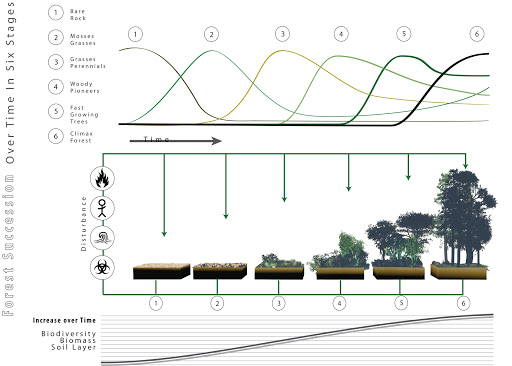
Forest Garden Succession
(click on the image to enlarge)


In ecology, as well as in Permaculture, there is a concept known as succession. This is the idea that an ecosystem will transition through stages of growth and maturation. To look at it simply, an empty field will first grow weeds and grasses then shrubs and small fast growing trees then more mature, longer-lived trees until a forest is formed. The individual species and final result will vary depending on where in the world this occurs with its macroclimate and microclimates taken into account.

How do we define the basic steps in succession starting from a piece of bare, lifeless ground to a self-sustaining forest? There are a number of ways to categorize and describe it; following is the system I prefer:
  1. Bare soil – No life here at all
  2. Soil Initiation – Bacteria then Algae begin to grow and spread
  3. Crust – Lichens, Mosses
  4. Oldfield – Annual herbs and grasses, then Herbaceous perennials
  5. Oldfield Mosaic – Shrubs begin to grow, then Sun-loving trees
  6. Stand Initiation – Maturation of Sun-loving trees
  7. Understory Repression – the previous herbs, grasses, herbaceous perennials, and shrubs that cannot tolerate shade will die back
  8. Stand Differentiation – as faster lived trees die back, the slower growing trees fill in the gaps to complete the canopy layer
  9. Understory Reinitiation – this really occurs with Stand Differentiation, and is when shade tolerant plants (sub-canopy trees, shrubs, herbs, etc.) establish under the canopy layer
  10. Climax – this is the stable, self-replicating, self-sustaining ecosystem

Of course, since this is nature, there are a number of problems with any simplistic generalizations. First, there really is no place that naturally occurs where there is Bare Soil and no life. Man has created a few of these places, way too many, in fact, but they are very uncommon. Second, at the other end of our succession scale we find Climax. Unfortunately, in nature we rarely find a place that is in true Climax either.

Third, succession is not linear. What we really see in nature is a piece of land in various stages of succession. There may be a large forest somewhere close to a Climax stage when a storm blows down a massive tree. The sudden opening of the canopy, which lets in a lot more light, causes that one section to revert many years or decades, maybe to the Oldfield stage. Forest fires, floods, drought, pests, disease, and man-made interventions like logging, mining, etc. can all cause a disturbance in the natural progression of linear succession. What we actually see in nature is a constant cycling back around through these stages. This is known as a Shifting Mosaic.

In the Shifting Mosaic theory there are a few phases:
  1. Primary Succession – described above
  2. Disturbance – described above
  3. Reorganization – the ecosystem reestablishes control of the energy flows of nutrients, sunlight, water, etc.
  4. Aggradation Stage – this is just a fancy way of saying the “building up” stage; has also been called Secondary Succession
  5. Transition – this is where the ecosystem is maturing, but is not yet at the Climax stage
  6. Steady State – this is another way of describing the Climax stage

Again, this does not perfectly describe what happens in nature. Ecosystems will cycle through the disturbance, reorganization, aggradation, transition phases only to be hit with another disturbance before a steady state has been reached. This will happen over and over again. Also, the idea of a stead state is also not static or stable. There are always shiftings of species diversity and plant density and small disturbances with isolated reorganization and aggradation here and there. I love David Jacke’s phrase for this: Cycles of Succession and Wobbling Stability.

It is important to keep in mind that this non-linear journey of succession actually leads to a more diverse ecosystem in the long run. There are more opportunities for new plant species to grow and develop a niche.

So there you have it. A quick primer on ecosystem succession. I'll be writing soon on how to apply this to Permaculture design.
  

Friday, May 25, 2012

Geoff Lawton on the Survival Podcast


I wanted to throw up a quick link to an interview I just listened to. It's Geoff Lawton, the director of the Permaculture Research Institute, being interviewed by Jack Spirko of the Survival Podcast. Geoff Lawton is one of the leading and most knowledgeable practioners of Permaculture today. If you would like a general overview of what Permaculture is all about, listen to this podcast.

Tuesday, January 31, 2012

The Permaculture Movement Grows From Underground


This is an interesting article from The New York Times "In The Garden" section.


The Permaculture Movement Grows From Underground
By MICHAEL TORTORELLO
(photo of author and his daughter planting seeds - by Sara Jorde for The New York Time)
(click here for a link to the original article)

As a way to save the world, digging a ditch next to a hillock of sheep dung would seem to be a modest start. Granted, the ditch was not just a ditch. It was meant to be a “swale,” an earthwork for slowing the flow of water down a slope on a hobby farm in western Wisconsin.

And the trenchers, far from being day laborers, had paid $1,300 to $1,500 for the privilege of working their spades on a cement-skied Tuesday morning in late June.

Fourteen of us had assembled to learn permaculture, a simple system for designing sustainable human settlements, restoring soil, planting year-round food landscapes, conserving water, redirecting the waste stream, forming more companionable communities and, if everything went according to plan, turning the earth’s looming resource crisis into a new age of happiness.

It was going to have to be a pretty awesome ditch.

That was the sense I took away from auditing four days of a weeklong Permaculture Design Certificate course led by Wayne Weiseman, 58, the director of the Permaculture Project, in Carbondale, Ill.
The movement’s founders, Bill Mollison and David Holmgren, coined the term permaculture in the mid-1970s, as a portmanteau of permanent agriculture and permanent culture.

In practice, permaculture is a growing and influential movement that runs deep beneath sustainable farming and urban food gardening. You can find permaculturists setting up worm trays and bee boxes, aquaponics ponds and chicken roosts, composting toilets and rain barrels, solar panels and earth houses.
Truly, permaculture contains enough badges of eco-merit to fill a Girl Scout sash. Permies (yes, they use that term) like to experiment with fermentation, mushrooming, foraging (also known as wildcrafting) and herbal medicine.

Yet permaculture aims to be more than the sum of those practices, said David Cody, 39, who teaches the system and creates urban food gardens in San Francisco.

“It’s an ecological theory of everything,” Mr. Cody said. “Here’s a planet Earth operating manual. Do you want to go along for a ride with us?”

It’s hard to say just how many have climbed aboard the mother ship. In San Francisco, Mr. Cody saw more than 1,500 volunteers turn out in 2010 to create Hayes Valley Farm, a pop-up food garden near the site of a collapsed freeway ramp.

“I like to say it was the largest sheet-mulching project ever done in the world,” said Mr. Cody, who designed the garden following the permaculture principles and directed the process of covering the ground with a cardboard weed barrier and organic material.

“We sheet-mulched about an acre and a half,” he said. “That’s something like 80,000 pounds of cardboard diverted from the waste stream.”

In the last four years, Mr. Cody has helped train 250 students through the Urban Permaculture Institute in San Francisco.

Scott Pittman, 71, who directs the national Permaculture Institute from a farmstead outside Santa Fe, N.M., estimates that 100,000 to 150,000 students have completed the certificate course since the philosophy was developed in Tasmania over three decades ago. “In the U.S., I would say we represent 40,000 to 50,000 of that number,” he said.

But then pemaculture has no membership rolls or census-takers. By intention, “it has been, for all of the years I’ve been involved, a pretty decentralized movement,” Mr. Pittman said. The message seems to get out in its own fashion, without publicists. Mr. Mollison, for example, has been permaculture’s leading figure since the late 1970s, and his books have hundreds of thousands of copies. Yet his name has apparently never warranted a mention in this newspaper.

Permaculture, Mr. Pittman said, is “guided by the curriculum and a sense of ethics, and that’s pretty much it.”

The ethic of permaculture is the movement’s Nicene Creed, or golden rule: care of the earth; care of people; and a return of surplus time, energy and money, to the cause of bettering the earth and its people.

In its effort to be universal, permaculture espouses no religion or spiritual element. Still, joining the movement seems to strike many of its practitioners as a kind of conversion experience.

MR. Pittman first encountered Mr. Mollison and his teachings at a weekend seminar in New Mexico in 1985. As a system, permaculture impressed him as panoptic and transformational. “It shook my world,” Mr. Pittman said.

Almost on the spot, he decided to drop his work and follow Mr. Mollison to the next stop on his teaching tour: Katmandu, Nepal. Soon after, he began to lead courses alongside Mr. Mollison, in cities and backwaters around the globe.

Mr. Mollison hasn’t toured the United States in almost 15 years. At 83, Mr. Mollison has “kind of faded into semi-retirement in Tasmania,” Mr. Pittman said.

Yet in recent years, Mr. Mollison’s ideas seem to have bubbled up from underground, into the mainstream. “I just trained the Oklahoma National Guard,” Mr. Pittman said. “If that’s any kind of benchmark.” The troops, he said, plan to apply permaculture to farming and infrastructure projects in rural Afghanistan.

It’s a system, permaculturists contend, that can work anywhere. In Park Slope, Brooklyn, Claudia Joseph, 53, has used the precepts of permaculture to develop new food gardens at the Old Stone House. (Its original 1699 Dutch edifice was a locus of the Battle of Brooklyn in the Revolutionary War.) “It’s a huge breakthrough,” she said. “To go from a swatch of grass to 1,000 blueberry bushes.”

The parks department recently bulldozed two of her gardens in an overhaul of the playground in the surrounding Washington Park. But in a few protected spots, Ms. Joseph, an environmental educator and consultant who lives two blocks away, has already started on an edible food forest.

This “guild” of complementary plants is the opposite of annual row-crop agriculture, with its dead or degraded soil and its constant demand for labor and fertilizer. Permaculture landscapes, which mimic the ecology of the area, are meant to be vertical, dense and self-perpetuating. Once the work of the original planting is done, Mr. Mollison jokes in one of his videos, “the designer turns into the recliner.”

At the lowest level of a food forest, then, are subterranean crops like sweet potatoes and carrots. On the floor of the landscape, mushrooms can grow on felled logs or wood chips. Herbs go on the next level, along with “delicious black cap raspberries,” Ms. Joseph said.

Other shrubs, like inkberry, winterberry and elderberry, are attractive to butterflies and birds. They’re an integral part of the system, too.

But more likely to appeal to the children who attend the nearby William Alexander Middle School is a Newtown Pippin apple tree, “a variety first grown in Queens,” Ms. Joseph said.

Ruling the forest’s heights are the 40 large pin oaks already in the park, whose abundance of acorns will make a banquet for squirrels. Permaculture also looks favorably on high-quality bushmeat. But Ms. Joseph will be leaving that harvest well enough alone.

With its focus on close planting and human-scale projects, permaculture is ideally suited to a small suburban yard or a patio garden. But most of the students I met in Wisconsin had their own 1,000-blueberry-bush visions and ideas on how permaculture could help fulfill them.

Kellie Anderson, a 27-year-old rolfer, lived for five months in a giant sequoia tree named Keyandoora. (At the time, she was protesting a logging plan in Humboldt County, Calif.) After the workshop, Ms. Anderson said, she planned to inhabit a 1986 diesel school bus that she and her boyfriend were in the process of converting into a camper. But fortune seems to have taken her instead to Sanibel Island, Fla., where she is now helping to plan a sustainable-housing community.

Kris Beck, 48, a founder of an energy-efficiency tech company, had a notion to build a sanctuary with a megalithic stone circle (think Stonehenge) on her family’s old Wisconsin dairy farm, along the Mississippi River bluffs.

Bruce Feldman, 60, who spent two decades as an English teacher overseas, experienced the collapse of the baht in Thailand (he was being paid in that currency), and an earthquake in Japan, in 1995, that left him wandering the streets for four days. These events, Mr. Feldman said, “got me thinking that I should start preparing for my own future,” ideally, a four- or five-acre self-reliant homestead in the Ozarks of Arkansas.

The site of the workshop was a permaculture Shangri-La unto itself: 60 acres of rolling pasture and woodlands, a few miles from the Buffalo River in Wisconsin. In 2004, Jeff Rabkin and his wife, Susan Scofield, bought this Amish farm for $125,000.

The original plan was to lease out the fields and build a cordwood cabin as a weekend home. Instead, under the influence of permaculture, Mr. Rabkin became seized with the idea of stewarding the property himself. To this end, he and a permaculture buddy, Victor Suarez, 44, bought a small flock of sheep and planted 300 fruit and nut trees.

During the work week, Mr. Rabkin, 49, and Ms. Scofield, 48, run a marketing and public relations firm in Minneapolis. That background is apparent in the catchy name they gave the place: Crazy Rooster Farm and Amish Telephone Booth.

But the Amish telephone booth is no gimmick. The couple installed a phone line in the shed next to their farmhouse, and their neighbors roll up in buggies to make calls.

While Amish visitors mill around in Mr. Rabkin’s yard, they may strike a deal to sell him three steer and two heifers, or 20 black-locust fence posts. Like a coneflower patch draws honeybees, Mr. Rabkin said, “I like to say that the telephone attracts beneficial wildlife — our Amish neighbors — which is what permaculture tells us to do.”

Ms. Scofield collected asparagus, beets and raw milk from neighboring farms to feed the permies. The occasional Amish visitor, like Thomas Zook, who delivered a bucketful of new potatoes in the middle of a downpour, gave a glimpse of what low-impact living might look like, taken to an extreme.

Mr. Zook’s father, Jonas Zook, even dropped in to watch a video about pond management, but walked out after a minute or two. After marathon days of PowerPoint presentations, I wouldn’t have minded joining him. For all its exhilarating ideals, permaculture is a movement grounded in “zones,” “patterns” and “functions.”

Labs, as it were, took place in the toolshed. On the first day, Mr. Weiseman demonstrated how to create biochar, or partly burned charcoal, in a primitive “rocket” stove, a device he assembled out of a piece of ductwork and a paint can.

Helpful mineral elements attach themselves to the unique molecular structure of biochar, Mr. Weiseman explained. Mixed with compost, it makes a top-dressing for trees.

Next, he started bubbling compost tea with an aquarium pump in a plastic bucket. (“Even petroleum has a place in permaculture,” he said. “The five-gallon bucket is the greatest application of petroleum in the world.”) He wrapped a clump of standard compost in a cloth like a hobo’s bandanna pack and dunked it in water. Next, he added molasses to feed the brew.

After a couple of days, we would fling this brownish broth over the kitchen garden to enrich the soil with beneficial bacteria.

That was the concept, anyway. A week after the workshop, I ran these theories past Jeff Gillman, 41, an associate professor at the University of Minnesota and an author of four books about gardening practices and the environment.

He professed to be “a believer in the whole concept of permaculture.” But he dismissed the compost tea as “lunacy.” Scattering a few foreign microbes into a sea of soil, he said, was like parachuting 10,000 people across the breadth of the Sahara. They would not survive.

Normal compost, the solid stuff from a backyard bin, “should already contain all the microbes that are beneficial to the soil,” he said. And if it doesn’t, “beneficial microbes move in very, very quickly.”

With biochar, Mr. Gillman admitted to a bit of bafflement. “Charcoal, in general, is not in and of itself harmful to soil,” he explained. “It helps to hold on to nutrients. But having said that, it boggles my mind why you would take a perfectly good block of wood that you could use as compost or mulch, and burn it.”

In a broad sense, though, permaculture is not about the scientific method or textbook agronomy.

“I don’t know that anyone has ever done a double-blind study of permaculture,” said Mr. Pittman of the national Permaculture Institute. “Most people in permaculture are not that interested in doing those kinds of studies. They’re more interested in demonstrating it. You can see the difference in species diversity and yield just by looking at the system.”

As Mr. Weiseman observed, permaculture may be a “leap of faith.” But not leaping might have its own consequences.

Beginning with Mr. Mollison, permaculturists have forecast a near future of resource scarcity. “Not just peak oil,” Mr. Weiseman said, “but peak water, peak soil.”

And the news, with its drumbeat of economic decline and ecological catastrophe, feeds the prophecies. In this dystopia to come, permaculture won’t be a lifestyle choice, but a necessity.

“We know what’s right,” Mr. Weiseman said. “We know what’s best. We feel this thing in our bones and in our heart. And then we don’t do anything about it. Or we do. And I did. And it’s bearing fruit.”

But preparing for doomsday in San Francisco, Mr. Cody said, is not what draws a crowd of busy souls to shovel horse manure on a drizzly Saturday morning. To the 12 central tenets of permaculture, then, Mr. Cody added a 13th: “If it’s not fun, it’s not sustainable.”

In other words, why mourn the eventual demise of our office blocks and factory farms, when there’s a feast to be made, right now, in your own backyard?

Thursday, January 26, 2012

Permaculture Succession

This tiny apple seedling...

...will one day become a large tree, but it can take a decade.

When most of us think about landscape design, we think about what goes where. We think about three dimensions. Height. Width. Depth. The X-Y-Z axis... Will this plant "work" here or there? I think I will plant this shrub next to this tree for a specific benefit.

A few of us will think about seasonal changes... This deciduous tree will lose its leaves in Autumn and let sunlight through in the Winter. These bulbs will come up in early Spring, bloom, and die back before my other perennials really start growing tall enough to over-shadow them.

There are even fewer still who will think about the changes that take place over years or decades. This is the realm of Succussion.

Succession is a well known ecological concept.
We need to remember that Permaculture is about modeling the natural world...
so our designed ecosystems should at the minimum acknowledge succession.

Succession, in a Permaculture or Forest Gardening world, deals with the design of plant community changes and transformations over the fourth dimension... time. This is a massive topic. When we starts to think about it in depth, we can get easily overwhelmed. I just want to introduce the topic today. Future articles will tackle specific aspects of succession, but today, I just want to wrap our minds around the idea of design over years.

Let's just take the planting of a single tree. Let's make it a full-sized, or standard, apple tree. This tree will take up to eight years to begin producing and over a decade to begin producing full crops (yet another reason I need to get my land as soon as possible! but that is another story). In a Permaculture design, especially a Forest Garden, we need to remember that this tree will not be growing on its own in a field by itself. There will be other plants around it. There will be other trees nearby. But this tree when first planted is likely only a few years old and no more than a few feet tall... a spindly twiggy shadow of what it will be in future years.

The most important thing we need to do is plan for the future mature size of this tree. The biggest mistake people make in planting trees in a Forest Garden is to plant trees way too close together. This is done often because they have limited space and want to squeeze as many varieties of plants and trees in as they can, and this temptation is made easier when the trees are so small to begin. The second reason, closely related to the first, is that because the tree is so small in its young stage, it is hard to picture what it will be like when full grown. Its hard to see that one foot sapling black walnut as a towering 100 foot (30 meter) colossal tree.

I cannot overemphasize the importance of schematic sketches of our land. We need to have a rough sketch, at the minimum, even if you are not a great artist, of what the land will look like in 1 year, 5 years, 10 years, 20 years, etc. We need to keep in mind how things will change, because they will change! This is not a bad thing. In fact, it is what we want!

I've seen too many people get upset that, for instance, a ten year old raspberry patch just isn't producing anymore. They don't want to pull it out, because they are attached to it. But it isn't producing much anymore, and the birds eat what is produced. It then gets straggly and overgrown and frankly, quite ugly looking. Well, raspberries only have about a ten year useful life! What did you expect? Plan for that change!

How about this? Place that raspberry patch surrounding that young apple tree. We will be using that space that will one day be shaded out by that apple tree. We will be protecting that young apple tree by surrounding it with thorny plants to keep the deer away. We will be collecting a yield from that land until the apple tree really starts to produce. The raspberries will just be fading out as part of their normal life cycle just as the apple is coming into its own. We will be motivated to clear out the old raspberries, so we can harvest the apples easier.

This is the concept of succession. Start thinking in the fourth dimension!

Wednesday, November 9, 2011

Principles of Permaculture: Principle Twelve - Creatively Use and Respond to Change


Holmgren's Twelve Principles of Permaculture
1.  Observe and Interact
2.  Catch and Store Energy
3.  Obtain a Yield
4.  Apply Self Regulation and Accept Feedback
5.  Use and Value Renewable Resources and Services
6.  Produce No Waste
7.  Design from Patterns to Details
8.  Integrate Rather than Segregate
9.  Use Small and Slow Solutions
10. Use and Value Diversity
11. Use the Edges and Value the Margin
12. Creatively Use and Respond to Change


Principle Twelve: Creatively Use and Respond to Change
Holmgren's Proverb for this Principle:  Vision is not seeing things as they are but as they will be.

I believe that this principle is really talking about two types of change and our reaction to it.  The first is change that is seen or anticipated.  A prime example of this is the concept of succession.  In ecology, succession is the change that an environment will go through as it progresses toward maturity or climax.  An idealized illustration is how an abandoned farm field will become overgrown with weeds and grasses and then become a meadow then an early forest and then a mature forest.  Another example is the progression of the seasons from Summer to Autumn to Winter to Spring and back around again.  If we are managing our land and garden for this change, which comes as no surprise, then we can incorporate these changes into our Permaculture design.  One quick design example is how we can sow an area that has poor quality soil with a non-frost-resistant nitrogen-fixing plant.  Come winter, the plant will die back providing a mulch, organic material, and nitrogen to the soil.  We don't have to do the work that nature can do for us instead.  That is smart design!

The other type of change is the change that is unforeseen.  The change for which we did not plan.  This can be anything from a tree that is killed by lightning, wind, or pest to the death of your chickens by a raccoon.  It can be as big as the death of a loved on or a house fire or as small as a flat tire or seeds that didn't sprout.  Also, remember that not all unforeseen change is negative.  We may have a bumper crop of tomatoes or peppers, a sheep that bears triplets, or an unexpected inheritance.  The key to success with this type of change is how we handle it, our ability to adapt.  The overused adage, "When life gives you lemons, make lemonade" is very applicable.  There is a famous quote from Bill Mollison, the co-founder of Permaculture, when discussing pests in the garden.  He said, "You don't have a slug problem, you have a duck deficiency!" That is the attitude and the creativity we need to have in the face of unforeseen change.

"Vision is not seeing things as they are but as they will be" (an old Japanese proverb) reminds us that there is usually an opportunity in all change, unforeseen and expected.  It is up to us to have the vision to plan for or adapt to that change to come out better, or at least not as bad as others in a similar situation, on the other side.

We can have a positive impact on inevitable change by carefully observing, and then intervening at the right time.
- David Holmgren

Tuesday, September 27, 2011

Permaculture Principles: Principle Eleven - Use the Edges and Value the Margin


Holmgren's Twelve Principles of Permaculture


Principle Eleven: Use the Edges and Value the Margin
Holmgren's Proverb for this Principle:  Don't think you are on the right track just because it's a well beaten path.

This principle highlights a vital component to Permaculture design itself... the edge.  I wrote about the Importance of Edge more extensively in this post.  The main thing to consider is that if there is more life and richer biodiversity in the edge, then we should do all we can to increase the edge.  While the fastest route from point A to point B is a straight line, nature doesn't do straight lines.  If we are truly trying to mimic nature, then we should avoid straight lines as much as possible.  Of course, sometimes we need straight lines with certain design elements (roads, piping, wires, etc.), but the point is to question it when you see it.  Make sure it is vital and not just for us to impart our perception of "order" on the natural world.

Valuing the Margin reminds us that the mainstream is not always right.  There have been many things that have been abandoned, left on the margin, for reasons that have more to to with mass commercialism than wisdom or prudence or sustainability.  I often think about the loss of all the genetic diversity and flavor in our extinct varieties of plants and animals that we call Heirloom or Heritage Food.  The main reasons for their absence on our dinner plates is mainly due to shipping and storage and not flavor or consumer desire.  What else on the Margin have we passed by because everyone else has ignored... ideas, tools, design, people?

"Don't think you are on the right track just because it's a well beaten path" reminds us to reevaluate what we consider not worth considering.

The interface between things is where the most interesting events take place, these are often the most valuable, diverse and productive elements in the system.
- David Holmgren

Wednesday, September 14, 2011

Permaculture Principles: Principle Ten - Use and Value Diversity


Holmgren's Twelve Principles of Permaculture


Principle Ten: Use and Value Diversity
Holmgren's Proverb for this Principle:  Don't put all your eggs in one basket.

Variety is the spice of life!  It is also the key to sustainability.  Nowhere in nature do you see just one thing, one plant, one environment.  Our Permaculture Design should be no different.

Our plants should be diverse - this allows more variety in our diets which is healthy, more redundancy in our harvest which is prudent, less monoculture which is great for pest confusion, healthier soil, and creates habitats and microclimates which in turn lead to increased diversity of insects, birds, mammals, fungi, and all life in general.  One way to utilize diversity in plants as a design element is with the concept of Permaculture Guilds.

Our plant species themselves should be diverse - besides diversity in flavors, different varieties also provide diversity in pest and disease resistance.  Early season, mid season, and late season varieties also provides much needed and desired redundancy.  It helps ensure a crop regardless of late frosts, droughts, pests, or any other unforeseen calamity that strikes at the perfect, or worst possible, time.

Our systems should be diverse - again this also allows for greater redundancy, which again provides more stability in our total system.  Water harvesting is one of the most important systems that need to have diversification.

Finally, this diversity can also apply to many things non-agricultural: investing, skills, education, transportation, communication, communities, etc.

"Don't put all your eggs in one basket" reminds us that when we rely on only one method or system, if that system fails, then we have guaranteed failure instead of success and sustainability.

Diversity reduces vulnerability to a variety of threats and takes advantage of the unique nature of the environment in which it resides.
- David Holmgren

Wednesday, September 7, 2011

A Pictoral Representation of Permaculture... the Temperate Climate Permaculture Header

 
I wanted to take a post to explain my header you see at the top of the page.  This is not just a random collection of images or something I found on the web.  Each element was chosen specifically for what it represents.  I must admit though, that my previous years as a graphic designer and my perfectionism causes me some consternation every time I look at it.  I don't think the images merge very well, but I don't have the time or the resources to make this header exactly as I see it in my mind.  But it's not too bad, and it really does represent what I see as the big picture of what Permaculture is all about.

 
 This central circle represents examples from the seven most important aspects, as I see it, of Permaculture.  At the top and moving in a counter-clockwise manner is:

 
  1. Sunlight.  All energy that we are really concerned about on Earth is derived from the Sun.  Whether this is direct as heat, indirect as solar electricity, or very indirect like petroleum.  It all came from the Sun.
  2. Water.  Without water, we have no life.  Very simple.
  3. Soil.  Healthy, living, rich soil contains all the building blocks of life.  It is not just dirt.
  4. Fungus.  Connects all living plants in an amazing underground network through the soil in a way we are just beginning to understand.  Vital to decomposition.  The fruiting bodies (mushrooms) of some fungi can be used for medicine, food, and dyes.  Pictured is a Golden Chanterelle, one of my favorites.
  5. Insect (Animal).  Vital to pollination.  Vital to a healthy soils and ecosystems.  Certain insects, like the honey bee, can be beneficial to humans by not only providing pollination, but also honey and wax.  Many other animals (and yes, insects are animals) can have symbiotic relationships with humans; we provide them a happy, and maybe shortened, life, and they provide us with many of our needs.
  6. Plants.  The sunflower represents a plant that has many uses: beauty for humans, seed for humans and animals, nectar producer for insects and birds, shade, large leaves that are great for mulch, strong central stem that could be used as a trellis for climbing beans... we need to pick plants that have many uses.
  7. Harvest.  Represented here by the apple.  The ultimate goal of Permaculture Systems is the harvest for humans.  By incorporating the Ethics of Permaculture and the Principles of Permaculture into our design, we can have sustainable harvests.


This image shows both a pasture with trees (used to represent the sustainable method of rotational grazing) and an untouched forest (used to represent Permaculture Zone 5).  The transition between the two, the Edge, is another very important concept in Permaculture.


These three images are examples of food items that can be produced from our Permaculture System.  They can be used as storage for personal use weeks to years later or sold for income as "value added" products bringing in more money than the individual ingredients.  The examples here represent:
  1. Preserving the harvest - represented with canning (vegetables, fruits, jams, preserves, jellies, etc), but also includes dehydrating, freezing, smoking, curing, etc.
  2. Food from animals - honey from our bees can be used in many ways, but meat and eggs from other animals can be used as well
  3. Fermentation -  alcohol (beer, wine, liquor, mead, etc), vinegar, pickles, sauerkraut, etc.

 
These three images are examples of non-food products that can be used by us or sold:
  1. Fiber - this can be from animal or plant and can make string, yarn, and rope
  2. Wood - this can be as firewood, lumber, or support (fenceposts, trellises, etc.)
  3. Seedling - as small and as personal as saving our own seed for next season to running a full nursery for added income


These images are just a partial representation of the animals that can be utilized in a Permaculture System:
  1. Cattle - large ruminants, like the Highland Cattle, provide a lot of resources but require more commitment of land, time, and energy.
  2. Chickens - meat, eggs, feathers, pest control, and more.  Can you have a homestead without chickens?  This is the Dominique Chicken, and it is the first American chicken breed.
  3. Fish - this Brown Trout can be raised in an aquaculture system, but wild or semi-wild fish in rivers, streams, and ponds are great resources as well.
  4. Ducks - provide many of the same products as chickens but can be more independant.  Used here to represent all the other types of birds that can be raised (ducks, geese, swans, guinneafowl, peacocks, pigeons, etc.).  This is a female Silver Appleyard duck, one of the most recent ducks to be added to the American Poultry Association.
  5. Sheep - The sheep represents the smaller mammals that can be kept in a Permaculture System.  There can be sheep, goats, pigs, rabbits, etc.  This is a Katahdin Hair sheep, developed in Maine for its meat and lack of required shearing.


This left side panel is a grouping of plants used to represent the Edible Food Forest or Forest Garden.
  1. Canopy Layer - represented by the walnuts
  2. Windbreak - can be a canopy layer as well, represented by the birch tree trunk
  3. Subcanopy Layer - represented by the pear for the pear tree
  4. Shrub and Herbaceous Layer - represented by the red currants
  5. Soil Surface Layer - represented by the ground cover, alpine strawberry
  6. Rhizosphere (or subsurface) Layer - represented by the King Bolete mushroom (aka porcini)
  7. Climbing Layer - represented by the vining grapes
And don't forget the Ladybug here, representing the beneficial insects we need to always attract.


This right side panel represents an additional grouping of items that are important to a sustainable Permaculture System:
  1. Sustainable Energy - represented by the solar panel in the background.
  2. Perennial Vegetables - represented by the asparagus.
  3. Semi-Perennial Vegetables - represented by the sweet potato which can be grown as a partial perenial.  Not harvesting all the potatoes allows more to develop next season.
  4. Annual Vegetables - represented here with the heirloom Brandywine Tomato and Purple Dragon Carrots.  Heirloom plants are usually open-pollenated so we can save the seeds for next season.  There is nothing wrong with having an annual vegetable garden, but we should not have it exclusive to perennial food producing plants.
  5. Cooking Herbs - represented with this Basil plant
  6. Medicinal Herbs - represented with this Purple Coneflower (aka Echinacea) plant.  Herbs can often be both cooking and medicinal herbs at the same time.
There you have it.  The explanation of the elements in the header, what they are and why they were chosen.  It was rather fun creating it!

Tuesday, September 6, 2011

Permaculture Principles: Principle Nine - Use Small and Slow Solutions


Holmgren's Twelve Principles of Permaculture


Principle Nine: Use Small and Slow Solutions
Holmgren's Proverb for this Principle:  Slow and steady wins the race.
                                                             The bigger they are, the harder they fall.

It's funny how each time I start to write my views on each of these Principles of Permaculture, I end up thinking, "This is so important!  It is one of the most important aspects of Permaculture!"  Duh!  That is why it is one of the main principles!   And this principle is no different.

There are a number of aspects to this principle.  For me, the most important aspect has to do with our actions on the land or in our projects.  It is so easy to get carried away and build a massive system before you truly know if you will use it or if it will even work.  I think it is part of human nature to over-build.  The problem with over-building is that it is often a waste.  A waste of energy.  A waste of time.  A waste of resources that were not needed for the project or that will be pumped into the system because we don't want to admit we over-built it!  This principle keeps that urge to over-build in check.

This also ties into an older idea by Bill Mollison, the co-founder of Permaculture along with David Holmgren.  This idea is known as Appropriate Scale.  The solution should fit the problem exactly, not too big or too small... just appropriate.

Another important aspect of this principle is that when we make small changes (and then observe as we are instructed to do in Principle One), we can see if that small change made any difference or not.  If it was a bad idea to make that small change, thank goodness it was just a small change and not a very large one.  Small mistakes are much easier to repair than large mistakes.  If that small change was good, maybe we learn that a small change was all that was really needed - again reminding us that over-building is usually not necessary.  "The bigger they are, the harder they fall" reminds us of this aspect of using small and slow solutions.

"Slow and steady wins the race" reminds us that we just need to keep moving.  We should do it slowly to avoid the mistakes discussed above, but it is important to keep moving.  Keep striving.  Keep improving.  Principle One tells us to observe and interact, not just observe.  We need to be engaged in the world around us, constantly trying to improve it and ourselves, while keeping the other Principles of Permaculture and Ethics of Permaculture in mind.

Make the least change for the greatest possible effect.
- Bill Mollison

Small and slow systems are easier to maintain than big ones, make better use of local resources, and produce more sustainable outcomes.
- David Holmgren