Showing posts with label Energy. Show all posts

Wednesday, November 28, 2012

The Trompe - An Almost Forgotten Air Compression System

The simple, yet brilliant, Trompe

A Trompe (also spelled Trombe) is a water powered air compressor system. This simple device was used for hundreds of years to produce compressed air for furnaces, mining equipment, ventilation systems, and even for air conditioning and ice production. Trompes were almost entirely replaced when fossil fuels, with their high energy potential, came into more general use at the beginning of the twentieth century (I believe the only large scale Trompe still in use is at the Ragged Chute plant on the Montreal River in Ontario, Canada). Unfortunately, the knowledge of these systems has been almost completely forgotten. At this time of increasing energy prices and likely post-peak oil, this is the type of information that needs to be shared and implemented.
The function of a Trompe is brilliantly simple. It has no moving parts. Water is directed into a tall, vertical pipe that decreases in diameter. As the column of water is constricted from the piping, air is sucked in through ports. The air bubbles in the water are pressurized – the higher the column of water (i.e. the more head), the higher the pressure. At the end of the vertical pipe, the water with pressurized air bubbles, flows into a larger chamber (called a plenum or reservoir) where the air bubbles are released. The water flows out and the air, now compressed in a tight space, can be harvested.

Correct me if I am wrong, but from my understanding there is a loss of heat energy in this process which cools the air. Actually, the air compression is isothermal (no change in heat energy), but then the air coming out of compression is cooling. This cooling effect can then be utilized for simple air conditioning systems or refined for ice production.

The compressed air can be used directly as a power source to pump pistons or turn gears, or it can be stored in tanks and used elsewhere.

There is a lot of physics involved with a Trompe, but it is really a basic design. The higher the water origin, the greater the potential of energy produced. This is why many of the larger systems were built near waterfalls. However, I think there are plenty of smaller applications in a home or homestead where a Trompe could be used. It is time to bring this almost lost technology back to modern use.

For More Information:

Wednesday, April 18, 2012

Plastic Bottle Lights... Amazing!


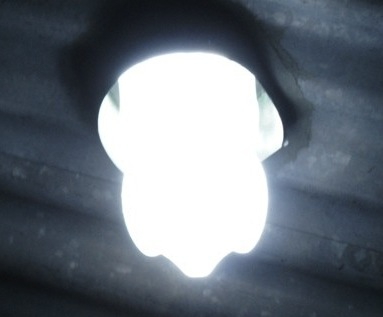
Using only sunlight for "power", these plastic bottles filled with water are providing interior light to the developing world. This is an amazing example of Permaculture Principle Six: Produce No Waste. Here is a quick video explaining this simple, but amazing, invention.

Wednesday, March 7, 2012

Video: There's No Tomorrow


This video takes a look at the future of energy and food production in the world. I have not seen a presentation that takes the the problems we face and explains them so well. I highly recommend taking the 33 minutes to watch this video. I fear too many will start to watch it and turn it off too quickly (and stick their heads back in the sand), because they don't like the message. I have studied the facts behind this video for a long time, and I cannot find one overt error in the information presented. All I am asking is for you to become aware of the issues, become knowledgeable on the information. This is the only way out of the crash I see coming our way. Yeah... it's a bit of a downer, but unless we actually understand the problems, we will never create a solution or an alternative.

Friday, February 24, 2012

Solar Water Heaters

Classic image of rooftops in Turkey... solar water heaters and satellite dishes.

In my travels overseas, I occasionally come across things that make me say, "Why in the world do we not do this in the United States?"  Solar Water Heaters are one of them.  Yes, there are some people (mostly corporations) who are utilizing solar water heaters in the U.S., but it is nothing like the common everyday use like in Turkey, South Africa, Germany, and India.

I think the biggest reason why the U.S. is not utilizing this technology more is because of the photo at the top of this article. Home owners associations do not want their roofs to look cluttered like this... it's unattractive. Who cares about the monetary savings and reduction in pollution to generate the energy to heat the water conventionally? But in reality, they do not have to look bad. German rooftops seem to integrate the solar systems into the design a lot more.

Solar water heating systems in Germany are a bit more aesthetically pleasing.

According to 2010 data, it would take over 12 years to have the initial system's cost paid back in energy savings in the United States. In Brazil and South Africa, the payback time is 5 years or less. However, this is for a purchased system. There are many systems that can be designed, built, and installed for only a few hundred dollars (if that) if we are willing to do a little scrounging and do-it-yourself work. I'll try to highlight some of these systems in future posts.

Passive (A) and Active (B) Solar Water Heating Systems.

There are two basic design types of solar water heating systems, passive and active. Passive Systems (aka Thermosiphon Systems) allow the natural properties of water (hot rises and cold sinks) to run the system. This is not as efficient a system, but it is cheaper and is often more reliable as it contains no moving parts and has no electronics that could break. Active Systems (aka Forced-Circulation Systems) utilize an electric pump and an electric controller to maximize the sun's heating power, and well designed systems also use solar energy to power the electric pump and controller.

Another way to categorize solar water heating systems is Direct Circulation vs. Indirect Circulation systems. Simply put, direct circulation systems heat up your home's water directly. Indirect circulation systems will heat up some sort of anti-freeze fluid that then runs through coils of pipe (a heat exchanger) that heats up your home's water indirectly. I always think of an indirect system like an electric blanket... the wires heat up the blanket which heat me up. Indirect circulation systems are good for areas that freeze frequently or severely; the anti-freeze fluid won't freeze and crack the pipes which could happen with a direct circulation system in colder climates.

A Direct Circulation Solar Water Heating System (this one is a passive design type).

An Indirect Circulation Solar Water Heating System (this one is an active design type).

Finally, there is a choice of solar collector types. The solar collector is the heart of the system, it is how solar energy is actually captured. There are three basic solar collector design types:

  • Batch or Integral Collector-Storage (ICS) - These systems utilize one or more tanks, painted black or coated with a "selective absorber" finish, which is inside an insulated box with a clear top often made of glass. This design uses the same concept as solar ovens. Cold water flows into the black tank which is "cooked" by the sun to fairly high temperatures. The water is heated and returns either actively or passively back to the home. These systems are probably the most common do-it-yourself types of systems. Old refrigerators with the door removed and glass placed on top are frequently used.
  • Flat-Plate Collector - This is a very similar design to the Batch or ICS system. However, instead of large tanks inside the sealed box, there is a tube that slowly winds its way back and forth through the flattened box.
  • Evacuated-Tube Collector - This collector design relies on the fact that heat cannot be lost easily through a vacuum. This is basically a tube within a tube. The space between the inner and outer tubes is "evacuated" of all air (made into a vacuum). The outer tube is clear, typically glass, and the inner tube is painted black. The sunlight passes through glass tube and heats up the black tube, but the heat cannot escape back out through the vacuum. These systems are almost always an indirect circulation design where an anti-freeze liquid is circulated through the inner black tube. The heated anti-freeze then flows back to a heat exchanger and heats up the home's water. Evacuated-Tube Collectors are very efficient, but much more expensive.

The last thing to consider with solar water heaters is how they will be integrated into the home. Some people choose to utilize the solar water heating system as the home's primary water heating system. If the sun is out, they you have hot water. If the sun does not come out, then within hours to days, depending on the size of your storage system and its ability to retain heat, you will be out of heat. Homes that are completely "off-grid" often do not have, or do not want to use, extra electricity or gas to heat water on cloudy days.

Another way to integrate solar water heating systems, and one that is most often used, is to have the solar water heating system pre-heat water going to a conventional water heater (either electric or gas). Newer constructs are using on-demand water heaters that have no hot water storage tank. The pre-heated water then needs significantly less energy (sometimes none) to heat it up for the home's needs. This allows a home greatly reduced energy costs, but still provides hot water on cloudy days.

Solar water heating systems will become more and more popular in the U.S. as people start to understand their benefits and start to feel the pain of increased energy costs.


Wednesday, February 15, 2012

Potential for Photovoltaic (Solar) Power in the U.S.


This is a map showing the annual potential solar photovoltaic (i.e. solar power) resource for the United States. Basically, the closer to red the higher the potential, and the closer to purple (well, green on this map) the lower the potential for solar energy production.

Here is the key for the map.


Not much more than that. Just want to save this map for my reference. Kind of cool. 


Tuesday, February 7, 2012

The BioLite Stove... Electrical Energy from Wood Burning


Thanks to my friend Shane for the tip on this product.  BioLite has a new product that uses twigs or other small flammable material to create heat for cooking and electrical energy for charging USB-adaptor-charged devices... like phones, GPS, Kindle, Ipods, etc.

I love to apply Permaculture concepts to anything that I can, and this is no different. Permaculture Principle Six states "Produce No Waste". Outdoor stoves are notorious for "wasting" a lot of energy by releasing heat into the environment. The BioLite stove captures some of that heat and converts it into a usable form of energy.

I don't know if I will be purchasing this specific product, but it is making my mind race with ideas... Can we adapt this technology to home use wood stoves or even fireplaces? Can we attach sort of trickle charger that will charge larger capacity batteries?

I love the idea behind this product. I will be watching this technology closely and will post if any new developments arise.

The BioLite stove is no larger than a Nalgene water bottle.


Tuesday, December 27, 2011

CFL Fluorescent Light Bulbs: More Hype Than Value


The following is a very interesting article on the Compact Fluorescent Light Bulbs written by Paul Wheaton the founder of Permies.com


Don't get all bent out of shape if you don't agree.  I think he brings up some very valid points.  An interesting read...


I used to like fluorescent lights and then I changed my mind.
As the years passed, I found more and more folks like me, and more and more reasons to be uncomfortable with fluorescent lights. When some people see that I don't use them, they try to tell me about how great they are. When I try to explain why I prefer incandescent, I nearly always get a dismissive wave - signaling that I am clearly a fool and whatever tripe I am about to utter is clearly not worth their time. This article represents a glimpse into that tripe.


If you leave all of the lightbulbs in your house on 24/7, then replacing all of the incandescent light bulbs in your house with CFL light bulbs will save you money. For people that typically leave lights off when not in use, it turns out that incandescent light is cheaper than fluorescent light - the exact opposite of what we have been told all these years. 
With a little knowledge, you can stop wasting money on CFLs. Both in the short term and the long term. The long term stuff includes tax issues and the toxicity tie-in which leads to superfund cleanups and medical bills. 
In a nutshell:

  • CFLs do not last as long as is claimed
  • Many CFLs provide 42% less light than claimed
  • CFLs put out 20% to 30% less light as they get older


With these three things alone, I will make a rock solid case of how incandescent lights are cheaper than CFL. But there's more:

  • CFLs are subsidized to make them appear cheaper
  • the toxicity of a CFL is downplayed
  • there are better ways to save electricity than fiddling with bulb type
  • There are incandescent bulbs that are claimed to last longer than fluorescents
  • There are new incandescents coming out that give off more light per watt


Friday, September 9, 2011

Rocket Mass Heater

A Rocket Mass Heater

I have been intrigued by Rocket Mass Heaters ever since I heard of them about a year ago.  So what exactly is a Rocket Mass Heater?  Well, it is a variation of a Rocket Stove (don't worry if you haven't heard of that either) combined with the concept of a Masonry Stove.

The concept is simple and brilliant.  Wood is burned in a uniquely shaped "combustion chamber" that burns wood very efficiently.  The heat produced from the burning wood heats up a large thermal mass (usually some form of bench).  By the time the exhaust exits the room, it is only about 90 degrees F (32 C).  The exhaust is mostly water and carbon dioxide. 

Let me show you an illustration of a Rocket Mass Heater for better understanding:
Illustration of a Rocket Mass Heater


What are the benefits of a Rocket Mass Heater?
  • Use a lot less wood for heating.  The amount depends on where you live, but you can expect about one fourth to one sixth of what a very efficient fireplace or woodburning stove uses to heat a room/home.
  • Almost no pollution.  The fire burns so hot and intense, that only water vapor and carbon dioxide is released.  And for you "Carbon Footprint" Nazi's out there, it is "carbon neutral".  Clippings from branches in the yard or from branches fallen out of trees or even from coppiced trees is all that is needed in most cases.  All that is left in the combustion chamber is a little bit of white ash.
  • Better at keeping and sustaining heat.  Almost 90% of the heat produced stays within the home instead of being lost out the chimney.  The thermal mass can keep radiating heat for 12-48 hrs after the fire is out. 
  • Needs less tending.  As the heat is radiating long after the fire is out, there is no need to tend the fire or watch for spitting embers.
What are the downsides to a Rocket Mass Heater?
  • You need to build it yourself.  There is no commercial version available now.
  • It is heavy!  The thermal mass being made mostly of clay/adobe is weighs a lot.  You can't just install these anywhere.
  • It uses clay/adobe.  For some, this is great.  For others, well, let's just say a Rocket Mass Heater doesn't blend will with a New World Colonial Design.  (I actually have no idea if that is a design style or not, but it sounds pretty good!)
  • They take a while to warm up.  A big thermal mass can take up to 4 hours to heat up (but then it will retain heat for a long longer as well).
  • Building codes don't really know what to make of this yet.  It is a relatively new concept (2004 as I can best tell from researching it).
  • You can get some "smoke back" when initially lighting the wood or if the Rocket Mass Heater is not designed well.

WARNING: Sloppy hippy alert.  As is often the case, it is the more eccentric individuals who are the first to attempt/try new innovative projects like a Rocket Mass Heater.  These individuals are usually hippies.  These hippies are usually very messy or sloppy individuals who leave piles of junk all over the place.  Unfortunately, it is hard for many people to see past this chaos and find the gem underneath.  In my opinion, a Rocket Mass Heater has an amazing potential for energy savings.  I think they need to be made a lot more attractive before they will be adopted on a more widespread scale, but what an amazing concept!

Here is a pretty good video that highlights a number of Rocket Mass Heaters (with the aforementioned sloppy hippies).  It was done by Paul Wheaton of Permies.com.


This is just an introduction to the concept of Rocket Mass Heaters.  I plan on providing more detailed information in the future. Stay tuned!

Thursday, August 18, 2011

Saved by my Power Box!

Stanley DPS109 Digital Portable Power Station

Yesterday morning I climbed into my car to go to work.  I turned the key... nothing.  No lights or radio.  Nothing.  I was already running a few minutes late.  I looked up and noticed a very faint glow from the dome light overhead.  Then I noticed the door ajar light was also barely lit indicating that the rear door was open - we've been having trouble with the back door latch for a few weeks.  I muttered under my breath as I began trying to figure out who I could get to drive over and jump my battery.  But then I remembered my Power Station (also sold as a Power Box, Jumper Starter, or Power Dome).

Here is the product detail:
You won’t get stuck on the side of the road again if you have the Stanley Digital Power Station. It features a 350-amp battery jump starter with 700 peak battery amps, a built-in digital tire inflator with automatic set and auto shut off, a 200 watt 120 volt power supply, a 3 LED emergency light, USB, and DC outlet.

There are many similar products on the market.  This was the only one I could find the day before I left the U.S. to live overseas (I packed it in my car at the port).  I am a fan of the Stanley Power Station, but I know there are other versions that have much higher ratings on Amazon and other sites. 

Bottom line, I highly recommend getting one of these portable jump starters.  I have used mine to inflate low car tires, bike tires, balls, and air mattresses.  I have recharged a cell phone with this, and now I have jumped my dead car battery... in less than 3 minutes and made it to work on time!


Friday, July 29, 2011

Running an Engine on Wood - Biomass Gasification

Gasification

This is an amazing subject that I am finally getting my head wrapped around.  Honestly, the more I read and learn about this, the more I am shocked that this technology is not more widespread.  Let me start with a few definitions first:

Gasification:  This is a process of converting organic materials into carbon monoxide (CO), hydrogen (H), carbon dioxide (CO2), and methane (CH4) through really high temperatures without combustion (burning).  Wikipedia has a pretty good article on gasification here.

Syngas (aka Synthesis Gas or "Producer Gas"): This is the gas that results from Gasification.  It mainly consists of carbon monoxide and hydrogen.

Biomass Gasification: Another way of saying Gasification that is fueled by organic (carbonaceous) materials like wood and other waste products.

Fischer-Tropsch Process:  This is a set of chemical reactions that will convert a gaseous mixture of Syngas into a liquid form of synthetic fuel that can be used as a replacement for petroleum-derived fuel.  While I am mentioning it here just because it is really cool, the video below shows an engine running on only the gaseous form of Syngas.

A Brief History
This technology is over 180 years old!  Many towns were fueled with the gasification method until the advent of widespread electricity.  During the World Wars, it is estimated that close to a million vehicles were run by gasification when petroleum-derived fuels were rationed.  FEMA (yeah, the US Federal Emergency Management Agency) published a book in 1989 that outlines how to build a gasification generator in an emergency if petroleum-based fuels are not available. 

Obviously, there are some downsides to this or else it would be everywhere.  They take a while to warm up.  It is not as cheap for commercial enterprises.  It takes a while to cool down.  Produces wood tar which can dirty an engine.

The advantages, especially for a small-scale home producer, are many.  Gasification can run internal-combustion engines (like a generator to power the house!).  It can be pretty easily made using common materials.  It can run on any organic waste products and wood.  It can be combined with a water heater for dual purpose.

So let me show you a Biomass Gasification Generator in action:


Here is a set of really well done videos that explains a lot about Gasification:


Monday, July 25, 2011

A (very) Basic Overview of Solar Power

Basic Solar Power System

I have been fascinated by Solar Energy ever since I was a kid.  There was something very "space age" about it, and in fact it really was the space industry that pushed the technology to the extent that made it available to the public.  While I don't buy into much of the pseudo-scientific, "eco-friendly", modern environmentalism (I am more of an evidence-based environmentalist), it is pretty obvious that modern coal-based electricity, while more efficient, produces a lot of pollution.  Solar is much more clean since its production produces minimal waste, and a good solar panel will last and function well for 25-30 years!  It also provides another layer of self-sufficiency.

Today, I just want to give a very basic overview of a solar power set-up.  I am not going to get into the science/physics of solar power.  I will probably get more into the details in later posts, but today I'll stick to the simple basics.

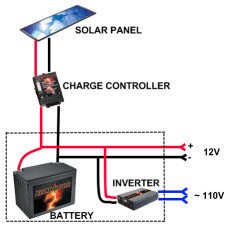
There are four main components of a solar power system:
  1. Solar Panels
  2. Charge Controller
  3. Batteries
  4. Power Inverter

The basics of a photovoltaic cell.

An individual solar cell.

Solar Panels
Solar panels are composed of individual solar cells.  A solar cell (aka photovoltaic or photoelectric cells) has the ability to convert light energy into electrical energy.  Certain materials are better at converting light to electricty than other materials.  Traditionally, and currently, silicon crystals are by far the most common.  This is considered a "bulk" material since the set-up is fairly thick (think of the traditional solar panels you've seen on a roof or road sign).  Scientists are continuing to develop Thin Film technologies that use much less material to still produce a current.  There are plans of "painting" buildings with solar organic dyes or coating windows with a solar polymer (that also acts like a tinting), but so far, Thin Film has not been as successful yet.  Most solar cells are about 10-25% efficient at producing electricity from sunlight.

A number of individual solar cells are connected to form a solar module (commonly called a "solar panel"), and multiple solar modules are wired together to create a solar array.

Charge Controllers
Charge Controllers are used to properly manage the voltage flowing to the batteries.  Voltage too high can damage the batteries.  The minimum charge controller for a home uses a technology called Pulse Width Modulation (PWM), but the best charge controllers use Maximum Power Point Tracking (MPPT) technology.  This technology is rapidly changing.

Batteries
Deep Cycle Batteries are needed to store energy that will be used frequently.  These batteries can be drained and recharged many times without damage.  Marine Batteries, Golf Cart Batteries, and RV batteries can be used for smaller applications, but more specialized batteries will be needed for larger applications like powering your home. 

Power Inverters
Solar power is Direct Current (aka DC).  DC is battery power.  If you are using only battery powered devices, such as a simple solar powered battery charger for things like flashlights or cell phones, then a power inverter is not required.  However, if you want to power anything that "plugs in" to the wall, then you will need to convert that DC to Alternating Current (AC).  Almost all power inverters will convert to 120 volts AC.  Again there is a variety of technologies available.  Square Wave inverters should be avoided as they are very hard on the devices they power.  Modified Sine Wave Inverters are far better, and they are really the least expensive and usable power inverters.  The best power inverters are the True Sine Wave Inverters, but they come with a higher price tag.  Finally, if you plan on using solar power for your needs, but would also like to sell back power to the electric company, then you will need a Grid Tie Power Inverter.  I'll get into how this works in future posts.

Another diagram of a basic solar power system.

So that is it.  The four basic components of a Solar Power System.  Solar Power is a great addition to your Permaculture System, and it is getting more economical every year.  I plan on writing some more posts on various aspects of solar power in the next few weeks. 

Saturday, July 16, 2011

Hypermiling: Ways to Save When You Don't Have a "Green" Car

Hypermiling (Hyper-mile-ing) is the art of driving economically and exceeding vehicle manufacturers stated efficiency by modifying driving habits and techniques.  - http://www.hypermiler.co.uk/

In this era of increasing fuel costs and shortages of petroleum-based fuels (see my post on Peak Oil), hypermiling is a brilliant concept that will help you save money.  There are a number of websites and articles written about this, so I will not reinvent the wheel.  Today, I'll just provide links to what I consider the more high yield sites:

CNN Article on Hypermiling

Overview of Tips for Hypermiling - Not the best website (cluttered with ads), but the information is solid.

Hypermiling Tips from the UK Hypermiling website


CNN Video on Hypermiling

Saturday, June 25, 2011

Peak Oil

Is Peak Oil already here?


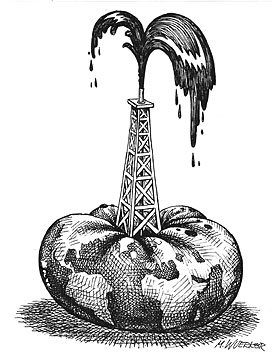
Peak Oil is a simple concept.  Many of you may have already heard of it.  Peak Oil is the point in time when the world reaches the maximum extraction of oil from the earth.  After Peak Oil, the extraction of oil will become less and less.

Peak Oil is not the same as Oil Depletion.  Oil Depletion is when the earth feels the scarcity of oil, and is associated with rapidly rising prices and limited supply (i.e. you can't buy it anymore).

The concept of Peak Oil came from the American geophysicist, M. King Hubbert.  In 1956, he proposed ("predicted") that the U.S. would reach peak oil production between 1965 and 1970.  In the early 1970's the U.S. maxed out its extraction/production of oil.  Since that time, there has been a gradual, but steady, decline.  He was right.

Hubbert's theory, now known as Hubbert Peak Theory, can be applied to any region, country, or the planet as a whole.  It states that oil production will always follow a bell-shaped curve.

Graph showing Hubbert's prediction (blue) with actual data (dots).

So, where are we at today on a global level?  Here is a graph that shows the majority of the world's oil producing counties and their oil production curves.  Most countries in the world have already reached Peak Oil.  There are only a handful of countries (in the Middle East) that have not yet reached Peak Oil.

Graph showing countries in the world that have already reached Peak Oil.


No one knows for sure when Global Peak Oil will take place.  Some people think it has already occurred.  Others, though not many, think that it will not happen for at least another hundred years.  As you can see from the chart below, there are a lot of different theories/models out there that are attempting to answer the question of when Global Peak Oil will occur.

Graph showing different models of prediction for global Peak Oil.

In science, when you see so many models without consensus, you can be sure that the scientist truly do not know.  What you can take out of this is the common trend showing Peak Oil is coming sooner than we would like.  The International Energy Agency, which is a pretty legitimate intergovernmental organization, believes we reached Global Peak Oil in 2006.  There are other organizations who believe that Global Peak Oil will not occur until after 2020.  These organizations also believe that through the period of Oil Depletion, alternative energy scientists will make major breakthroughs that will allow the major oil-dependant countries to smoothly transition to an oil-free world.

I don't know if I am quite so confident.  I don't believe we will have a world-wide societal meltdown, but I don't think the transition to an oil-free world is going to be very smooth.

This is yet another reason I am a huge proponent of Permaculture.  With proper design, so many of our dependancies on oil start to diminish.  If we have the ability to produce the majority of our own food and energy needs, then Peak Oil is an inconvenience, and not the end of the world as we know it.