Wednesday, February 8, 2012

Permaculture Plants: Skirret

Skirret is a great tasting root crop with many useful attributes.

Common Name: Skirret
Other Names: Suikerwortel (Netherlands), Crummock (Scotland), Zuckewurzel (Germany)
Scientific Name: Sium sisarum
Family: Apiaceae/Umbelliferae (Carrot Family)


Above ground, Skirret is a small to medium-sized herbaceous plant.


Description:
Skirret was once a very well known small to medium-sized perennial root crop. Its bright white, pencil-thin roots are sweet and said to have a flavor somewhere between potato and parsnip. Unfortunately, this is one plant I have yet to taste. I keep my eyes open in my travels through the U.S., Europe, and the Middle East in hopes of finding some to sample one day.


Botanical illustration of Sium sisarum.
Prof. Dr. Otto Wilhelm Thomé Flora von Deutschland, Ã–sterreich und der Schweiz 1885


History:
Likely originating in China, Skirret made its way to Europe early in the Middle Ages where it was a primary root crop. Unfortunately, Skirret was rather quickly replaced by the potato (from South America) given that potatoes are a larger, more easily cleaned crop. However, skirret is still used widely through northeastern Asia.

Trivia:

  • The name “Skirret” comes from the Dutch “Suikerwortel” meaning “sugar root”.
  • The wild ancestor of Skirret grows on the banks of waterways. This shows how tolerant skirret is of moist soils.
  • Pliny the Elder stated that Skirret was a favorite vegetable of the Emperor Tiberius.


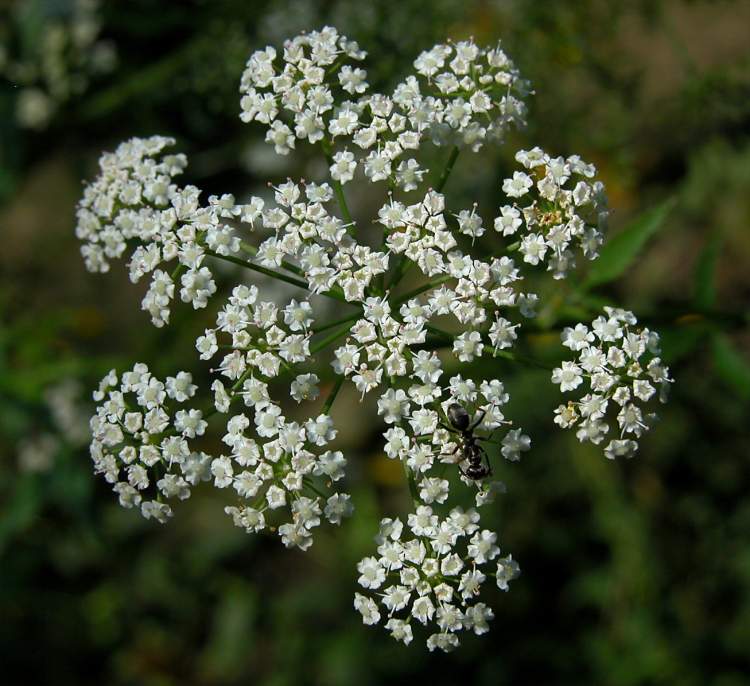
Skirret flowers are attractors of beneficial insects.


USING THIS PLANT
Primary Uses:

  • Cooked (primarily): boiled, roasted, baked, braised, stewed, creamed, mashed, batter-fried
  • Used interchangeably or with carrots, parsnips, potatoes, or salsify in most recipes
  • Raw: peeled, sliced, chopped, or grated


Secondary Uses:

  • General insect nectar plant
  • Specialist insect nectar plant… lacewings prefer Skirret plants
  • Refuge plant for parasitoid wasps… they like to hide in Skirret foliage
  • Historically was used as a flavoring in beers, wines, and liquors


Yield: Varies widely depending on plant, soil, climate, and growing conditions in general
Harvesting: Autumn – Winter (October – March) after the foliage is killed by the frost. Skirret becomes sweeter with frosts like carrots and parsnips. Break the individual roots free and scrub the dirt off with a brush under running water. If you have a plant with a woody core, then the sweeter, softer root surrounding the core needs to be cut to scraped away first – try using a vegetable peeler. This emphasizes the importance of choosing higher-quality, woody-core-free cultivars.
Storage: Store like carrots... unwashed/uncleaned and wrapped in plastic and stored in the coldest part of the refrigerator, or unwashed and stored in straw or barely moist sand in a cool, high-humidity location like a root cellar. Keep the roots whole - if the root is damaged or broken, use them fresh instead of stored. Can be stored with other root vegetables like potatoes. Should not be stored near/with fruit (like apples), since they give off ethylene gas that can cause spoilage or off flavors.


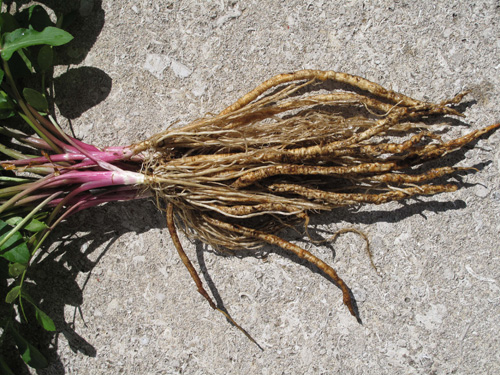
Skirret roots can have a variety of forms depending on the soil conditions.


DESIGNING WITH THIS PLANT
USDA Hardiness Zone: 4-9 (Zone 4 at a minimum, maybe even colder)
AHS Heat Zone: None described
Chill Requirement: Since this is a root crop, a chill requirement is rather irrelevant; however, this plant does appear to produce better in areas that are a bit colder. Also, flavor seems to get better with below freezing temperatures.

Plant Type: Small to Medium-sized Herbaceous Perennial
Leaf Type: Deciduous
Forest Garden Use: Underground layer; Small to Medium-sized Herbaceous Perennial
Cultivars/Varieties: There are a number of unnamed varieties available. Be sure to find one that is free of a woody core in the roots. It may take some time and a few sources to find a good, high quality parent plant that we can propagate on our land.

Pollination: Self-Pollinating/Self-Fertile
Flowering: August - September

Life Span: No good data as this plant is harvested and split well before its lifespan reaches its end.


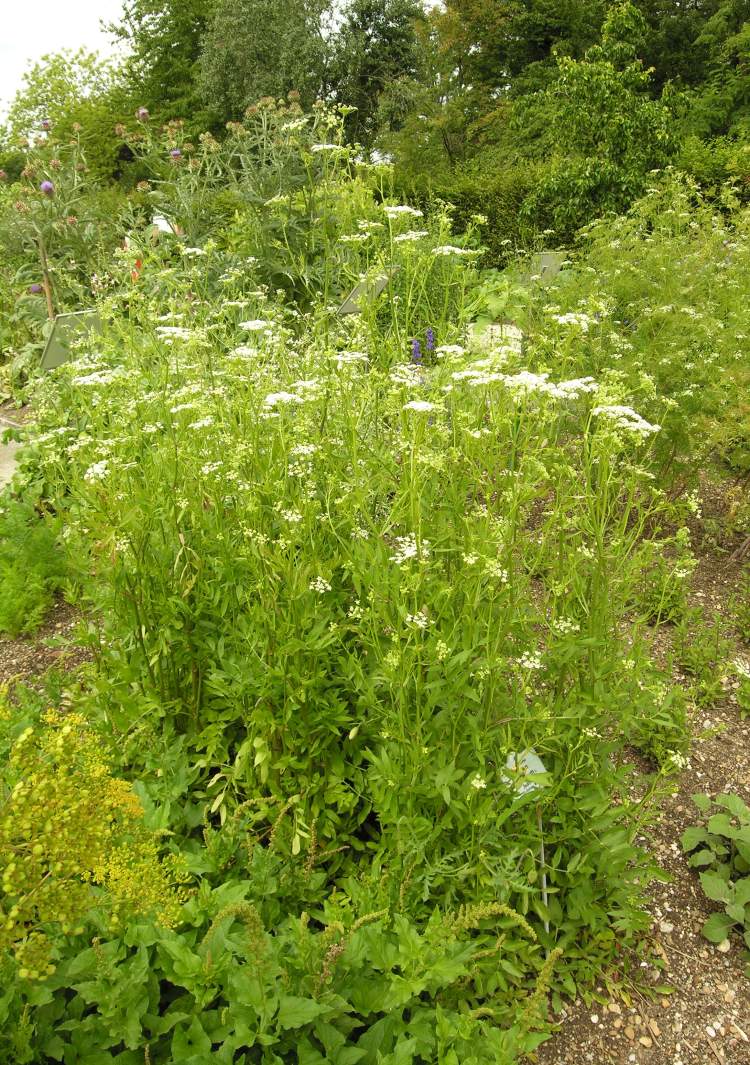
Skirret can tolerate shade and wet soils... a great plant for those "tough" locations.


PHYSICAL CHARACTERISTICS OF THIS PLANT
Size: 4 feet (1 meter) tall and 1-2 foot (0.3-0.6 meters) wide
Roots: Tuberous
Growth Rate: Medium


Skirret is a classic "plant/replant perennial" 
(see Propagation below).


GROWING CONDITIONS FOR THIS PLANT
Light: Prefers full sun
Shade: Easily tolerates light shade (about 50%)
Moisture: Can tolerate high moisture levels, but does not require them.
pH: Can handle slightly acidic to alkaline soils

Special Considerations for Growing:
Skirret can tolerate rather wet and/or maritime soils.
It appears to grow the best tasting and least fibrous roots in rich, moist soils.

Propagation: Very easy to divide from the root. It is a classic “plant/replant perennial” plant… i.e. we can harvest a plant, take some of the roots for harvest and replant some of the remainder in the original hole and the rest in new locations where it will grow into a new plant.
Skirret can be grown from seed; however, the new plant is typically inferior to the parent plant.

Maintenance:
Minimal once established.

Concerns:
None reported.


Tuesday, February 7, 2012

The BioLite Stove... Electrical Energy from Wood Burning


Thanks to my friend Shane for the tip on this product.  BioLite has a new product that uses twigs or other small flammable material to create heat for cooking and electrical energy for charging USB-adaptor-charged devices... like phones, GPS, Kindle, Ipods, etc.

I love to apply Permaculture concepts to anything that I can, and this is no different. Permaculture Principle Six states "Produce No Waste". Outdoor stoves are notorious for "wasting" a lot of energy by releasing heat into the environment. The BioLite stove captures some of that heat and converts it into a usable form of energy.

I don't know if I will be purchasing this specific product, but it is making my mind race with ideas... Can we adapt this technology to home use wood stoves or even fireplaces? Can we attach sort of trickle charger that will charge larger capacity batteries?

I love the idea behind this product. I will be watching this technology closely and will post if any new developments arise.

The BioLite stove is no larger than a Nalgene water bottle.


Monday, February 6, 2012

Permaculture Plants: Groundcover Raspberry

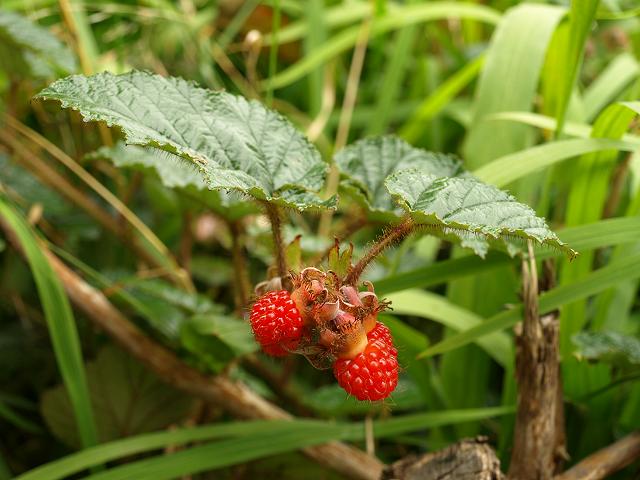
Groundcover Raspberries (like this Rubus pentalobus) are great additions to any garden.

Common Name: Groundcover Raspberries
Scientific Name: 
  • Rubus nepalensis (Nepalese Raspberries)
  • Rubus pentalobus/rolfei/calycinoides (Creeping Bramble)
  • Rubus tricolor (Chinese Bramble/Groundcover Raspberry)
Family: Rosaceae (Rose Family)


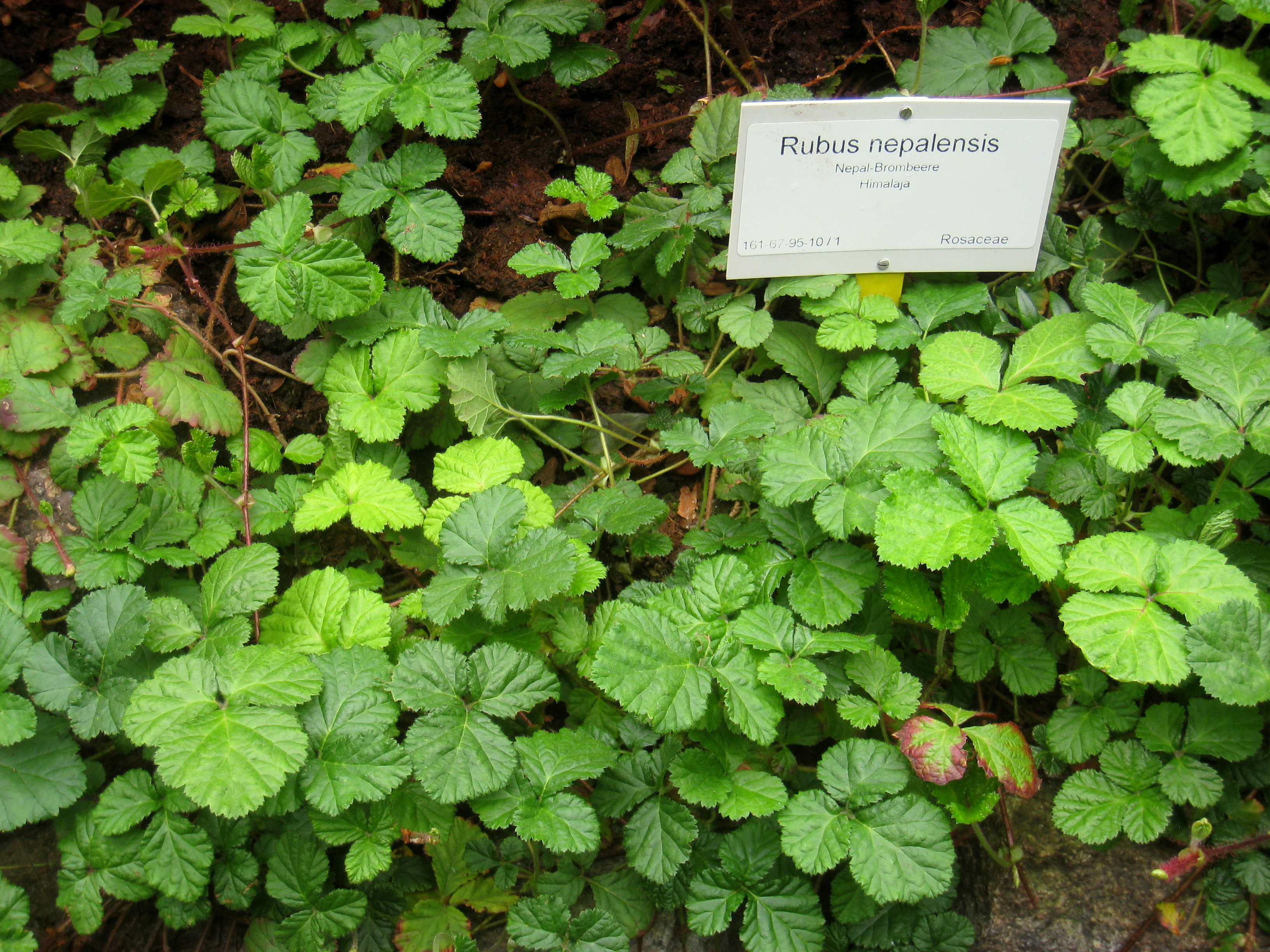
Groundcover Raspberries are not as large, but just as flavorful, as their full-sized relatives.


Groundcover Raspberries are low-growing and evergreen. 

Description:
I consider any of the low-growing, shade tolerant Rubus species to be Groundcover Raspberries. They come from around the world, and they all produce raspberry-like fruit. They tolerate light to medium foot traffic well. They are great nectar plants for beneficial insects, especially honeybees. These plants are growing quickly in popularity as more and more people hear about them, and they will be a major groundcover species in my Forest Garden.

There are a variety of fruit colors with Groundcover Raspberries, Rubus pentalobus are orange.


There are a variety of flower designs depending on the species.

USING THIS PLANT
Primary Uses:
  • Fresh eating – just like small raspberries
  • Preserves (jams, jellies)

Secondary Uses:
  • Groundcover
  • General insect (especially bees) nectar plant
  • Wildlife food, especially birds, in Summer
  • Leaves make a mild tea
  • Frozen fresh
  • Dehydrated


Yields are not high, but any food production from a ground cover plant is great!


Yield: This is a ground cover plant which means that many individual plants are used in a single planting area, and as such there are no good yield numbers recorded; however, yields are not very high.
Harvesting: Summer (July-September)
Storage: Use fresh. Can be frozen (individually on a cookie sheet is best, then stored in a freeze bag). Can be dehydrated. Use within a few days at most.

Great use of Rubus pentalobus around structures in a garden.

DESIGNING WITH THIS PLANT
USDA Hardiness Zone: 6-7
AHS Heat Zone: None recorded
Chill Requirement: None recorded, but likely produces better with some chilling.

Plant Type: Small Perennial Shrub
Leaf Type: Evergreen
Forest Garden Use: Groundcover
Cultivars/Varieties: A number of species and varieties available

Pollination: Some are Self-Pollinating/Self-Fertile but most will only produce with cross-pollination from another or similar plans
Flowering: June-August depending on the species and latitude

Life Span:
Years to Begin Bearing: 1-2 years
Years to Maximum Bearing: 2-3 years
Years of Useful Life: 6-10 years


There are many closely related Groundcover Raspberry species that can only be found locally.
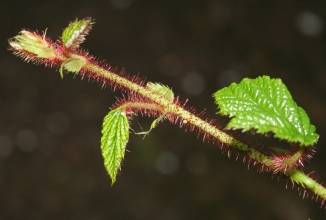
This is Rubus lasiococcus native to the Pacific Northwest.

PHYSICAL CHARACTERISTICS OF THIS PLANT
Size: 
  • Rubus nepalensis (Nepalese Raspberries) – 1 foot (0.3 meter) high and widely spreading
  • Rubus pentalobus/rolfei/calycinoides (Creeping Bramble) – 4 inches (0.1 meter) high and widely spreading
  • Rubus tricolor (Chinese Bramble/Groundcover Raspberry) – 2 feet (0.6 meter) tall and widely spreading

Roots: Shallow and flat, suckering roots – widely spreading
Growth Rate: Medium to Fast


Stems can root which makes propagation rather easy.


GROWING CONDITIONS FOR THIS PLANT
Light: Prefers full sun to light shade
Shade: Tolerates light to full shade
Moisture: Medium (Rubus tricolor Chinese Bramble, is quite drought tolerant, but it yields less)
pH: most species prefer fairly neutral soil (6.1 - 7.0), but can handle a wide variety

Special Considerations for Growing: 
These are rather vigorous plants. They tolerate light to medium foot traffic. Some areas can become weedy, so it makes sense to grow other goundcover plants with groundcover raspberries (Mint is a great choice).
Rubus pentalobus/rolfei/calycinoides (Creeping Bramble) – space plantings 1-3 feet apart
Rubus tricolor (Chinese Bramble/Groundcover Raspberry) – space plantings 3-5 feet apart

Propagation:  
Usually by detaching rooting stems… meaning that as taller stems grow up tall, they will eventually bend over and touch the ground. When this happens, these stems will take root. The bent over stem can be cut when roots have formed, and another individual plant is ready to replant to another location. These plants can be easily layered into pots by pinning taller stems into a small pot of soil.
Plants can propagate through seeds, but need some cold stratification.

Maintenance:
Minimal.  Occasional weeding may be necessary. May need to cut back, or mow back, when it grows into areas that we don’t want it to grow… this is not a matter of if, but when.

Concerns:
May be slowly and locally invasive if not kept in check… regular mowing on paths works quite well.


Thursday, February 2, 2012

Organic Fertilizers: Sawdust


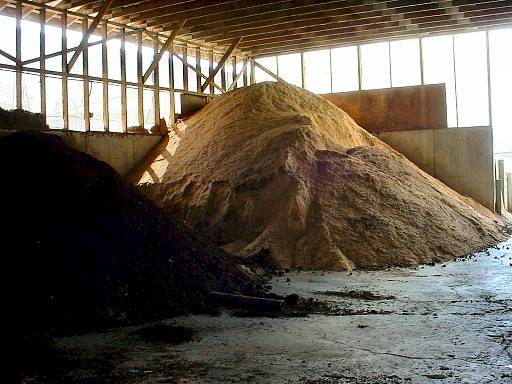
Sawdust can often be easily found.

What is it?
Sawdust is the powdery by-product of cutting wood with a saw. Pretty simple really.

What is the primary benefit?
Sawdust is a great source of organic matter for our fertilizer and our soil.  Depending on where we live, we may have access to large amounts of sawdust. Where I am right now in Turkey, there are a number of lumber mills near me. Each year I am frustrated by the site of men pouring gasoline on huge piles of sawdust and just burning it off. Remember, Permaculture Principle Six tells us to Produce No Waste! What a great way to repurpose this "waste" product... instead of just burning it.

Large amounts of sawdust of often burned or discarded... losing a valuable resource!

How is it used?
The first thing to keep in mind before using sawdust, is to make sure that it is well rotted (2-4 years) before incorporating it onto our land or into our compost piles. Just leave piles of it out in the weather, and time will do all the work.

The reason it should be rotted first, is that the process of decomposition of wood binds nitrogen, and nitrogen is needed by our plants. Unless you are using sawdust in a Hugelkultur application, then let it rot first. If you apply sawdust directly to your soil, then watch for nitrogen deficiency (pale green leaves and slowed growth). Add some additional nitrogen fertilizer (Blood Meal would be a good choice) if needed.

Note - Do not use sawdust from chemically treated lumber. Just ask before you collect it!

Application:
Add rotted sawdust to your soil or compost directly.
Add fresh sawdust sparingly to established plants or mix 2-3:1 with manure or other nitrogen-rich source (2-3 parts sawdust to 1 part manure).
Add fresh sawdust to an area of land you are planning on improving in the future (2-4 years) and let it rot in place.


If your soil has adequate organic matter levels: 100 lbs per 1,000 square feet
If your soil has medium organic matter levels: 150 lbs per 1,000 square feet
If your soil has low organic matter levels: 250 lbs per 1,000 square feet


Composition:
NPK Ratio:  0.2-0.0-0.2


A GENERAL NOTE ABOUT FERTILIZERS:
Always test your soil before adding any fertilizers.  We can easily damage our plants and the soil by indiscriminately adding soil amendments.


Tuesday, January 31, 2012

The Permaculture Movement Grows From Underground


This is an interesting article from The New York Times "In The Garden" section.


The Permaculture Movement Grows From Underground
By MICHAEL TORTORELLO
(photo of author and his daughter planting seeds - by Sara Jorde for The New York Time)
(click here for a link to the original article)

As a way to save the world, digging a ditch next to a hillock of sheep dung would seem to be a modest start. Granted, the ditch was not just a ditch. It was meant to be a “swale,” an earthwork for slowing the flow of water down a slope on a hobby farm in western Wisconsin.

And the trenchers, far from being day laborers, had paid $1,300 to $1,500 for the privilege of working their spades on a cement-skied Tuesday morning in late June.

Fourteen of us had assembled to learn permaculture, a simple system for designing sustainable human settlements, restoring soil, planting year-round food landscapes, conserving water, redirecting the waste stream, forming more companionable communities and, if everything went according to plan, turning the earth’s looming resource crisis into a new age of happiness.

It was going to have to be a pretty awesome ditch.

That was the sense I took away from auditing four days of a weeklong Permaculture Design Certificate course led by Wayne Weiseman, 58, the director of the Permaculture Project, in Carbondale, Ill.
The movement’s founders, Bill Mollison and David Holmgren, coined the term permaculture in the mid-1970s, as a portmanteau of permanent agriculture and permanent culture.

In practice, permaculture is a growing and influential movement that runs deep beneath sustainable farming and urban food gardening. You can find permaculturists setting up worm trays and bee boxes, aquaponics ponds and chicken roosts, composting toilets and rain barrels, solar panels and earth houses.
Truly, permaculture contains enough badges of eco-merit to fill a Girl Scout sash. Permies (yes, they use that term) like to experiment with fermentation, mushrooming, foraging (also known as wildcrafting) and herbal medicine.

Yet permaculture aims to be more than the sum of those practices, said David Cody, 39, who teaches the system and creates urban food gardens in San Francisco.

“It’s an ecological theory of everything,” Mr. Cody said. “Here’s a planet Earth operating manual. Do you want to go along for a ride with us?”

It’s hard to say just how many have climbed aboard the mother ship. In San Francisco, Mr. Cody saw more than 1,500 volunteers turn out in 2010 to create Hayes Valley Farm, a pop-up food garden near the site of a collapsed freeway ramp.

“I like to say it was the largest sheet-mulching project ever done in the world,” said Mr. Cody, who designed the garden following the permaculture principles and directed the process of covering the ground with a cardboard weed barrier and organic material.

“We sheet-mulched about an acre and a half,” he said. “That’s something like 80,000 pounds of cardboard diverted from the waste stream.”

In the last four years, Mr. Cody has helped train 250 students through the Urban Permaculture Institute in San Francisco.

Scott Pittman, 71, who directs the national Permaculture Institute from a farmstead outside Santa Fe, N.M., estimates that 100,000 to 150,000 students have completed the certificate course since the philosophy was developed in Tasmania over three decades ago. “In the U.S., I would say we represent 40,000 to 50,000 of that number,” he said.

But then pemaculture has no membership rolls or census-takers. By intention, “it has been, for all of the years I’ve been involved, a pretty decentralized movement,” Mr. Pittman said. The message seems to get out in its own fashion, without publicists. Mr. Mollison, for example, has been permaculture’s leading figure since the late 1970s, and his books have hundreds of thousands of copies. Yet his name has apparently never warranted a mention in this newspaper.

Permaculture, Mr. Pittman said, is “guided by the curriculum and a sense of ethics, and that’s pretty much it.”

The ethic of permaculture is the movement’s Nicene Creed, or golden rule: care of the earth; care of people; and a return of surplus time, energy and money, to the cause of bettering the earth and its people.

In its effort to be universal, permaculture espouses no religion or spiritual element. Still, joining the movement seems to strike many of its practitioners as a kind of conversion experience.

MR. Pittman first encountered Mr. Mollison and his teachings at a weekend seminar in New Mexico in 1985. As a system, permaculture impressed him as panoptic and transformational. “It shook my world,” Mr. Pittman said.

Almost on the spot, he decided to drop his work and follow Mr. Mollison to the next stop on his teaching tour: Katmandu, Nepal. Soon after, he began to lead courses alongside Mr. Mollison, in cities and backwaters around the globe.

Mr. Mollison hasn’t toured the United States in almost 15 years. At 83, Mr. Mollison has “kind of faded into semi-retirement in Tasmania,” Mr. Pittman said.

Yet in recent years, Mr. Mollison’s ideas seem to have bubbled up from underground, into the mainstream. “I just trained the Oklahoma National Guard,” Mr. Pittman said. “If that’s any kind of benchmark.” The troops, he said, plan to apply permaculture to farming and infrastructure projects in rural Afghanistan.

It’s a system, permaculturists contend, that can work anywhere. In Park Slope, Brooklyn, Claudia Joseph, 53, has used the precepts of permaculture to develop new food gardens at the Old Stone House. (Its original 1699 Dutch edifice was a locus of the Battle of Brooklyn in the Revolutionary War.) “It’s a huge breakthrough,” she said. “To go from a swatch of grass to 1,000 blueberry bushes.”

The parks department recently bulldozed two of her gardens in an overhaul of the playground in the surrounding Washington Park. But in a few protected spots, Ms. Joseph, an environmental educator and consultant who lives two blocks away, has already started on an edible food forest.

This “guild” of complementary plants is the opposite of annual row-crop agriculture, with its dead or degraded soil and its constant demand for labor and fertilizer. Permaculture landscapes, which mimic the ecology of the area, are meant to be vertical, dense and self-perpetuating. Once the work of the original planting is done, Mr. Mollison jokes in one of his videos, “the designer turns into the recliner.”

At the lowest level of a food forest, then, are subterranean crops like sweet potatoes and carrots. On the floor of the landscape, mushrooms can grow on felled logs or wood chips. Herbs go on the next level, along with “delicious black cap raspberries,” Ms. Joseph said.

Other shrubs, like inkberry, winterberry and elderberry, are attractive to butterflies and birds. They’re an integral part of the system, too.

But more likely to appeal to the children who attend the nearby William Alexander Middle School is a Newtown Pippin apple tree, “a variety first grown in Queens,” Ms. Joseph said.

Ruling the forest’s heights are the 40 large pin oaks already in the park, whose abundance of acorns will make a banquet for squirrels. Permaculture also looks favorably on high-quality bushmeat. But Ms. Joseph will be leaving that harvest well enough alone.

With its focus on close planting and human-scale projects, permaculture is ideally suited to a small suburban yard or a patio garden. But most of the students I met in Wisconsin had their own 1,000-blueberry-bush visions and ideas on how permaculture could help fulfill them.

Kellie Anderson, a 27-year-old rolfer, lived for five months in a giant sequoia tree named Keyandoora. (At the time, she was protesting a logging plan in Humboldt County, Calif.) After the workshop, Ms. Anderson said, she planned to inhabit a 1986 diesel school bus that she and her boyfriend were in the process of converting into a camper. But fortune seems to have taken her instead to Sanibel Island, Fla., where she is now helping to plan a sustainable-housing community.

Kris Beck, 48, a founder of an energy-efficiency tech company, had a notion to build a sanctuary with a megalithic stone circle (think Stonehenge) on her family’s old Wisconsin dairy farm, along the Mississippi River bluffs.

Bruce Feldman, 60, who spent two decades as an English teacher overseas, experienced the collapse of the baht in Thailand (he was being paid in that currency), and an earthquake in Japan, in 1995, that left him wandering the streets for four days. These events, Mr. Feldman said, “got me thinking that I should start preparing for my own future,” ideally, a four- or five-acre self-reliant homestead in the Ozarks of Arkansas.

The site of the workshop was a permaculture Shangri-La unto itself: 60 acres of rolling pasture and woodlands, a few miles from the Buffalo River in Wisconsin. In 2004, Jeff Rabkin and his wife, Susan Scofield, bought this Amish farm for $125,000.

The original plan was to lease out the fields and build a cordwood cabin as a weekend home. Instead, under the influence of permaculture, Mr. Rabkin became seized with the idea of stewarding the property himself. To this end, he and a permaculture buddy, Victor Suarez, 44, bought a small flock of sheep and planted 300 fruit and nut trees.

During the work week, Mr. Rabkin, 49, and Ms. Scofield, 48, run a marketing and public relations firm in Minneapolis. That background is apparent in the catchy name they gave the place: Crazy Rooster Farm and Amish Telephone Booth.

But the Amish telephone booth is no gimmick. The couple installed a phone line in the shed next to their farmhouse, and their neighbors roll up in buggies to make calls.

While Amish visitors mill around in Mr. Rabkin’s yard, they may strike a deal to sell him three steer and two heifers, or 20 black-locust fence posts. Like a coneflower patch draws honeybees, Mr. Rabkin said, “I like to say that the telephone attracts beneficial wildlife — our Amish neighbors — which is what permaculture tells us to do.”

Ms. Scofield collected asparagus, beets and raw milk from neighboring farms to feed the permies. The occasional Amish visitor, like Thomas Zook, who delivered a bucketful of new potatoes in the middle of a downpour, gave a glimpse of what low-impact living might look like, taken to an extreme.

Mr. Zook’s father, Jonas Zook, even dropped in to watch a video about pond management, but walked out after a minute or two. After marathon days of PowerPoint presentations, I wouldn’t have minded joining him. For all its exhilarating ideals, permaculture is a movement grounded in “zones,” “patterns” and “functions.”

Labs, as it were, took place in the toolshed. On the first day, Mr. Weiseman demonstrated how to create biochar, or partly burned charcoal, in a primitive “rocket” stove, a device he assembled out of a piece of ductwork and a paint can.

Helpful mineral elements attach themselves to the unique molecular structure of biochar, Mr. Weiseman explained. Mixed with compost, it makes a top-dressing for trees.

Next, he started bubbling compost tea with an aquarium pump in a plastic bucket. (“Even petroleum has a place in permaculture,” he said. “The five-gallon bucket is the greatest application of petroleum in the world.”) He wrapped a clump of standard compost in a cloth like a hobo’s bandanna pack and dunked it in water. Next, he added molasses to feed the brew.

After a couple of days, we would fling this brownish broth over the kitchen garden to enrich the soil with beneficial bacteria.

That was the concept, anyway. A week after the workshop, I ran these theories past Jeff Gillman, 41, an associate professor at the University of Minnesota and an author of four books about gardening practices and the environment.

He professed to be “a believer in the whole concept of permaculture.” But he dismissed the compost tea as “lunacy.” Scattering a few foreign microbes into a sea of soil, he said, was like parachuting 10,000 people across the breadth of the Sahara. They would not survive.

Normal compost, the solid stuff from a backyard bin, “should already contain all the microbes that are beneficial to the soil,” he said. And if it doesn’t, “beneficial microbes move in very, very quickly.”

With biochar, Mr. Gillman admitted to a bit of bafflement. “Charcoal, in general, is not in and of itself harmful to soil,” he explained. “It helps to hold on to nutrients. But having said that, it boggles my mind why you would take a perfectly good block of wood that you could use as compost or mulch, and burn it.”

In a broad sense, though, permaculture is not about the scientific method or textbook agronomy.

“I don’t know that anyone has ever done a double-blind study of permaculture,” said Mr. Pittman of the national Permaculture Institute. “Most people in permaculture are not that interested in doing those kinds of studies. They’re more interested in demonstrating it. You can see the difference in species diversity and yield just by looking at the system.”

As Mr. Weiseman observed, permaculture may be a “leap of faith.” But not leaping might have its own consequences.

Beginning with Mr. Mollison, permaculturists have forecast a near future of resource scarcity. “Not just peak oil,” Mr. Weiseman said, “but peak water, peak soil.”

And the news, with its drumbeat of economic decline and ecological catastrophe, feeds the prophecies. In this dystopia to come, permaculture won’t be a lifestyle choice, but a necessity.

“We know what’s right,” Mr. Weiseman said. “We know what’s best. We feel this thing in our bones and in our heart. And then we don’t do anything about it. Or we do. And I did. And it’s bearing fruit.”

But preparing for doomsday in San Francisco, Mr. Cody said, is not what draws a crowd of busy souls to shovel horse manure on a drizzly Saturday morning. To the 12 central tenets of permaculture, then, Mr. Cody added a 13th: “If it’s not fun, it’s not sustainable.”

In other words, why mourn the eventual demise of our office blocks and factory farms, when there’s a feast to be made, right now, in your own backyard?

Monday, January 30, 2012

New Plant Index Page!


Quick post to let you know I updated my slowly growing Plant Index listing with a new page... and a new illustration I did over the weekend.  My goal is to make searching for plant information even easier.

Friday, January 27, 2012

Permaculture Garden at UMass

Here is a great couple of videos on a Permaculture project that was started at the University of Massachusetts. They designed and created a Permaculture Garden just outside the dining hall on campus.

Very well done video that focuses more on the why of the project. It deals with the motivation and excitement of the project. Unfortunately, it doesn't go into a whole lot of detail... the stuff that I really like, but it is a fun video either way.

There are only two parts so far.  The third is yet to be published!


For more information about this project: